Bass & panfish · Freshwater
White crappie
Pomoxis annularis
USGS: native to the southern Great Lakes, Hudson Bay (Red River) and Mississippi basins from New York and southern Ontario to Minnesota and South Dakota, south to the Gulf, and Gulf Slope drainages from Mobile Bay to the Nueces River.
Also called specks, sac-a-lait, papermouth.
- Stillwater
- Ordinary target
- 4 of 4 overlays reviewed
- Reviewed 2026-10-25
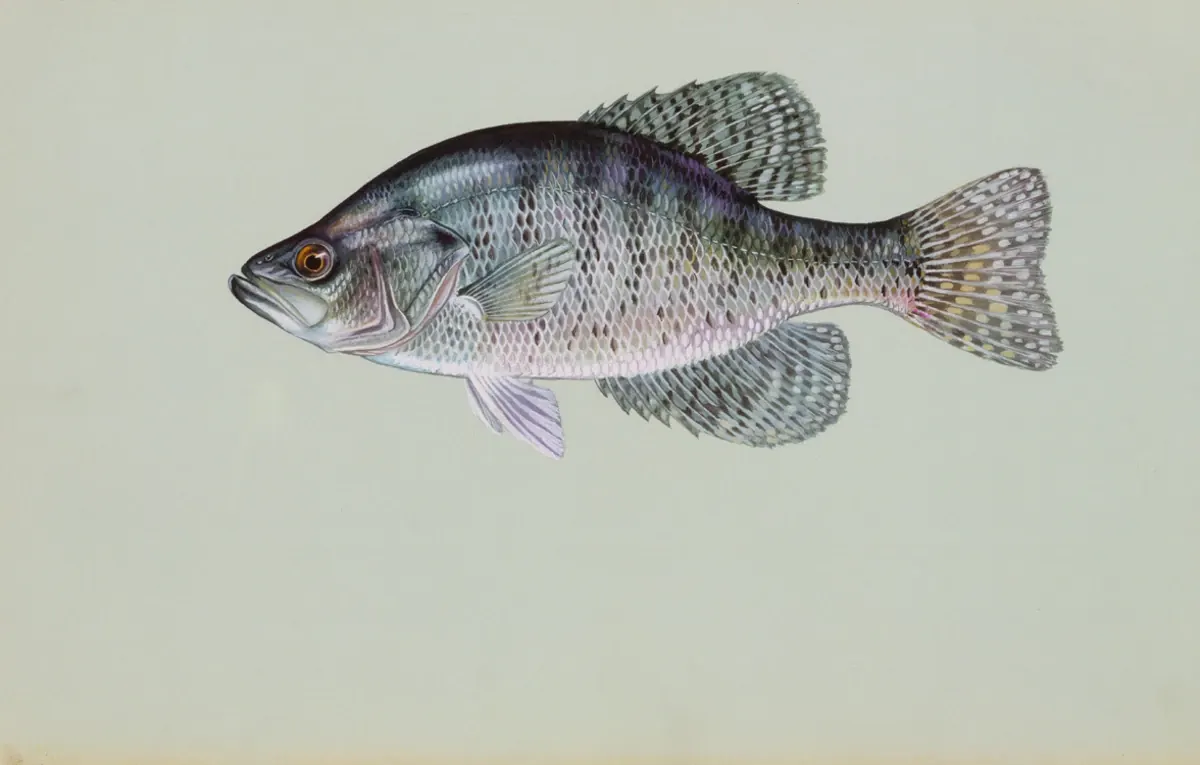
Scientific illustration · reviewed 2026-10-25
USFWS species-labelled illustration, full lateral. Faint, regularly spaced vertical bars on silvery sides, a short spiny dorsal joined to the soft dorsal, and a large mouth are visible — the bars-not-speckles split from black crappie. Count the dorsal spines in hand: five or six is white crappie.
Duane Raver / USFWS · U.S. Fish and Wildlife Service · Public Domain — USFWS-commissioned artwork, published by USFWS as public domain · Identified by the publishing body Source
- Body form
- Deep, laterally compressed centrarchid with a small head and a large, oblique mouth (USGS). The forehead is concave.
- Mouth
- Missouri DoC: the upper jaw is long and reaches past the middle of the eye — a far larger mouth than bluegill or pumpkinseed.
- Habitat
- Suspends around cover and follows bait; winter often deeper timber or basins. Texas Parks & Wildlife: juvenile schools often sit in the middle of lakes; adults gather around submerged trees, docks and other structure.
- Prey
- Texas Parks & Wildlife: fry feed on microscopic animals once they leave the nest; adults feed on small fish and insects. Missouri DoC: mainly small fish such as minnows and young shad, plus aquatic insects and small crustaceans. Observed forage still has to be declared.
Handling · field practice, not a product
How to hold this fish, and what the record actually says
The four steps are field practice for every fish. Species-specific handling is listed only when the reviewed record has it. Nothing here is a harvest instruction or a legal opinion.
01 · Wet hands
Keep the slime on the fish. Dry hands and dry cloth scrape it off.
02 · Support the body
Hold it horizontal. Do not hang it from the jaw in air.
03 · Minimize air
Photograph fast. Return faster. The clock starts when it leaves the water.
04 · Clean, drain, dry
Before the next water. Invasives travel in live wells, bilges and felt soles.
Take this somewhere
This page is the record. The reading is what happens when you add water, a season and a temperature to it — that is where the families below get ranked against each other instead of just listed.
Those three links carry the fish and nothing else. No conditions were declared on this page, so none travel, and the link says so rather than sending an empty reading.
The half nobody publishes
What this record does not know
Everything else on this page comes from a named agency or peer-reviewed source. This is the other side of that: the questions a reviewer went looking for an answer to and came back without, and the fields the record leaves empty because filling them would mean guessing.
It is here rather than at the bottom because a page that only shows what it knows is easy to read as a page that knows everything. For White crappie there are 10 of them.
Named by a reviewer
8Somebody looked for this and wrote down that they did not find it.
- Behaviour
Nobody has sourced:
- species-specific angling-pressure response beyond general cover/light notes
- cold-front / barometric response with primary-source support
- water-level rise/fall response with primary-source support
- Identification
Nobody has sourced:
- a single continent-wide mean length
- a sourced key for black × white crappie hybrids
- Forage
Nobody has sourced:
- finer month-by-month diet inside a season, which is waterbody-specific
- complete regional forage-substitution table
- Season
Nobody has sourced:
- month-by-month location changes inside a season, which are waterbody-specific
Absent from the record
2No reviewer wrote a gap here. The field is simply empty, which is its own answer.
- Water temperature
These figures mix measured preference and catch-distribution evidence. The edges are softer than the core.
- Population context
No regional population profile is registered. The species-level reading stands on its own; it does not silently become a local one.
Where the record puts it
Water and range
Stillwater
7 reviewed holding classes- Wood
- Dock / shade
- Weed edge
- Drop-off
- Basin
- Inlet
- Suspended / open water
DepthSuspends around cover and follows bait; winter often deeper timber or basins. Texas Parks & Wildlife: juvenile schools often sit in the middle of lakes; adults gather around submerged trees, docks and other structure.
Moving waterSlack and slow water. USGS: in rivers it uses low-velocity water and does not require vegetation.
LightShade and stained water; bright clear days push fish tighter to cover or deeper. USGS: tolerant of turbid water, though growth is better in clearer water.
Thermal band
Temperature
- Preferred
- 58–72°F
- Reported active
- 50–78°F
- Cold edge
- 44°F
- Warm edge
- 82°F
A mix of measured preference and distribution data.
Carried over unchanged when the merged crappie record was split on 2026-10-25, so it is still a black/white envelope rather than a white crappie preferendum. Hasnain compiled white crappie FTP 19.1°C (about 66°F), while the USGS fact sheet gives an optimum of 27–29°C; the two do not agree and the disagreement is registered rather than resolved. Sources: Hasnain, Shuter & Minns 2013 (CJFAS 70:964–972); USGS NAS Pomoxis annularis.
How it uses water
Behaviour
USGS: tolerant of warm, turbid water; most abundant in lakes and reservoirs larger than about 5 acres.
Texas Parks & Wildlife: fry feed on microscopic animals; adults on small fish and insects. Minnesota DNR: adults can stay on plankton but usually eat many small fish. Capacity is not a current forage event.
Minnesota DNR: feeding on similar foods at night, dawn, and dusk. Bright clear days push fish tighter to cover or deeper. That is a light/cover shift, not a catch claim.
Seasonal activitySpring colonial nesting is conservation context. Winter often deeper timber or basins. Summer follows bait around cover and shade.
Temperature-driven behaviourPreferred band roughly 58–72°F, cold edge near 44°F and warm edge near 82°F — carried over from the merged crappie record. Sources disagree on a white crappie preferendum (Hasnain FTP 19.1°C against a USGS optimum of 27–29°C).
Depth movementSuspend around cover and follow bait. Winter often deeper timber or basins. Bright midday summer is a down-move or a tighter-to-wood move.
Facing the currentSlack. Backwaters, eddies, and side channels — not the current core.
ClarityUSGS: tolerant of turbid water, though growth is better in clearer water. Stain can allow shallower daylight use.
CoverMissouri DoC: open water near submerged timber or other cover. Wood, dock shade, drop-offs, basins, and suspended water around bait.
Open waterSchools travel open water when following forage. That is still not a white-bass pelagic chase, and it is not a pin.
Predator avoidanceWood, docks, shade, and depth. Open bright flats are a poor default.
TerritorySchools more than holds a single lie. USGS: in rivers it uses low-velocity water and does not require vegetation.
Spawning (conservation context)Texas Parks & Wildlife: nest builders in relatively large beds, generally at 65–70°F though seen at 56°F; fry hatch in three to five days. Missouri DoC: colonies in or near plant growth, up to 35 nests in one colony. USGS: nests usually under 1 m deep. Colonial nests are excluded from target guidance.
Where the general rule stops
- Black and white crappie often share a lake. Count the dorsal spines before choosing this record: white crappie usually carry five or six, black crappie seven or eight.
- USGS: breeding males turn very dark, head and breast nearly black. A dark spring fish is not a black crappie on colour alone.
What it can eat
Forage
- Small forage fish
- Zooplankton
- Aquatic insects
- Crustaceans
Texas Parks & Wildlife: fry feed on microscopic animals once they leave the nest; adults feed on small fish and insects. Missouri DoC: mainly small fish such as minnows and young shad, plus aquatic insects and small crustaceans. Observed forage still has to be declared.
- Feeding style
- Opportunistic
- Feeding zone
- Mixed
Through the year
- Winter
- Zooplankton and remaining invertebrates in deeper timber or basins, with small fish where they occur.
- Spring
- Insects, crustaceans, and small fish as water warms. Spawning overlap is conservation context.
- Summer
- Small forage fish around cover and suspended bait. Zooplankton remains capacity, especially for smaller fish.
- Fall
- Small forage fish continue as schools follow bait.
By life stage
- Young of year
- Small aquatic invertebrates and zooplankton.
- Juvenile
- Zooplankton, insects, and crustaceans.
- Adult
- Small fish and insects (Texas Parks & Wildlife); minnows and young shad, insects and small crustaceans (Missouri DoC).
Ontogenetic shiftMicroscopic animals and zooplankton to small forage fish.
SubstitutionsWhite crappie tolerate turbid open water that black crappie avoid (Missouri DoC; USGS), so the forage field around them can differ. This record does not auto-select one.
Diet capacity is not proof that a hatch or prey event is occurring. Observed current forage still comes from a user observation or Hatch Match.
Through the year
Season
Winter
- Where they sit
- Deeper timber, basins, and drop-offs in the remaining active band.
- Depth
- Often deeper than the summer cover default.
- Feeding
- Slow intercept of remaining plankton and small fish.
- Temperature
- Near the 44°F cold edge, activity compresses.
What that changesVertical jig, suspend / pause, and slow drag. Live / natural bait suspension where the band is known.
What would count against it
- treating winter as a shallow-weed bluegill problem
Spring
- Where they sit
- Wood, dock shade, plant growth, and sheltered coves as water warms toward the mid-60s.
What that changesDrop presentation, suspend / pause, and pulse / jig. Stationary bait in slack.
What would count against it
- using nesting cover as holding water
Texas Parks & Wildlife: generally at 65–70°F, seen as low as 56°F. Missouri DoC: colonies in or near plant growth, up to 35 nests. Colonial nests are excluded from target guidance.
Summer
- Where they sit
- Submerged trees, docks and other structure, and suspended open water around bait; vegetation is not required (USGS).
- Depth
- Bright clear days push fish tighter to cover or deeper.
- Light
- Night, dawn, and dusk feeding windows are optically more plausible. That does not imply a catch.
What that changesSuspend / pause, drop presentation, and live / natural bait suspension. Vertical jig when fish are marked in the column.
What would count against it
- forcing a bright open-flat default
- assuming black crappie clear-water habits
Fall
- Where they sit
- Wood, drop-offs, and basins as schools follow bait.
- Forage
- Small forage fish. Do not infer a bait event from the calendar.
What that changesVertical jig, slow drag, and suspend / pause.
Spawning · Spring
Texas Parks & Wildlife: generally as water reaches 65–70°F, though spawning has been seen at 56°F. Missouri DoC: colonial nests in or near plant growth in sheltered coves.
Recorded as conservation context. No spawning site, staging concentration or migration bottleneck is named anywhere in this catalog, because naming one is how a population gets fished out.
Telling it apart
Identification
Body form Deep, laterally compressed centrarchid with a small head and a large, oblique mouth (USGS). The forehead is concave.
Mouth Missouri DoC: the upper jaw is long and reaches past the middle of the eye — a far larger mouth than bluegill or pumpkinseed.
Adult A deep, large-mouthed panfish, silvery with faint vertical bars and five or six dorsal spines.
Juvenile Young fish already show the large mouth and faint barring. They are not round, small-mouthed bluegill fry.
Sexes Spawning males darken sharply (USGS). Size overlap is large; sex is not the field key.
Regional colour Missouri DoC: the bars are often faint. Colour is not a lake-versus-river key; the spine count is the check.
Spawning colour USGS / Texas Parks & Wildlife: males darken, the throat and breast nearly black. Colonial nests in spring are biology, not a targeting cue.
What to look at
- Minnesota DNR / Missouri DoC: usually five or six dorsal spines; Texas Parks & Wildlife: never more than six. Black crappie usually have seven or eight.
- Missouri DoC: five to ten often faint, dark, regularly arranged vertical bars on silvery sides. USGS: ten or fewer indistinct bars.
- Missouri DoC: spiny and soft dorsal broadly connected with no notch between them; the anal fin carries six spines and is nearly as large as the dorsal.
- Missouri DoC: the upper jaw is long and reaches past the middle of the eye — a far larger mouth than bluegill or pumpkinseed.
- USGS: breeding males become very dark, head and breast nearly black. A dark spring male is not a black crappie; count the spines.
- Average adult length
- Missouri DoC: typically 9–10 in, rarely over 15 in.
- Common angling size
- 9–12 in in many reservoirs and lakes.
- Typical weight
- Minnesota DNR: a 2-pound fish is unusually large.
- Maximum documented
- USGS lists a maximum of 53 cm (about 21 in); Texas Parks & Wildlife notes fish over 4.5 lb landed in Texas. Maxima are waterbody-specific.
- Longevity
- Missouri DoC: usually 3 or 4 years, some 8 or more.
What it gets confused with
- Black crappie
- Black crappie usually have seven or eight dorsal spines and irregular speckles and blotches rather than bars. White crappie have five or six spines and regular vertical bars (Missouri DoC; Minnesota DNR).
- Bluegill
- Bluegill have a small mouth, a dark ear flap and a soft-dorsal spot. White crappie have a much larger mouth and no Lepomis ear flap.
- White bass
- White bass are temperate bass with horizontal stripes and two separate dorsal fins. White crappie bars run vertically and the dorsal fins are joined.
What follows from all of that
Presentation families
Stillwater
Vertical jig
Work a compact bait up and down through a marked depth, basin, or timber pocket.
- stay over the target
- measured lift
- controlled drop
- watch slack
What it asks of the tackle
- Depth control
- High
- Sensitivity
- High
- Casting distance
- Vertical
- Weight range
- 1/8–3/4 oz
- Cover resistance
- Moderate
- Line visibility
- Low
- Retie frequency
- Moderate
Suspend / pause
Leave a neutrally buoyant bait hanging in place where fish are already holding.
- reach the band
- long pause
- tiny pulse only if needed
- do not leave the zone
What it asks of the tackle
- Depth control
- High
- Sensitivity
- High
- Casting distance
- Moderate
- Weight range
- 1/8–3/8 oz suspending
- Cover resistance
- Low
- Line visibility
- Low
- Retie frequency
- Low
Drop presentation
Let a bait fall on a controlled line into cover, along a wall, or through a hole in vegetation.
- place then fall
- watch the line
- hold at depth
- short hop only after the fall
What it asks of the tackle
- Depth control
- High
- Sensitivity
- High
- Casting distance
- Short
- Weight range
- 1/16–3/8 oz
- Cover resistance
- High
- Line visibility
- Low
- Retie frequency
- High
Slow drag
Move a bait along the bottom slowly enough that it stays in the feeding layer of inactive fish.
- continuous contact
- very slow travel
- pause at changes in bottom
- do not hop out of the zone
What it asks of the tackle
- Depth control
- High
- Sensitivity
- High
- Casting distance
- Moderate
- Weight range
- 1/8–3/8 oz
- Cover resistance
- Moderate
- Line visibility
- Low
- Retie frequency
- Moderate
Live / natural bait suspension
Present a natural food form with enough life or scent to hold in a station without looking mechanical.
- keep it alive or fresh
- match the holding depth
- minimize hardware bulk
- detect without pulling it away
What it asks of the tackle
- Depth control
- High
- Sensitivity
- High
- Casting distance
- Short to moderate
- Weight range
- As light as conditions allow
- Cover resistance
- Moderate
- Line visibility
- Low
- Retie frequency
- High
What moves them for this fish
Reviewed rules that push particular families up when the conditions match. Each one names the conditions it needs and why it exists, so you can disagree with it.
Cold-season crappie frequently suspend around deeper cover or basins; reinforce precise vertical/suspended mechanics.
When
Stillwater · Winter or Late fall · Basin, Suspended / open water, Wood
Moves up
Vertical jig, Suspend / pause, Live / natural bait suspension, Slow drag
Reviewed 2026-08-27
Spring crappie use shallow-to-mid cover strongly; reinforce precise cover placement without turning reproductive concentrations into location guidance.
When
Stillwater · Spring · Wood, Dock / shade, Weed edge, Inlet
Moves up
Drop presentation, Vertical jig, Live / natural bait suspension
Reviewed 2026-08-27
Where every sentence came from
Sources
Agency
Missouri Department of Conservation field guide: white crappie
Used for habitat, thermal band and presentation families; identification; behaviour; forage; season. Read 2026-10-25, next check 2027-01-23.
Agency
Texas Parks & Wildlife white crappie species profile
Used for habitat, thermal band and presentation families; identification; behaviour; season. Read 2026-10-25, next check 2027-01-23.
Agency
USGS Nonindigenous Aquatic Species fact sheet: Pomoxis annularis
Used for habitat, thermal band and presentation families; identification; behaviour; season. Read 2026-10-25, next check 2027-01-23.
Agency
Used for habitat, thermal band and presentation families; behaviour. Read 2026-10-25, next check 2027-01-23.
Agency
Minnesota DNR crappie biology (spine counts, vertical bars, 2 lb unusually large)
Used for identification. Read 2026-10-25, next check 2027-01-23.
Agency
Texas Parks & Wildlife white crappie species profile (fry and adult diet)
Used for forage. Read 2026-10-25, next check 2027-01-23.
Agency
Minnesota DNR crappie biology (invertebrates then small fish and plankton)
Used for forage. Read 2026-10-25, next check 2027-01-23.
Peer reviewed
Hasnain, Shuter & Minns 2013 thermal metrics (CJFAS 70:964–972)
Used for habitat, thermal band and presentation families. Read 2026-10-25, next check 2027-01-23.
A source with no link predates the rule that one has to carry a URL. It is still a real citation and still checkable; it just takes a search rather than a click, and that is worth knowing before you rely on it.