Freshwater predator · Freshwater
Yellow perch
Perca flavescens
Native to northern and eastern North America; schooling, cool-water perciform.
Also called perch, ring perch.
- Stillwater
- Flowing water
- Ordinary target
- 4 of 4 overlays reviewed
- Reviewed 2026-08-27
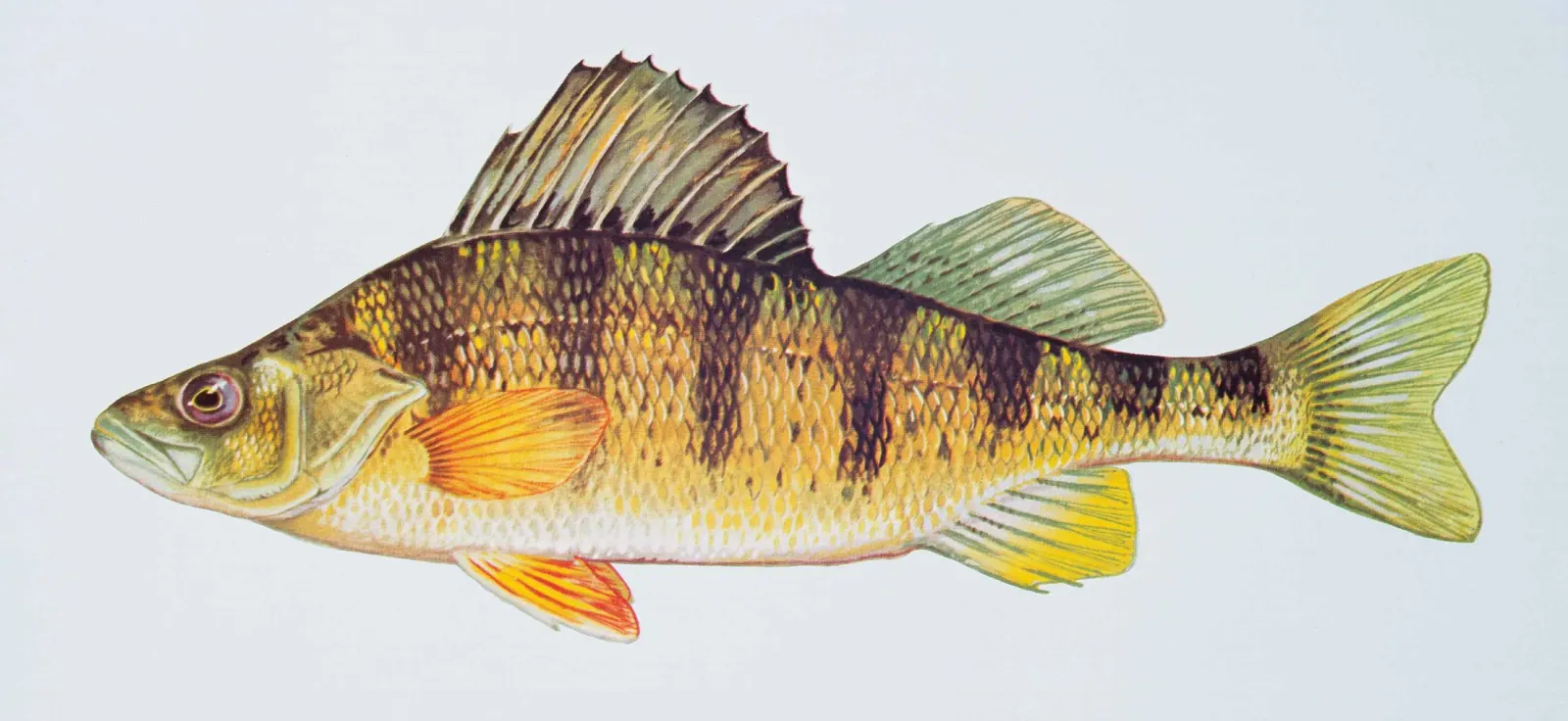
Scientific illustration · reviewed 2026-09-08
USFWS public-domain lateral illustration explicitly labeled Perca flavescens. It cleanly shows the separate dorsal fins, yellow-gold body, dark vertical bars and orange lower fins used for species identification without adding habitat or behavior claims.
Duane Raver / USFWS · U.S. Fish and Wildlife Service National Digital Library · Public Domain — U.S. federal government work · Identified by the publishing body Source
Take this somewhere
This page is the record. The reading is what happens when you add water, a season and a temperature to it — that is where the families below get ranked against each other instead of just listed.
Those three links carry the fish and nothing else. No conditions were declared on this page, so none travel, and the link says so rather than sending an empty reading.
The half nobody publishes
What this record does not know
Everything else on this page comes from a named agency or peer-reviewed source. This is the other side of that: the questions a reviewer went looking for an answer to and came back without, and the fields the record leaves empty because filling them would mean guessing.
It is here rather than at the bottom because a page that only shows what it knows is easy to read as a page that knows everything. For Yellow perch there are 14 of them.
Named by a reviewer
12Somebody looked for this and wrote down that they did not find it.
- Behaviour
Citation gap: “Great Lakes perch assessments” describes a source category rather than one resolvable document.
Nobody has sourced:
- cold-front / barometric response with primary-source support
- species-specific angling-pressure response beyond general cover/light notes
- water-level rise/fall response with primary-source support
- Identification
Citation gap: “Great Lakes perch assessments” describes a source category rather than one resolvable document.
Nobody has sourced:
- Great Lakes vs inland mean-size tables
- stunting thresholds by waterbody
- Forage
Nobody has sourced:
- finer month-by-month diet inside a season, which is waterbody-specific
- complete regional forage-substitution table
- Season
Citation gap: “Great Lakes perch assessments” describes a source category rather than one resolvable document.
Nobody has sourced:
- month-by-month location changes inside a season, which are waterbody-specific
- population-archetype calendars beyond the species-level overlay (see RPC)
Absent from the record
2No reviewer wrote a gap here. The field is simply empty, which is its own answer.
- Water temperature
No agency or peer-reviewed temperature band for Yellow perch was found that a review would accept. The reading runs without one rather than borrowing a number from a related fish.
- Population context
No regional population profile is registered. The species-level reading stands on its own; it does not silently become a local one.
Where the record puts it
Water and range
Stillwater
6 reviewed holding classes- Weed edge
- Drop-off
- Point
- Basin
- Riprap
- Inlet
Flowing water
3 reviewed holding classes- Current break
- Run
- Pool tail
DepthFollows zooplankton and bait; often mid-depth along a break.
Moving waterMild current and current-washed points; schools more than holds a single lie.
LightDaylight schooling; low light may break schools toward shallows.
Thermal band
Temperature
No reviewed temperature band
Nobody publishes a preferred or active temperature range for Yellow perch that a review would accept. Borrowing one from a related fish would look like knowledge and behave like a guess, so the reading runs without it and says which parts of the answer that weakens.
How it uses water
Behaviour
Michigan DNR: perch travel in schools, generally preferring relatively shallow water near shore.
Michigan DNR: adults take immature insects, larger invertebrates (crayfish), and the eggs and young of other fish, from open water and from the bottom. Eggs are an agency diet note, not a catalog forage class on this record. Capacity is not a current hatch.
Michigan DNR: tend to travel shoreward each morning and evening to feed; in spring and fall they appear to feed throughout the day. At night they rest on the bottom and refrain from feeding. Low light may break schools toward shallows without turning night into the feeding default.
Seasonal activityEarly-spring spawning over vegetation and wood is conservation context. Summer follows cooler, slightly deeper water. Michigan DNR: unlike many Great Lakes species, perch remain active all winter under ice in both shallow and deeper water.
Temperature-driven behaviourPreferred band roughly 54–68°F. Michigan DNR: when given the choice they prefer about 66–70°F and often follow the 68°F level. Cold edge near 40°F; warm edge near 76°F. Summer surface heat is a down-move along a break, not a deep-basin lake-trout problem.
Depth movementMichigan DNR: rarely taken from waters more than 30 feet deep; spring and fall shallower than in the heat of summer. Follows zooplankton and bait along a break.
Facing the currentMild current and current-washed points. Schools move; they do not face a trout-style seam as a default.
ClarityDaylight schooling in a wide clarity range. Extreme turbidity is a walleye/sauger optical story, not this one.
CoverWeed edges, drop-offs, points, basins, riprap, and inlets. Cover is a school location class, not an ambush hole.
Open waterOften mid-depth along a break or over a basin when following forage. Still a school, not a pelagic white-bass chase.
Predator avoidanceSchooling and modest depth. Bass, walleye, and pike all prey on perch (Michigan DNR) — that is ecology, not a presentation rule.
TerritorySchools more than holds a single lie. Mild current and current-washed points, not a defended hole.
Spawning (conservation context)Michigan DNR: spawn in the spring, laying eggs in gelatinous strings over dense vegetation, roots, and fallen trees in the shallows. That habitat is excluded from target guidance. Do not convert egg strings into a fishing cue.
Where the general rule stops
- A school is not a hotspot. It is a forage-linked, moving aggregation.
What it can eat
Forage
- Zooplankton
- Aquatic insects
- Small forage fish
- Crustaceans
Michigan DNR: adults dine primarily on immature insects, larger invertebrates (crayfish), and the eggs and young of other fish, taken from open water and from the bottom. Eggs are an agency note, not a catalog forage class here. Young-of-year add zooplankton. Capacity is not a current hatch.
- Feeding style
- Opportunistic
- Feeding zone
- Mixed
Through the year
- Winter
- Insects, crustaceans, and small fish in the cold column. Michigan DNR: remain active under ice — that is winter capacity, not a bite claim.
- Spring
- Insects, crustaceans, and small fish as water warms. Spawning overlap is conservation context, not an egg-forage prescription.
- Summer
- Insects and small forage fish along breaks and weed edges. Follows forage and the cooler band, not a deep-basin default.
- Fall
- Insects and small forage fish as schools use shallower structure than in summer heat.
By life stage
- Young of year
- Zooplankton-scale prey.
- Juvenile
- Aquatic insects, crustaceans, and zooplankton.
- Adult
- Immature insects, crayfish-scale crustaceans, and young of other fish (small_forage_fish).
Prey sizeTypical angling-size perch do not take larger_prey_fish. That class is not on this record.
Ontogenetic shiftZooplankton to insects and crustaceans to small fish.
SubstitutionsGreat Lakes vs inland prey fields differ. Stunted populations stay insect-heavy. This overlay does not auto-select them.
Diet capacity is not proof that a hatch or prey event is occurring. Observed current forage still comes from a user observation or Hatch Match.
Through the year
Season
Winter
- Where they sit
- Basins, drop-offs, and submerged humps; also shallower ice-cover water. Michigan DNR: active under ice in both shallow and deeper water.
- Feeding
- Insects, crustaceans, and small fish in the cold column.
What that changesVertical jig, slow drag, and live / natural bait suspension.
What would count against it
- converting winter activity into a catch claim
Early spring
- Where they sit
- Weed edges, inlets, riprap, and shallow wood as water leaves ice-out.
What that changesSlow drag, drop presentation, and pulse / jig.
What would count against it
- converting egg strings into a fishing cue
Michigan DNR: spawn in spring, laying gelatinous egg strings over vegetation, roots, and fallen trees. That habitat is excluded from target guidance.
Summer
- Where they sit
- Weed edges, drop-offs, and points. Michigan DNR: rarely taken from water more than about 30 feet; summer is deeper than spring/fall, not a deep-basin default.
- Depth
- Mid-depth along a break. Follows the cooler band — Michigan DNR notes a preference near 66–70°F.
- Temperature
- Preferred 54–68°F. Warm edge near 76°F.
What that changesVertical jig, slow drag, and drop presentation. Flowing water: bottom-contact drift and pulse / jig.
What would count against it
- forcing a lake-trout summer depth story
Fall
- Where they sit
- Shallower than summer heat: weed edges, points, riprap, and inlets.
- Forage
- Insects and small forage fish. A school is a moving aggregation, not a named pin.
What that changesVertical jig, slow drag, drop presentation, and live / natural bait suspension.
Spawning · Early spring, Spring
Shallow vegetation and wood shortly after ice-out.
Recorded as conservation context. No spawning site, staging concentration or migration bottleneck is named anywhere in this catalog, because naming one is how a population gets fished out.
Telling it apart
Identification
What to look at
- Michigan DNR: two dorsal fins separated into a spiny and a soft-rayed portion; yellow sides; seven blackish bars on the sides; no canine teeth.
- The even vertical bars are the field look. Walleye and sauger of similar size have canines and do not carry this regular bar pattern.
- Lower fins often orange to red-orange. The eye is not the pearlescent tapetum eye of walleye.
- Mouth is smaller and more terminal than Sander; the upper jaw does not give the walleye canine profile.
- A schooling fish. A single fish is still this species; a group is not a location pin.
- Average adult length
- Michigan DNR: average adult length four to 10 in. Crowded waters may never exceed six in.
- Common angling size
- 6–10 in in many inland and Great Lakes fisheries; larger fish occur where density allows.
- Typical weight
- Michigan DNR: four to 10 oz at typical adult size.
- Maximum documented
- Large Great Lakes and productive inland fish exceed the 4–10 in average. Stunting is density- and habitat-dependent (Michigan DNR).
- Longevity
- Michigan DNR notes maturity at about three to four years; a continent-wide maximum age is not reviewed here.
What it gets confused with
- Walleye
- Walleye have canine teeth, a pearlescent tapetum eye, and no regular seven-bar pattern. Yellow perch have the bars and no canines.
- Sauger
- Sauger have canines, saddle blotches, and a spotted first dorsal. They are not a barred yellow perch.
- White perch
- White perch are Morone: deeper-bodied temperate bass without the yellow-perch bar recipe. Do not collapse the two “perch” names.
What follows from all of that
Presentation families
Stillwater
Vertical jig
Work a compact bait up and down through a marked depth, basin, or timber pocket.
- stay over the target
- measured lift
- controlled drop
- watch slack
What it asks of the tackle
- Depth control
- High
- Sensitivity
- High
- Casting distance
- Vertical
- Weight range
- 1/8–3/4 oz
- Cover resistance
- Moderate
- Line visibility
- Low
- Retie frequency
- Moderate
Slow drag
Move a bait along the bottom slowly enough that it stays in the feeding layer of inactive fish.
- continuous contact
- very slow travel
- pause at changes in bottom
- do not hop out of the zone
What it asks of the tackle
- Depth control
- High
- Sensitivity
- High
- Casting distance
- Moderate
- Weight range
- 1/8–3/8 oz
- Cover resistance
- Moderate
- Line visibility
- Low
- Retie frequency
- Moderate
Drop presentation
Let a bait fall on a controlled line into cover, along a wall, or through a hole in vegetation.
- place then fall
- watch the line
- hold at depth
- short hop only after the fall
What it asks of the tackle
- Depth control
- High
- Sensitivity
- High
- Casting distance
- Short
- Weight range
- 1/16–3/8 oz
- Cover resistance
- High
- Line visibility
- Low
- Retie frequency
- High
Live / natural bait suspension
Present a natural food form with enough life or scent to hold in a station without looking mechanical.
- keep it alive or fresh
- match the holding depth
- minimize hardware bulk
- detect without pulling it away
What it asks of the tackle
- Depth control
- High
- Sensitivity
- High
- Casting distance
- Short to moderate
- Weight range
- As light as conditions allow
- Cover resistance
- Moderate
- Line visibility
- Low
- Retie frequency
- High
Flowing water
Bottom-contact drift
Tick or crawl a food form along the substrate through a feeding lane without snagging constantly.
- feel the bottom
- short hops
- reset after hang
- weight just enough
What it asks of the tackle
- Depth control
- High
- Sensitivity
- High
- Casting distance
- Moderate
- Weight range
- 1/8–3/8 oz
- Cover resistance
- Moderate
- Line visibility
- Low
- Retie frequency
- Moderate
Pulse / jig
Lift and drop a compact bait so it occupies a pocket, seam, or head without leaving the water column.
- short lift
- controlled drop
- stay in the pocket
- repeat on the same piece
What it asks of the tackle
- Depth control
- High
- Sensitivity
- High
- Casting distance
- Short to moderate
- Weight range
- 1/8–3/8 oz
- Cover resistance
- Moderate
- Line visibility
- Low
- Retie frequency
- High
What moves them for this fish
Reviewed rules that push particular families up when the conditions match. Each one names the conditions it needs and why it exists, so you can disagree with it.
Cold-season yellow perch commonly school near bottom or structural depth changes; reinforce vertical and bottom-contact mechanics.
When
Stillwater · Winter or Late fall · Basin, Drop-off
Moves up
Vertical jig, Slow drag, Live / natural bait suspension, Drop presentation
Reviewed 2026-08-27
Where every sentence came from
Sources
Agency
Michigan DNR yellow perch species account
Used for behaviour; season. Read 2026-08-30, next check 2026-11-24.
Agency
Great Lakes perch assessments
Used for habitat, thermal band and presentation families. Read 2026-08-27, next check 2026-11-27.
Agency
Used for identification. Read 2026-08-30, next check 2026-11-22.
Agency
Michigan DNR yellow perch species account (insects, crayfish, eggs and young of other fish)
Used for forage. Read 2026-08-30, next check 2026-11-16.
Peer reviewed
Thorpe yellow perch biology
Used for habitat, thermal band and presentation families; identification; behaviour; forage; season. Read 2026-08-30, next check 2026-11-27.
A source with no link predates the rule that one has to carry a URL. It is still a real citation and still checkable; it just takes a search rather than a click, and that is worth knowing before you rely on it.