Bass & panfish · Freshwater
Smallmouth bass
Micropterus dolomieu
Great Lakes / Ohio / upper Mississippi native; widely introduced in cool rivers and rocky lakes.
Also called smallie, bronzeback, brown bass, smb, smallmouth.
- Flowing water
- Stillwater
- Ordinary target
- 4 of 4 overlays reviewed
- Reviewed 2026-08-27
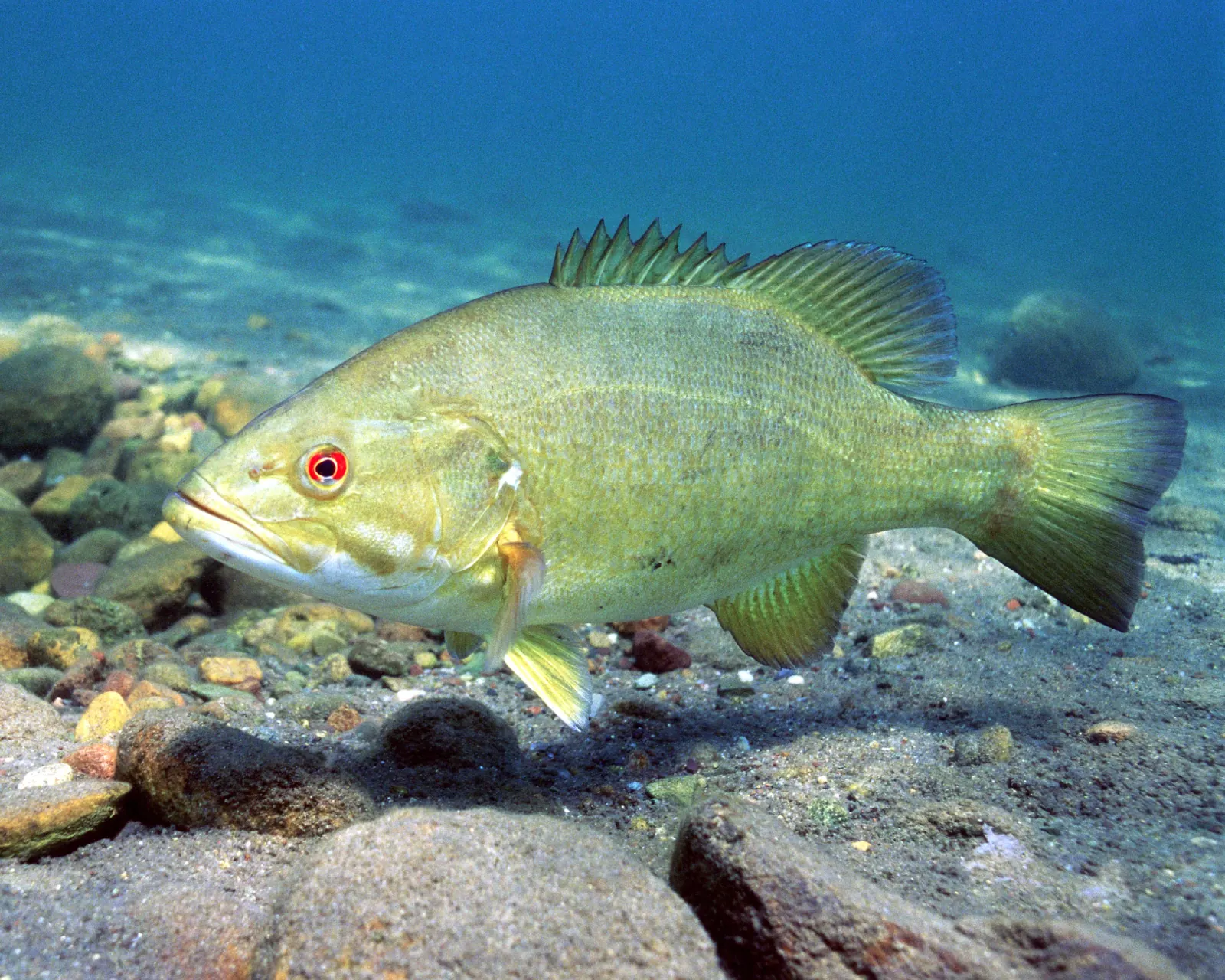
Photograph · reviewed 2026-09-08
USFWS species-labeled underwater photograph of Micropterus dolomieu. The whole fish is visible in lateral profile, including the moderate mouth, separate/spined dorsal profile, bronze-olive body and vertical barring used in the reviewed identification record.
Eric Engbretson / USFWS · U.S. Fish and Wildlife Service · Public Domain — U.S. federal government work · Identified by the publishing body Source
Take this somewhere
This page is the record. The reading is what happens when you add water, a season and a temperature to it — that is where the families below get ranked against each other instead of just listed.
Those three links carry the fish and nothing else. No conditions were declared on this page, so none travel, and the link says so rather than sending an empty reading.
The half nobody publishes
What this record does not know
Everything else on this page comes from a named agency or peer-reviewed source. This is the other side of that: the questions a reviewer went looking for an answer to and came back without, and the fields the record leaves empty because filling them would mean guessing.
It is here rather than at the bottom because a page that only shows what it knows is easy to read as a page that knows everything. For Smallmouth bass there are 12 of them.
Named by a reviewer
11Somebody looked for this and wrote down that they did not find it.
- Behaviour
Citation gap: “USGS / provincial smallmouth assessments” describes a source category rather than one resolvable document.
Nobody has sourced:
- species-specific angling-pressure response beyond general cover/light notes
- species-specific frontal literature beyond the catalog post-front depth note
- Identification
Citation gap: “USGS / provincial smallmouth assessments” describes a source category rather than one resolvable document.
Nobody has sourced:
- river versus reservoir mean-size split as a structured field
- Forage
Citation gap: “USGS / provincial smallmouth assessments” describes a source category rather than one resolvable document.
Nobody has sourced:
- crayfish-percent tables by waterbody
- finer month-by-month diet inside a season, which is waterbody-specific
- Season
Citation gap: “USGS / provincial smallmouth assessments” describes a source category rather than one resolvable document.
Nobody has sourced:
- month-by-month location changes inside a season, which are waterbody-specific
- river vs reservoir calendars (RPC)
Absent from the record
1No reviewer wrote a gap here. The field is simply empty, which is its own answer.
- Water temperature
No agency or peer-reviewed temperature band for Smallmouth bass was found that a review would accept. The reading runs without one rather than borrowing a number from a related fish.
Where the record puts it
Water and range
Flowing water
7 reviewed holding classes- Current break
- Seam
- Boulder pocket
- Eddy
- Run
- Riffle-to-run transition
- Pool head
Stillwater
6 reviewed holding classes- Rocky shoreline
- Point
- Secondary point
- Drop-off
- Riprap
- Submerged hump
DepthShallow to mid on rock; slides deeper on bright, calm, or post-front days.
Moving waterUses current; holds on the slow side of fast water, not in dead slack only.
LightFeeds in daylight; low light and wind often move fish shallower on the same rock.
Thermal band
Temperature
No reviewed temperature band
Nobody publishes a preferred or active temperature range for Smallmouth bass that a review would accept. Borrowing one from a related fish would look like knowledge and behave like a guess, so the reading runs without it and says which parts of the answer that weakens.
How it uses water
Behaviour
Multiple fish on a rock pile is structure sharing, not a white-bass school.
Current-facing and rock-oriented. Catalog exception: forage is often crayfish even when baitfish are visible. Do not let one observation erase the other class.
Feeds in daylight; low light and wind often move fish shallower on the same rock.
Seasonal activityRock and current remain the organizing idea through the open-water year. Post-front bright calm days commonly slide fish deeper on the same structure class.
Temperature-driven behaviourCooler-leaning than largemouth. Extreme heat in still water pushes toward depth, shade rock, or current-oxygenated water.
Depth movementShallow to mid on rock; slides deeper on bright, calm, or post-front days.
Facing the currentUses current; holds on the slow side of fast water, not in dead slack only.
Change in flowElevated, still-fishable flow can pin fish tighter to current breaks; high unfishable flow is an invalidator, not a new family.
ClarityClear water favors sight feeding on rock; stain can pull fish shallower on the same break.
CoverCurrent breaks, boulder pockets, seams, rocky shorelines, points, riprap, and humps.
Open waterReservoir fish will use offshore rock and humps; they remain structure-oriented rather than shad-school pelagic as a default.
Predator avoidanceDepth, rock, and current rather than vegetation as the default.
TerritoryNesting males guard rock or gravel. Outside spawning, they use current breaks more than a weed ambush.
Spawning (conservation context)Spawns on rock in current or on windward lake gravel as water holds near 60°F. Beds are not a targeting product.
Where the general rule stops
- Forage is often crayfish even when baitfish are visible; do not let one observation erase the other class.
What it can eat
Forage
- Crustaceans
- Small forage fish
- Aquatic insects
Crayfish are often the energetic core on rock. Insects and small fish fill the rest. This is more benthic than largemouth in the same season.
- Feeding style
- Opportunistic
- Feeding zone
- Benthic
Through the year
- Winter
- Reduced feeding; remaining crayfish and sculpins or other benthic prey in deeper rock.
- Spring
- Insects and crayfish as water nears the 60°F spawning band. Nests on rock are conservation context.
- Summer
- Crayfish on rock plus small fish. River fish intercept current-delivered prey.
- Fall
- Fish can increase in the diet as crayfish activity drops and baitfish group. Not a prescribed chase.
By life stage
- Young of year
- Aquatic insects and tiny crustaceans.
- Juvenile
- Insects and small crayfish.
- Adult
- Crayfish-weighted, with small forage fish as a regular complement.
Ontogenetic shiftInsect to crayfish/fish. Large river adults may take more fish than lake fish of the same length.
SubstitutionsRivers with sculpins or madtoms substitute those fishes. Lakes without crayfish shift toward fish and insects.
Diet capacity is not proof that a hatch or prey event is occurring. Observed current forage still comes from a user observation or Hatch Match.
Through the year
Season
Winter
- Where they sit
- Deeper rock, channel edges, and the slow side of remaining current.
- Feeding
- Reduced crayfish and benthic fish.
What that changesBottom-contact, vertical jig, and drop-presentation in still water; bottom-contact drift in current.
Spring
- Where they sit
- Rocky shoreline, points, boulder pockets, and current breaks.
- Light
- Feeds in daylight; wind can move fish shallower on the same rock.
What that changesCross-current retrieve, pulse-jig, and upstream retrieve in flowing water.
What would count against it
- using spawning gravel as a target class
Spawns on rock in current or on windward lake gravel as water holds near 60°F. Nests are not a target class.
Summer
- Where they sit
- Current breaks, seams, points, and drop-offs.
- Depth
- Slides deeper on bright, calm, or post-front days.
- Temperature
- Preferred 60–72°F.
- Current
- Holds on the slow side of fast water, not in dead slack only.
What that changesCross-current retrieve and pulse-jig in rivers; bottom-contact and stop-and-go on lake rock.
Fall
- Where they sit
- Points, secondary points, and current seams as baitfish group.
- Forage
- Fish can increase relative to crayfish.
What that changesHorizontal retrieve and stop-and-go when bait is the observed forage.
Spawning · Spring, Early summer
Spawns on rock in current or on windward lake gravel as water holds near 60°F.
Recorded as conservation context. No spawning site, staging concentration or migration bottleneck is named anywhere in this catalog, because naming one is how a population gets fished out.
Telling it apart
Identification
What to look at
- TPWD: jaw does not extend beyond the back margin of the eye when the mouth is closed.
- Vertical barring along the sides rather than a single horizontal stripe.
- Brownish-green to bronze color; the white belly does not extend high on the sides.
- Spiny and soft dorsal fins connected (shallow notch).
- No rows of spots forming horizontal stripes on the lower side.
- Average adult length
- Common adults 10–16 in.
- Common angling size
- 11–17 in in many rivers and rocky lakes.
- Typical weight
- 1–3 lb is typical; 4–5 lb is a large fish in most waters.
- Maximum documented
- Fish over 6–7 lb are exceptional; agency trophy programs document the upper tail. Do not treat world-record size as a typical expectation.
- Longevity
- Often 6–12 years in northern waters.
What it gets confused with
- Largemouth bass
- Largemouth jaw extends well behind the eye; dorsal fins nearly separate; horizontal stripe rather than vertical bars.
- Spotted bass
- Spotted bass have a more horizontal / blotched stripe and rows of spots on the lower side, plus a tongue tooth patch. They are not bronze-barred like smallmouth.
- Rock bass
- Rock bass are deeper-bodied sunfish with red eyes and rows of dark spots on the sides, not a Micropterus profile.
What follows from all of that
Presentation families
Flowing water
Cross-current retrieve
Represent mobile prey crossing or holding near a current boundary.
- horizontal travel
- intermittent pause
- depth retention
- controlled acceleration
What it asks of the tackle
- Depth control
- Moderate
- Sensitivity
- Moderate
- Casting distance
- Moderate
- Weight range
- 1/8–3/8 oz
- Cover resistance
- Moderate
- Line visibility
- Low
- Retie frequency
- Moderate
Pulse / jig
Lift and drop a compact bait so it occupies a pocket, seam, or head without leaving the water column.
- short lift
- controlled drop
- stay in the pocket
- repeat on the same piece
What it asks of the tackle
- Depth control
- High
- Sensitivity
- High
- Casting distance
- Short to moderate
- Weight range
- 1/8–3/8 oz
- Cover resistance
- Moderate
- Line visibility
- Low
- Retie frequency
- High
Bottom-contact drift
Tick or crawl a food form along the substrate through a feeding lane without snagging constantly.
- feel the bottom
- short hops
- reset after hang
- weight just enough
What it asks of the tackle
- Depth control
- High
- Sensitivity
- High
- Casting distance
- Moderate
- Weight range
- 1/8–3/8 oz
- Cover resistance
- Moderate
- Line visibility
- Low
- Retie frequency
- Moderate
Upstream retrieve
Bring a bait back against current so it tracks a seam or bank the fish is already facing.
- cast down-and-across or down
- retrieve into the lane
- keep contact
- vary cadence at the head
What it asks of the tackle
- Depth control
- Moderate
- Sensitivity
- Moderate
- Casting distance
- Moderate
- Weight range
- 1/8–1/2 oz
- Cover resistance
- Moderate
- Line visibility
- Moderate
- Retie frequency
- Moderate
Stillwater
Bottom contact
Keep a bait on or just above the substrate along a break, flat, or inside a weed edge.
- feel bottom
- drag or hop
- pause on the break
- stay in contact
What it asks of the tackle
- Depth control
- High
- Sensitivity
- High
- Casting distance
- Moderate
- Weight range
- 1/8–1/2 oz
- Cover resistance
- High
- Line visibility
- Low
- Retie frequency
- High
Stop-and-go
Imitate injured or hesitating prey by mixing travel with pauses that hold the bait in the strike zone.
- travel
- pause
- keep depth on the pause
- restart without jumping the band
What it asks of the tackle
- Depth control
- High
- Sensitivity
- High
- Casting distance
- Moderate
- Weight range
- 1/8–3/8 oz
- Cover resistance
- Moderate
- Line visibility
- Low
- Retie frequency
- Moderate
Drop presentation
Let a bait fall on a controlled line into cover, along a wall, or through a hole in vegetation.
- place then fall
- watch the line
- hold at depth
- short hop only after the fall
What it asks of the tackle
- Depth control
- High
- Sensitivity
- High
- Casting distance
- Short
- Weight range
- 1/16–3/8 oz
- Cover resistance
- High
- Line visibility
- Low
- Retie frequency
- High
Horizontal retrieve
Move a swimming bait through a chosen depth band along structure or open water.
- count down
- steady or pulsing retrieve
- keep the band
- cover the edge
What it asks of the tackle
- Depth control
- Moderate
- Sensitivity
- Moderate
- Casting distance
- Moderate to long
- Weight range
- 1/8–1/2 oz
- Cover resistance
- Moderate
- Line visibility
- Low
- Retie frequency
- Low
Vertical jig
Work a compact bait up and down through a marked depth, basin, or timber pocket.
- stay over the target
- measured lift
- controlled drop
- watch slack
What it asks of the tackle
- Depth control
- High
- Sensitivity
- High
- Casting distance
- Vertical
- Weight range
- 1/8–3/4 oz
- Cover resistance
- Moderate
- Line visibility
- Low
- Retie frequency
- Moderate
What moves them for this fish
Reviewed rules that push particular families up when the conditions match. Each one names the conditions it needs and why it exists, so you can disagree with it.
Verified crustacean forage on rock is a particularly strong smallmouth distinction; reinforce substrate-contact mechanics.
When
Rocky shoreline, Point, Secondary point, Drop-off, Riprap, Submerged hump, Boulder pocket, Current break · Crustaceans
Moves up
Bottom contact, Bottom-contact drift, Pulse / jig, Drop presentation, Vertical jig
Reviewed 2026-08-27
Smallmouth exploit current boundaries aggressively when mobile fish forage is verified; reinforce cross-current travel mechanics.
When
Flowing water · Current break, Seam, Run, Riffle-to-run transition, Pool head · Small forage fish
Moves up
Cross-current retrieve, Upstream retrieve, Pulse / jig, Bottom-contact drift
Reviewed 2026-08-27
Not every population is the same fish
Regional population context
Cool clear river
- River resident
- Native or established
- Flowing water
Current breaks, seams, boulder transitions, and current-delivered crayfish or forage are primary mechanical structure for this population archetype.
Smallmouth are strongly associated with cool, clear rocky streams in parts of their range; current-facing mechanics deserve more weight than reservoir offshore logic.
- A river label does not justify fishing spawning beds or known seasonal concentration points.
- Very warm or unusually low flow can collapse otherwise typical shallow-current behavior.
Rocky reservoir / offshore structure
- Reservoir resident
- Native or introduced
- Stillwater
Points, humps, channel-edge breaks, and rocky depth transitions receive more weight than river-current lanes; fish can use substantially deeper structure in stable reservoirs.
Reservoir smallmouth retain their rock association but use offshore structure and depth transitions differently from current-oriented river populations.
- Reservoir water-level changes can make yesterday's structural edge biologically irrelevant.
- Stocking/introduction history matters outside the native range.
Where every sentence came from
Sources
Agency
USGS / provincial smallmouth assessments
Used for habitat, thermal band and presentation families; population context. Read 2026-08-27, next check 2026-11-27.
Agency
Texas Parks and Wildlife bass comparison and identification key
Used for identification. Read 2026-08-30, next check 2026-11-15.
Agency
Missouri Department of Conservation smallmouth bass habitat profile
Used for population context. Read 2026-08-27.
Agency
State reservoir black-bass management literature
Used for population context. Read 2026-08-27.
Peer reviewed
Coble smallmouth biology
Used for habitat, thermal band and presentation families; identification; behaviour; forage; season. Read 2026-08-30, next check 2026-11-27.
A source with no link predates the rule that one has to carry a URL. It is still a real citation and still checkable; it just takes a search rather than a click, and that is worth knowing before you rely on it.