Trout & salmon · Freshwater
Landlocked Atlantic salmon
Salmo salar (landlocked freshwater form)
Freshwater form of Atlantic salmon, native to a small number of northeastern lake/river systems and widely managed by stocking. Explicitly separate from wild sea-run Atlantic salmon.
Also called Landlocked salmon, Sebago salmon, sebago, ouananiche, landlocked atlantic, quananiche.
- Stillwater
- Flowing water
- Ordinary target
- 4 of 4 overlays reviewed
- Reviewed 2026-08-27
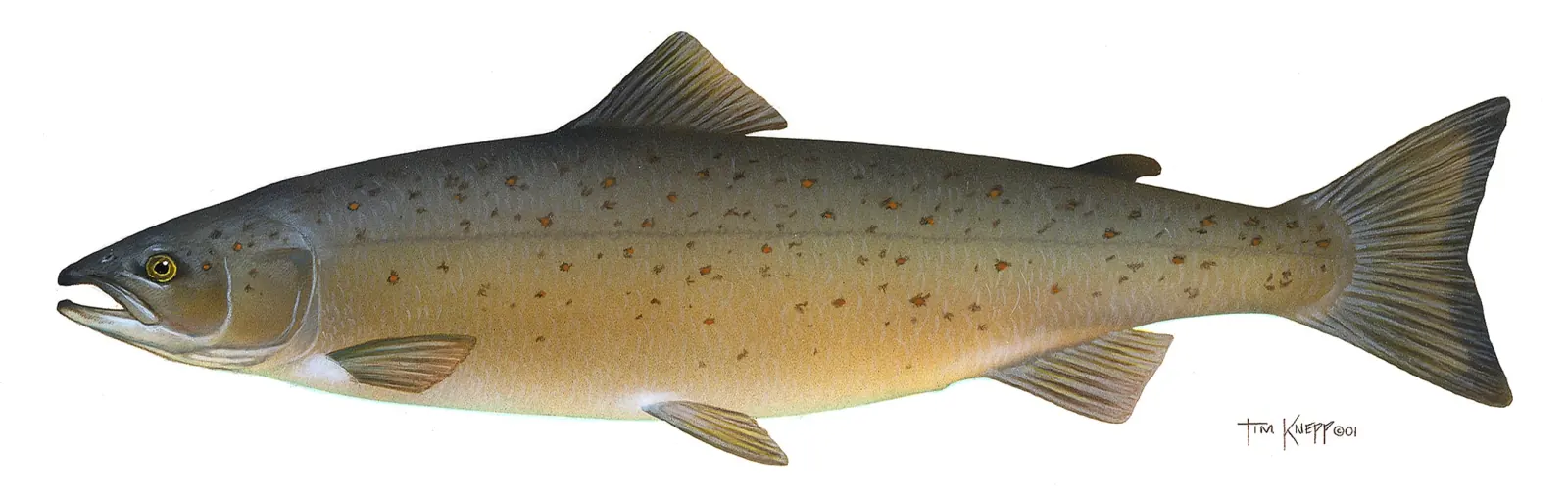
Scientific illustration · reviewed 2026-08-27
Species-level Salmo salar morphology only; landlocked life history is supplied by the reviewed record, not inferred from the image.
Ryan Hagerty / USFWS · U.S. Fish and Wildlife Service · Public Domain — U.S. federal government work Source
Take this somewhere
This page is the record. The reading is what happens when you add water, a season and a temperature to it — that is where the families below get ranked against each other instead of just listed.
Those three links carry the fish and nothing else. No conditions were declared on this page, so none travel, and the link says so rather than sending an empty reading.
The half nobody publishes
What this record does not know
Everything else on this page comes from a named agency or peer-reviewed source. This is the other side of that: the questions a reviewer went looking for an answer to and came back without, and the fields the record leaves empty because filling them would mean guessing.
It is here rather than at the bottom because a page that only shows what it knows is easy to read as a page that knows everything. For Landlocked Atlantic salmon there are 15 of them.
Named by a reviewer
13Somebody looked for this and wrote down that they did not find it.
- Behaviour
Citation gap: “Maine landlocked Atlantic salmon management literature” describes a source category rather than one resolvable document.
Nobody has sourced:
- cold-front / barometric response with primary-source support
- smelt-present vs smelt-absent lake calendars as a structured RPC split
- species-specific angling-pressure response beyond general cover/light notes
- Identification
Nobody has sourced:
- a single northeastern mean length
- ouananiche vs sebago form tables as structured fields
- Forage
Citation gap: “Maine landlocked Atlantic salmon management literature” describes a source category rather than one resolvable document.
Nobody has sourced:
- complete regional forage-substitution table
- finer month-by-month diet inside a season, which is waterbody-specific
- smelt-present vs smelt-absent diet as a structured split
- Season
Citation gap: “Maine landlocked Atlantic salmon management literature” describes a source category rather than one resolvable document.
Nobody has sourced:
- month-by-month location changes inside a season, which are waterbody-specific
- smelt-present vs smelt-absent lake calendars as a structured RPC split
Absent from the record
2No reviewer wrote a gap here. The field is simply empty, which is its own answer.
- Water temperature
No agency or peer-reviewed temperature band for Landlocked Atlantic salmon was found that a review would accept. The reading runs without one rather than borrowing a number from a related fish.
- Population context
No regional population profile is registered. The species-level reading stands on its own; it does not silently become a local one.
Where the record puts it
Water and range
Stillwater
6 reviewed holding classes- Suspended / open water
- Thermocline edge
- Inlet
- Outlet
- Drop-off
- Basin
Flowing water
5 reviewed holding classes- Run
- Seam
- Pool head
- Pool tail
- Current break
DepthOften near surface in cool spring/fall conditions, then commonly descends into cold oxygenated water during summer stratification.
Moving waterRiver fish use cold drift lanes and pools; lake fish are primarily pelagic and forage-linked rather than cover-bound.
LightLow light and broken surface conditions can support higher positioning; bright summer conditions reinforce depth in clear lakes.
Thermal band
Temperature
No reviewed temperature band
Nobody publishes a preferred or active temperature range for Landlocked Atlantic salmon that a review would accept. Borrowing one from a related fish would look like knowledge and behave like a guess, so the reading runs without it and says which parts of the answer that weakens.
How it uses water
Behaviour
Lake fish forage-link to smelt and other pelagic prey rather than holding a wood hole. River fish use cold drift lanes and pools.
Maine IFW: rainbow smelt are the principal forage in Maine lakes; growth can be poor without adequate smelt. River fish take aquatic, emerging, and terrestrial insects. Unlike Pacific salmon freshwater adults, this form still feeds.
Catalog: low light and broken surface conditions can support higher positioning; bright summer conditions reinforce depth in clear lakes.
Seasonal activityMaine IFW: wild fish spawn in lake inlets or outlets from mid-October through late November. Spawning runs are invalidators, not target layers. Summer is a cold-oxygen problem under 65°F preference.
Temperature-driven behaviourMaine IFW: a coldwater fish that prefers water temperatures below 65°F. Catalog preferred band roughly 48–60°F; warm edge near 68°F. Summer stratification sends fish into cold oxygenated water.
Depth movementOften near surface in cool spring/fall conditions, then commonly descends into cold oxygenated water during summer stratification (catalog).
Facing the currentRiver fish use cold drift lanes and pools. Lake fish are pelagic, not current-bound.
ClarityBright summer in clear lakes reinforces depth. Broken surface can support higher positioning. Neither is a catch claim.
CoverRiver: runs, seams, pool heads, pool tails, current breaks. Lake: suspended open water, thermocline edges, inlets, outlets, drop-offs, and basins as classes. Inlets and outlets during the spawn window are conservation context.
Open waterLake default is pelagic smelt-linked pursuit. Absence of smelt or equivalent pelagic forage can materially change growth and positioning (catalog).
Predator avoidanceDepth and pelagic distance in lakes; broken water and pools in rivers. Not a wood-ambush brown.
Spawning (conservation context)Maine IFW: wild fish spawn in lake inlets or outlets from mid-October through late November; eggs buried in gravel; landlocked salmon may spawn more than once. Spawning runs are invalidators. Do not confuse this record with federally endangered wild Gulf of Maine sea-run Atlantic salmon.
Where the general rule stops
- Maine identifies rainbow smelt as principal lake forage; absence of smelt or equivalent pelagic forage can materially change growth and positioning.
- Do not confuse this record with federally endangered wild Gulf of Maine sea-run Atlantic salmon.
What it can eat
Forage
- Small forage fish
- Aquatic insects
- Emerging insects
- Terrestrial insects
Maine IFW: rainbow smelt are the principal forage for landlocked salmon in Maine lakes; growth can be poor without adequate smelt. River fish take aquatic, emerging, and terrestrial insects. Unlike Pacific salmon freshwater adults, this form still feeds. Larger prey fish is not a catalog class here — do not import lake trout or brown-trout piscivory wholesale.
- Feeding style
- Opportunistic
- Feeding zone
- Mixed
Through the year
- Winter
- Pelagic forage fish in the remaining cold band. Insects recede. Capacity is not a current smelt event.
- Spring
- Smelt-scale forage in lakes as water leaves winter; insects and emergences in connected rivers. Do not infer a hatch.
- Summer
- Maine IFW: prefer water below 65°F. Lake fish follow cold oxygenated water and pelagic forage. Surface insects are capacity, not a default.
- Fall
- Forage continues until spawning overlap. Maine IFW: mid-October through late November spawn window is an invalidator, not a forage map.
By life stage
- Young of year
- Stream insects during the one-to-four-year river residence (Maine IFW).
- Juvenile
- Aquatic and emerging insects in streams, then a shift toward pelagic forage after lake entry.
- Adult
- Maine IFW: rainbow smelt principal lake forage. Insects remain river capacity. This is not wild sea-run Atlantic salmon, and it is not a non-feeding Pacific spawner.
Ontogenetic shiftStream insectivory to lake pelagic smelt-linked feeding. Absence of smelt or equivalent pelagic forage can materially change growth (catalog).
SubstitutionsLakes substitute other pelagic forage fish when smelt are scarce; growth often suffers. Rivers substitute hatches and terrestrials. Do not substitute a brown-trout hole diet or a steelhead egg diet as the default.
Diet capacity is not proof that a hatch or prey event is occurring. Observed current forage still comes from a user observation or Hatch Match.
Through the year
Season
Winter
- Where they sit
- Lake basins, thermocline remnants, drop-offs, and suspended open water in the remaining cold band.
- Depth
- Deeper than spring surface water.
- Feeding
- Pelagic forage fish. Insects recede.
- Temperature
- Near or below the 40°F cold edge, activity compresses.
What that changesTrolling, Vertical jig, and Suspend / pause remain the reviewed stillwater winter jobs.
What would count against it
- treating winter as a brown-trout wood problem
Spring
- Where they sit
- Higher pelagic water in lakes; cold river runs, seams, and pool heads in connected flowing water.
- Feeding
- Smelt-scale forage in lakes; aquatic and emerging insects in rivers. Capacity is not a hatch.
What that changesTrolling, Horizontal retrieve, and Surface retrieve in still water; Dead drift, Swing, and Surface drift in current.
Summer
- Where they sit
- Cold oxygenated lake water — thermocline edges, basins, drop-offs. Rivers that stay cold enough remain usable.
- Depth
- Catalog: commonly descends into cold oxygenated water during summer stratification.
- Temperature
- Maine IFW: prefer water temperatures below 65°F. Catalog warm edge near 68°F.
What that changesTrolling, Vertical jig, and Suspend / pause on the usable cold layer. Flowing water: Dead drift and Swing where temperature allows.
What would count against it
- forcing a warm surface default
- collapsing this record into brown trout summer cover
Fall
- Where they sit
- Cooling pelagic water; river runs as some fish move toward inlet and outlet spawning systems.
- Forage
- Forage continues until spawning overlap. Do not infer a smelt event from the calendar.
What that changesTrolling and Horizontal retrieve in lakes; Dead drift, Swing, Cross-current retrieve, and Surface drift in current.
What would count against it
- using inlets or outlets as a targeting prescription during the spawn window
Maine IFW: wild fish spawn from mid-October through late November in lake inlets or outlets. That window is an invalidator, not a target map.
Late fall
- Where they sit
- Spawning overlap continues. Remaining lake fish that are not on the run stay pelagic.
What that changesReviewed families remain lawful feeding jobs away from the spawn window; they are not a redd method.
What would count against it
- collapsing landlocked salmon into federally endangered sea-run Atlantic salmon
Spawning runs stay excluded from target guidance. This is not wild sea-run Atlantic salmon.
Spawning · Fall, Late fall
Wild fish spawn in lake inlets or outlets from mid-October through late November. Spawning runs are invalidators, not target layers.
Recorded as conservation context. No spawning site, staging concentration or migration bottleneck is named anywhere in this catalog, because naming one is how a population gets fished out.
Telling it apart
Identification
What to look at
- Maine IFW: salmon have a slightly forked caudal fin; brown trout have a square tail with almost no fork. The caudal peduncle on salmon is thinner; brown trout tend to be thick there.
- Maine IFW: salmon vomerine teeth are small and arranged in a single row on the shaft, few to none on the vomerine head. Brown trout have well-developed teeth on both vomerine head and shaft, in a zig-zag row on the shaft.
- Maine IFW: the maxillary on salmon typically will not extend much past the eye; brown trout often have a maxillary that slightly extends past the eye.
- Maine IFW: adults are generally silvery with small X-shaped markings on the back and upper sides. Spots are smaller and less defined than brown trout, which usually have more spots and a few more reddish spots.
- Maine IFW: salmon usually have a dark adipose fin; if spotted, the spots are harder to see. Brown trout tend to have larger adipose fins, often orange-tinted and obviously spotted.
- Average adult length
- Maine lake adults commonly 16–22 in; larger fish occur where smelt forage is adequate.
- Common angling size
- 16–22 in in many northeastern managed lakes.
- Typical weight
- Often 1.5–4 lb. Maine IFW: growth can be poor without adequate smelt.
- Maximum documented
- Large lake fish exceed typical size where pelagic forage is strong. Maxima are waterbody-specific and are not a sea-run Atlantic number.
- Longevity
- Maine IFW: landlocked salmon may spawn more than once (iteroparous), in consecutive or alternate years. Most fish observed on spawning runs are spawning for the first time.
What it gets confused with
- Brown trout
- Maine IFW: brown trout have a square unforked tail, a zig-zag vomerine row with teeth on the vomerine head, a maxillary that often extends past the eye, more and redder spots, and a larger often orange-tinted spotted adipose. Landlocked salmon are the slightly forked, small-X, dark-adipose Salmo.
- Lake trout
- Lake trout are char with light spots on a dark body and a deeply forked tail. Landlocked salmon have small dark X-marks on silver and a slight fork. Mouth and spotting, not fork alone, split them.
- Wild anadromous Atlantic salmon
- Same species complex, different life history and status. Wild Gulf of Maine sea-run Atlantic salmon are federally endangered and remain a fail-closed catalog record. Do not treat a managed landlocked lake fish as that fish, and do not use this overlay as a how-to-target layer for sea-run Atlantic salmon.
- Steelhead
- Steelhead are anadromous rainbow trout with a spotted tail and, often, a pink band after freshwater residence. Landlocked Atlantic salmon are Salmo with X-marks and a slight fork, not an Oncorhynchus.
What follows from all of that
Presentation families
Stillwater
Trolling
Cover a depth contour or basin at a controlled speed to intercept mobile fish.
- speed control
- depth control
- follow the contour
- turn to change action
What it asks of the tackle
- Depth control
- High
- Sensitivity
- Low
- Casting distance
- Boat
- Weight range
- Varies with speed and depth
- Cover resistance
- Low
- Line visibility
- Moderate
- Retie frequency
- Low
Horizontal retrieve
Move a swimming bait through a chosen depth band along structure or open water.
- count down
- steady or pulsing retrieve
- keep the band
- cover the edge
What it asks of the tackle
- Depth control
- Moderate
- Sensitivity
- Moderate
- Casting distance
- Moderate to long
- Weight range
- 1/8–1/2 oz
- Cover resistance
- Moderate
- Line visibility
- Low
- Retie frequency
- Low
Suspend / pause
Leave a neutrally buoyant bait hanging in place where fish are already holding.
- reach the band
- long pause
- tiny pulse only if needed
- do not leave the zone
What it asks of the tackle
- Depth control
- High
- Sensitivity
- High
- Casting distance
- Moderate
- Weight range
- 1/8–3/8 oz suspending
- Cover resistance
- Low
- Line visibility
- Low
- Retie frequency
- Low
Surface retrieve
Work a floating bait across shade, weed edges, or low-light shallows.
- walk, pop, or crawl
- pause in holes
- keep it on top
- cover the edge
What it asks of the tackle
- Depth control
- Surface
- Sensitivity
- Low
- Casting distance
- Moderate
- Weight range
- 1/4–3/4 oz
- Cover resistance
- Moderate
- Line visibility
- Moderate
- Retie frequency
- Low
Vertical jig
Work a compact bait up and down through a marked depth, basin, or timber pocket.
- stay over the target
- measured lift
- controlled drop
- watch slack
What it asks of the tackle
- Depth control
- High
- Sensitivity
- High
- Casting distance
- Vertical
- Weight range
- 1/8–3/4 oz
- Cover resistance
- Moderate
- Line visibility
- Low
- Retie frequency
- Moderate
Flowing water
Dead drift
Allow a food-form imitation to move at or near current speed through a defined feeding lane.
- controlled depth
- minimal drag
- short-to-medium presentation lane
- occasional repositioning
What it asks of the tackle
- Depth control
- High
- Sensitivity
- High
- Casting distance
- Short to moderate
- Weight range
- 1/64–1/8 oz or unweighted fly
- Cover resistance
- Low
- Line visibility
- Low
- Retie frequency
- Moderate
Swing
Let current carry a bait or fly across a lane so it broadens and lifts at the hang.
- downstream quartering
- controlled belly
- hang-down pause
- slow lift
What it asks of the tackle
- Depth control
- Moderate
- Sensitivity
- Moderate
- Casting distance
- Moderate
- Weight range
- Unweighted to 1/4 oz
- Cover resistance
- Low
- Line visibility
- Moderate
- Retie frequency
- Low
Cross-current retrieve
Represent mobile prey crossing or holding near a current boundary.
- horizontal travel
- intermittent pause
- depth retention
- controlled acceleration
What it asks of the tackle
- Depth control
- Moderate
- Sensitivity
- Moderate
- Casting distance
- Moderate
- Weight range
- 1/8–3/8 oz
- Cover resistance
- Moderate
- Line visibility
- Low
- Retie frequency
- Moderate
Surface drift
Present a floating food form in a feeding lane with as little drag as the water allows.
- slack management
- reach or mend
- dead or micro-twitch
- leave it in the lane
What it asks of the tackle
- Depth control
- Surface
- Sensitivity
- Moderate
- Casting distance
- Short to moderate
- Weight range
- Unweighted
- Cover resistance
- Low
- Line visibility
- Low
- Retie frequency
- Moderate
What moves them for this fish
Reviewed rules that push particular families up when the conditions match. Each one names the conditions it needs and why it exists, so you can disagree with it.
Verified small-fish forage strongly reinforces the pelagic smelt-oriented behavior documented for landlocked Atlantic salmon.
When
Stillwater · Suspended / open water, Thermocline edge, Drop-off, Basin · Small forage fish
Moves up
Trolling, Horizontal retrieve, Suspend / pause, Vertical jig
Reviewed 2026-08-27
In connected rivers, observed insect forage supports trout-like drift/surface mechanics without importing the sea-run Atlantic salmon policy record.
When
Flowing water · Aquatic insects, Emerging insects, Terrestrial insects
Moves up
Dead drift, Surface drift, Swing, Cross-current retrieve
Reviewed 2026-08-27
Where every sentence came from
Sources
Agency
Maine Department of Inland Fisheries and Wildlife Landlocked Salmon species profile
Used for behaviour; season. Read 2026-08-30, next check 2026-11-16.
Agency
Maine Department of Inland Fisheries and Wildlife Landlocked Salmon species profile
Used for habitat, thermal band and presentation families. Read 2026-08-27, next check 2026-11-27.
Agency
Maine landlocked Atlantic salmon management literature
Used for habitat, thermal band and presentation families. Read 2026-08-27, next check 2026-11-27.
Agency
Used for identification. Read 2026-08-30, next check 2026-12-03.
Agency
Maine IFW identification of salmon and brown trout (vomerine row, slightly forked vs square tail)
Used for identification. Read 2026-08-30, next check 2026-12-03.
Agency
Used for identification. Read 2026-08-30, next check 2026-12-03.
Agency
Used for forage. Read 2026-08-30, next check 2026-11-19.
A source with no link predates the rule that one has to carry a URL. It is still a real citation and still checkable; it just takes a search rather than a click, and that is worth knowing before you rely on it.