Trout & salmon · Freshwater
Brown trout
Salmo trutta
Eurasian native; introduced across temperate North America.
Also called brownie, german brown, browns, brown.
- Flowing water
- Stillwater
- Ordinary target
- 4 of 4 overlays reviewed
- Reviewed 2026-08-27
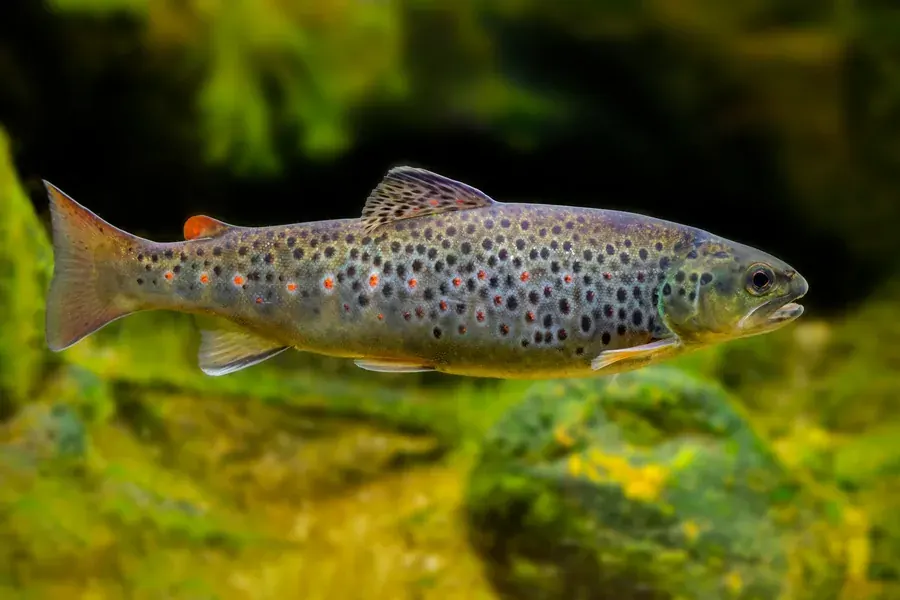
Photograph · reviewed 2026-08-29
Full lateral adult filling the frame against a green riverbed. Identified on diagnostic features rather than the stock keywords: dense black flank spotting, red/orange spots ringed with pale halos along the lateral line, and an essentially unspotted tail — which separates it from rainbow trout. Adipose fin and blunt snout visible. Photographic, with no generative artefacts in fins, eye or background falloff.
Adobe Stock contributor · asset 578037819 · Adobe Stock · Adobe Stock Standard licence · Identified on review of diagnostic features Source
Take this somewhere
This page is the record. The reading is what happens when you add water, a season and a temperature to it — that is where the families below get ranked against each other instead of just listed.
Those three links carry the fish and nothing else. No conditions were declared on this page, so none travel, and the link says so rather than sending an empty reading.
The half nobody publishes
What this record does not know
Everything else on this page comes from a named agency or peer-reviewed source. This is the other side of that: the questions a reviewer went looking for an answer to and came back without, and the fields the record leaves empty because filling them would mean guessing.
It is here rather than at the bottom because a page that only shows what it knows is easy to read as a page that knows everything. For Brown trout there are 14 of them.
Named by a reviewer
12Somebody looked for this and wrote down that they did not find it.
- Behaviour
Citation gap: “USGS / state brown trout habitat notes” describes a source category rather than one resolvable document.
Nobody has sourced:
- cold-front / barometric response with primary-source support
- water-level rise/fall response with primary-source support
- Identification
Citation gap: “USGS / state brown trout habitat notes” describes a source category rather than one resolvable document.
Nobody has sourced:
- a single continent-wide mean length
- sea-run vs inland color maps as a structured field
- Forage
Citation gap: “USGS / state brown trout habitat notes” describes a source category rather than one resolvable document.
Nobody has sourced:
- complete regional forage-substitution table
- finer month-by-month diet inside a season, which is waterbody-specific
- Season
Citation gap: “USGS / state brown trout habitat notes” describes a source category rather than one resolvable document.
Nobody has sourced:
- month-by-month location changes inside a season, which are waterbody-specific
- population-archetype calendars beyond the species-level overlay (see RPC)
Absent from the record
2No reviewer wrote a gap here. The field is simply empty, which is its own answer.
- Water temperature
No agency or peer-reviewed temperature band for Brown trout was found that a review would accept. The reading runs without one rather than borrowing a number from a related fish.
- Population context
No regional population profile is registered. The species-level reading stands on its own; it does not silently become a local one.
Where the record puts it
Water and range
Flowing water
7 reviewed holding classes- Seam
- Pool head
- Undercut bank
- Deep pool
- Current break
- Submerged wood
- Run
Stillwater
5 reviewed holding classes- Weed edge
- Drop-off
- Inlet
- Wood
- Thermocline edge
DepthHolds deeper than rainbow in daylight; slides shallower in low light.
Moving waterBalances food delivery against energy cost; velocity boundaries over uniform fast water.
LightStrong low-light and night feeding, especially in clear or pressured water.
Thermal band
Temperature
No reviewed temperature band
Nobody publishes a preferred or active temperature range for Brown trout that a review would accept. Borrowing one from a related fish would look like knowledge and behave like a guess, so the reading runs without it and says which parts of the answer that weakens.
How it uses water
Behaviour
Adult browns use a defended or repeatedly used lie more than rainbows of the same size. They are not a schooling pelagic species.
Intercepts drift and emergences, then shifts toward crayfish and fish as gape allows. Catalog exception: large piscivorous adults may ignore insect-scale presentations even when smaller fish are on them.
Catalog light response: strong low-light and night feeding, especially in clear or pressured water. Daytime feeding still occurs in broken light and stain.
Seasonal activityFall spawning is conservation context. Summer thermal refuge and winter slowing are constraints. Do not treat fall color as a targeting window.
Temperature-driven behaviourPreferred band roughly 50–60°F. Elliott's thermal work and the catalog put the cold edge near 40°F and the warm edge near 70°F. Warm edges push fish into cover, depth, or faster oxygenated water.
Depth movementHolds deeper than rainbow in daylight; slides shallower in low light.
Facing the currentBalances food delivery against energy cost. Faces into flow on seams, pool heads, and current breaks rather than occupying the fastest core.
ClarityVery clear water increases nocturnal and cover use. Stain can allow more daylight feeding without implying a surface event.
Angling pressureCatalog already ties pressure to stronger low-light and night feeding in clear water. This is a cover/light shift, not a catch-probability claim.
CoverUndercut banks, submerged wood, deep pools, seams, and current breaks.
Open waterLake fish use weed edges, drop-offs, inlets, wood, and thermocline edges rather than a river undercut. They still are not pelagic schoolers.
Predator avoidanceUndercut banks, wood, depth, and darkness. More cover-dependent than rainbow.
TerritoryMore hole-bound and cover-oriented than rainbow. Velocity boundaries, undercut banks, wood, and the slow side of fast water are typical adult lies.
AggressionLarger fish can exclude smaller trout from prime lies. That is spacing, not a catch claim.
Spawning (conservation context)Fall spawner as days shorten and temperature drops. Fish move onto gravel; spawning substrate and any pre-spawn holding water are excluded from target guidance.
Where the general rule stops
- Large piscivorous adults may ignore insect-scale presentations even when smaller fish are on them.
What it can eat
Forage
- Aquatic insects
- Emerging insects
- Terrestrial insects
- Crustaceans
- Small forage fish
- Larger prey fish
- Worms / annelids
Browns take drift, emergences, terrestrials, crayfish-scale crustaceans, and fish. Catalog exception: large piscivorous adults may ignore insect-scale foods even when smaller trout are on them. Capacity is not a current hatch.
- Feeding style
- Opportunistic
- Feeding zone
- Mixed
Through the year
- Winter
- Lower metabolic demand; nymphs, midges, and other slow subsurface prey. Night and cover feeding remain plausible in clear water.
- Spring
- Aquatic insects and emergences as water warms. This is capacity, not a declared hatch.
- Summer
- Terrestrials, crayfish, and subsurface insects in the usable thermal band. Large fish add baitfish.
- Fall
- Opportunistic insects, crayfish, and fish. Fall spawning is conservation context, not an egg-forage prescription. Do not assume an egg event.
By life stage
- Young of year
- Aquatic invertebrates and drift-scale prey.
- Juvenile
- Aquatic insects, emergences, and small crustaceans.
- Adult
- Insects remain important; larger fish add crayfish and forage fish, then larger prey fish.
Prey sizePrey length tracks gape. The catalog larger_prey_fish class belongs to large adults, not to parr.
Ontogenetic shiftInsectivory to mixed insect–crustacean–fish, with some adults becoming primarily piscivorous.
SubstitutionsStreams substitute hatches and terrestrials. Fertile rivers and lakes substitute crayfish and baitfish. Substitution is system-specific.
Diet capacity is not proof that a hatch or prey event is occurring. Observed current forage still comes from a user observation or Hatch Match.
Through the year
Season
Winter
- Where they sit
- Deep pools, current breaks, wood, and lake basins in the remaining active band.
- Depth
- Deeper in daylight; shallower in low light.
- Feeding
- Slow subsurface intercept.
- Temperature
- Near or below the 40°F cold edge, activity compresses.
What that changesDead-drift and bottom-contact drift in flowing water; suspend-pause or stop-and-go in still water.
What would count against it
- treating winter as a surface-terrestrial problem
Spring
- Where they sit
- Seams, pool heads, runs, and wood as water warms.
- Forage
- Aquatic insects and emergences where they occur.
What that changesDead-drift, surface-drift, and swing remain reviewed flowing families.
What would count against it
- inventing a hatch from diet capacity
Summer
- Where they sit
- Undercut banks, wood, deep pools, shade, and lake weed edges or drop-offs.
- Depth
- Deeper than rainbow in daylight.
- Temperature
- Preferred 50–60°F. The 70°F warm edge is a cover and oxygen constraint.
- Cover
- Undercuts, wood, and depth.
- Light
- Strong low-light and night feeding in clear or pressured water.
What that changesBottom-contact drift and cross-current retrieve in flow; surface-retrieve only when terrestrials are observed, not assumed.
What would count against it
- forcing bright shallow water above the warm edge
Fall
- Where they sit
- Feeding water as temperatures ease, then gravel as days shorten.
What that changesDead-drift, swing, and cross-current retrieve. Do not convert spawn color into a new family.
What would count against it
- using spawning substrate as holding water
- assuming an egg event from calendar alone
Fall spawner. Spawning gravel is excluded from target guidance.
Late fall
- Where they sit
- Spawning overlap continues, then wintering pools.
What that changesBottom-contact drift and dead-drift in remaining feeding water.
Late-fall spawning overlap remains caution.
Spawning · Fall, Late fall
Fall spawner; fish move onto gravel as days shorten and temps drop.
Recorded as conservation context. No spawning site, staging concentration or migration bottleneck is named anywhere in this catalog, because naming one is how a population gets fished out.
Telling it apart
Identification
What to look at
- Caudal fin is largely unspotted — a plain tail — unlike rainbow and cutthroat, whose tails carry black spots.
- Sides show a mix of dark spots and red-to-orange spots, the red spots commonly ringed by pale halos.
- Dark spots typically mark the operculum / gill cover.
- Adipose and anal fins are often orange or yellow-tinted; there is no pink lateral stripe.
- Maxillary commonly reaches past the eye in adults.
- Average adult length
- Stream adults commonly 10–16 in; many fertile rivers and lakes produce 16–22 in fish.
- Common angling size
- 12–18 in in most inland fisheries.
- Typical weight
- Often 0.75–3 lb in streams; large piscivorous fish are much heavier.
- Maximum documented
- Large lake and tailwater fish far exceed typical stream size. Continent-wide maxima are fishery-specific and are not a single catalog number.
- Longevity
- Commonly 5–8 years in inland waters; older fish occur in some lakes and cold tailwaters.
What it gets confused with
- Rainbow trout
- Rainbows have a pink-to-red lateral stripe and black spots on the caudal fin. Browns have a plain tail, haloed red spots, and no pink stripe.
- Brook trout
- Brook trout are char with worm-like vermiculations on the back, red spots with blue halos, a square tail, and white-then-black leading edges on the lower fins. Browns lack vermiculations and have a spotted-side / plain-tail trout look.
- Landlocked Atlantic salmon
- Landlocked Atlantic salmon have a more forked tail, smaller spots, and a different body language in lakes. They are a separate catalog record, not a large brown.
- Tiger trout (brown × brook hybrid)
- Tiger trout show worm-like vermiculations wrapping onto the sides without the brook’s blue-haloed red spots. Treat as a hybrid; do not force the fish into either parent record.
What follows from all of that
Presentation families
Flowing water
Dead drift
Allow a food-form imitation to move at or near current speed through a defined feeding lane.
- controlled depth
- minimal drag
- short-to-medium presentation lane
- occasional repositioning
What it asks of the tackle
- Depth control
- High
- Sensitivity
- High
- Casting distance
- Short to moderate
- Weight range
- 1/64–1/8 oz or unweighted fly
- Cover resistance
- Low
- Line visibility
- Low
- Retie frequency
- Moderate
Bottom-contact drift
Tick or crawl a food form along the substrate through a feeding lane without snagging constantly.
- feel the bottom
- short hops
- reset after hang
- weight just enough
What it asks of the tackle
- Depth control
- High
- Sensitivity
- High
- Casting distance
- Moderate
- Weight range
- 1/8–3/8 oz
- Cover resistance
- Moderate
- Line visibility
- Low
- Retie frequency
- Moderate
Cross-current retrieve
Represent mobile prey crossing or holding near a current boundary.
- horizontal travel
- intermittent pause
- depth retention
- controlled acceleration
What it asks of the tackle
- Depth control
- Moderate
- Sensitivity
- Moderate
- Casting distance
- Moderate
- Weight range
- 1/8–3/8 oz
- Cover resistance
- Moderate
- Line visibility
- Low
- Retie frequency
- Moderate
Swing
Let current carry a bait or fly across a lane so it broadens and lifts at the hang.
- downstream quartering
- controlled belly
- hang-down pause
- slow lift
What it asks of the tackle
- Depth control
- Moderate
- Sensitivity
- Moderate
- Casting distance
- Moderate
- Weight range
- Unweighted to 1/4 oz
- Cover resistance
- Low
- Line visibility
- Moderate
- Retie frequency
- Low
Surface drift
Present a floating food form in a feeding lane with as little drag as the water allows.
- slack management
- reach or mend
- dead or micro-twitch
- leave it in the lane
What it asks of the tackle
- Depth control
- Surface
- Sensitivity
- Moderate
- Casting distance
- Short to moderate
- Weight range
- Unweighted
- Cover resistance
- Low
- Line visibility
- Low
- Retie frequency
- Moderate
Stillwater
Stop-and-go
Imitate injured or hesitating prey by mixing travel with pauses that hold the bait in the strike zone.
- travel
- pause
- keep depth on the pause
- restart without jumping the band
What it asks of the tackle
- Depth control
- High
- Sensitivity
- High
- Casting distance
- Moderate
- Weight range
- 1/8–3/8 oz
- Cover resistance
- Moderate
- Line visibility
- Low
- Retie frequency
- Moderate
Suspend / pause
Leave a neutrally buoyant bait hanging in place where fish are already holding.
- reach the band
- long pause
- tiny pulse only if needed
- do not leave the zone
What it asks of the tackle
- Depth control
- High
- Sensitivity
- High
- Casting distance
- Moderate
- Weight range
- 1/8–3/8 oz suspending
- Cover resistance
- Low
- Line visibility
- Low
- Retie frequency
- Low
Horizontal retrieve
Move a swimming bait through a chosen depth band along structure or open water.
- count down
- steady or pulsing retrieve
- keep the band
- cover the edge
What it asks of the tackle
- Depth control
- Moderate
- Sensitivity
- Moderate
- Casting distance
- Moderate to long
- Weight range
- 1/8–1/2 oz
- Cover resistance
- Moderate
- Line visibility
- Low
- Retie frequency
- Low
Surface retrieve
Work a floating bait across shade, weed edges, or low-light shallows.
- walk, pop, or crawl
- pause in holes
- keep it on top
- cover the edge
What it asks of the tackle
- Depth control
- Surface
- Sensitivity
- Low
- Casting distance
- Moderate
- Weight range
- 1/4–3/4 oz
- Cover resistance
- Moderate
- Line visibility
- Moderate
- Retie frequency
- Low
What moves them for this fish
Reviewed rules that push particular families up when the conditions match. Each one names the conditions it needs and why it exists, so you can disagree with it.
When fish forage is actually observed, brown trout can shift materially toward mobile prey mechanics, especially larger adults.
When
Small forage fish, Larger prey fish
Moves up
Cross-current retrieve, Swing, Stop-and-go, Horizontal retrieve, Surface retrieve, Dead drift
Reviewed 2026-08-27
Brown trout are more cover/depth-oriented than rainbow trout in daylight and pressured water; reinforce bottom/cover mechanics.
When
Flowing water · Deep pool, Current break, Submerged wood, Undercut bank
Moves up
Bottom-contact drift, Cross-current retrieve, Dead drift, Surface drift
Reviewed 2026-08-27
Where every sentence came from
Sources
Agency
USGS / state brown trout habitat notes
Used for habitat, thermal band and presentation families. Read 2026-08-27, next check 2026-11-27.
Agency
State inland trout identification keys (unspotted caudal, haloed red spots, opercular spotting)
Used for identification. Read 2026-08-30, next check 2026-12-12.
Peer reviewed
Elliott thermal biology of brown trout
Used for habitat, thermal band and presentation families; identification; behaviour; forage; season. Read 2026-08-30, next check 2026-11-27.
A source with no link predates the rule that one has to carry a URL. It is still a real citation and still checkable; it just takes a search rather than a click, and that is worth knowing before you rely on it.