Other freshwater · Freshwater
Largescale sucker
Catostomus macrocheilus
Western North American sucker native to Pacific-slope/interior drainages; occupies both lakes and rivers and feeds broadly on substrate organisms.
Also called large-scale sucker.
- Flowing water
- Stillwater
- Ordinary target
- 4 of 4 overlays reviewed
- Reviewed 2026-08-27
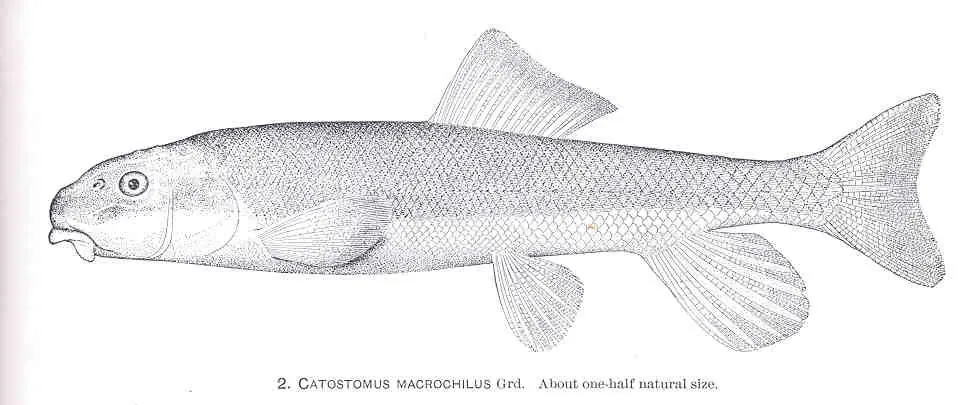
Scientific illustration · reviewed 2026-08-27
Full-lateral, explicitly labeled largescale sucker illustration. Suitable for canonical identity, not editorial habitat use.
Historical U.S. Fish Commission illustration · U.S. Fish Commission / Freshwater and Marine Image Bank · Public Domain — historical government collection Source
Take this somewhere
This page is the record. The reading is what happens when you add water, a season and a temperature to it — that is where the families below get ranked against each other instead of just listed.
Those three links carry the fish and nothing else. No conditions were declared on this page, so none travel, and the link says so rather than sending an empty reading.
The half nobody publishes
What this record does not know
Everything else on this page comes from a named agency or peer-reviewed source. This is the other side of that: the questions a reviewer went looking for an answer to and came back without, and the fields the record leaves empty because filling them would mean guessing.
It is here rather than at the bottom because a page that only shows what it knows is easy to read as a page that knows everything. For Largescale sucker there are 24 of them.
Named by a reviewer
22Somebody looked for this and wrote down that they did not find it.
- Behaviour
Nobody has sourced:
- an adult thermal preference or avoidance study; the temperature numbers reached are entirely reproductive, which is the main reason this record is partial
- whether the documented day-deep / evening-shallow movement corresponds to a feeding-activity rhythm
- winter habitat and overwintering behaviour
- non-spawning social structure (shoal vs. dispersed)
- cold-front / barometric response
- water-level and flow-change response
- angling-pressure response
- predator avoidance and territoriality — not described in any source reached
- Identification
Nobody has sourced:
- regional / vernacular names — no agency source reached supplied a list
- juvenile appearance beyond the statement that the scales are already large and distinct
- sexual dimorphism and breeding tubercles — not described in the sources reviewed
- longevity and age at which maximum size is reached — no source reached gives it, so the field is omitted
- regional colour variation
- a sourced field character separating largescale sucker from bridgelip sucker, which is the most likely real-world confusion through the Columbia basin
- Forage
Nobody has sourced:
- the sources also document algae, diatoms and benthic plant material as a substantial dietary fraction, which the catalog does not carry as a forage class; the catalog classes have been kept and the discrepancy recorded rather than resolved
- a quantified gut-content study for this species; every diet statement reached is a qualitative list
- season-by-season diet shifts — not described in the sources reviewed
- prey-size shifts with growth
- Season
Nobody has sourced:
- winter entry omitted — no sourced description of overwintering habitat or activity
- an adult thermal preference or avoidance study; the catalog's 55–70 °F band is carried but is not corroborated by anything reached
- depth tendency by season, as distinct from the daily vertical shift
- riprap and point structure are not documented for this species in any source reached; the catalog's still-water classes are only partly supported
Absent from the record
2No reviewer wrote a gap here. The field is simply empty, which is its own answer.
- Water temperature
No agency or peer-reviewed temperature band for Largescale sucker was found that a review would accept. The reading runs without one rather than borrowing a number from a related fish.
- Population context
No regional population profile is registered. The species-level reading stands on its own; it does not silently become a local one.
Where the record puts it
Water and range
Flowing water
5 reviewed holding classes- Run
- Pool tail
- Current break
- Deep pool
- Riffle-to-run transition
Stillwater
5 reviewed holding classes- Rocky shoreline
- Drop-off
- Basin
- Inlet
- Shallow flat
DepthPredominantly benthic, moving between shallow substrate feeding zones and deeper pools/basins with season and disturbance.
Moving waterAdults occupy a broad range of river velocities and lake habitats but feed primarily at the substrate; juveniles favor quiet backwaters/lakes.
LightBottom feeding makes light a secondary modifier relative to substrate and available benthic organisms.
Thermal band
Temperature
No reviewed temperature band
Nobody publishes a preferred or active temperature range for Largescale sucker that a review would accept. Borrowing one from a related fish would look like knowledge and behave like a guess, so the reading runs without it and says which parts of the answer that weakens.
How it uses water
Behaviour
Recorded conservatively. The British Columbia summary found largescale sucker at every sampled site in every sampling period and as the third most prevalent species in one large lake at 10–12% of the fish community, which describes ubiquity rather than shoaling. No source reviewed resolves whether non-spawning fish shoal or disperse. Spawning aggregation is conservation context only and is not located here.
An omnivorous bottom forager. Montana summarises the diet as almost any available organism found on the substrate; Idaho Fish and Game describes the fleshy sucker lips as adapted to pick up a wide variety of food off the bottom. Prey is worked off and out of the substrate, not intercepted in the drift.
The one sourced diel statement is a movement, not an activity rate: the British Columbia summary reports largescale sucker undergoing diel migration within the water column, typically moving from deeper water during the day to shallower shoreline areas in the evening. Whether feeding intensity itself follows that shift is not established in any source reviewed, so 'mixed' is entered rather than a nocturnal or crepuscular claim.
Seasonal activityMigratory within river systems, likely for spawning (Oregon Sea Grant); spawning runs April to May in Montana and late March to early June in the British Columbia account. Young rear in quiet backwaters or lakes (Montana). Autumn and winter activity is not resolved by the sources reviewed.
Temperature-driven behaviourOnly reproductive temperatures were reached: spawning begins when streams reach 7–10 °C (British Columbia). Montana documents a real thermal response at the population scale — largescale sucker declined below Libby Dam because colder released water delays spawning. The catalog's 55–70 °F preferred band is not corroborated by any adult thermal-preference or avoidance study in the sources reached and should be treated as unverified.
Depth movementOregon Sea Grant places the species along the river bottom, often in shallow water but occurring to 80 ft (24 m). The British Columbia summary adds the day-deep, evening-shallow vertical and shoreward shift.
Facing the currentIdaho Fish and Game places largescale suckers in the deeper, slow-moving currents of rivers near the bottom. Strong current appears in the sources only in the spawning context — gravel riffles with strong current, or lake margins.
CoverThe British Columbia summary reports a tendency to occur in shallow areas with aquatic macrophytes. That is the only cover statement any source reviewed provides.
Open waterA bottom-oriented fish of river mainstems, backwaters, floodplains, tributaries, lakes and reservoirs; Oregon Sea Grant records use of mainstem, backwater, floodplain and tributary habitat in the same system.
Spawning (conservation context)Spring spawner. Montana gives April to May, spawning in gravel riffles with strong current or along lake margins, with adhesive eggs that hatch within about two weeks and no parental care; British Columbia gives late March to early June, initiation at 7–10 °C, and riffle-and-pool spawning at 0.6–2.0 m over sand-to-cobble substrate. Oregon Sea Grant gives spawning on small gravel bars or sandy submerged beaches with up to 20,000 eggs per female. Maturity is at 4–5 years, some males at 3. Spawning substrate and any spawning-period concentration are excluded from target guidance.
Where the general rule stops
- Cold dam releases can delay spawning timing; calendar alone should not imply reproductive state.
- The species feeds on almost any available substrate organism, so observed forage should outrank a generic assumed diet.
What it can eat
Forage
- Aquatic insects
- Crustaceans
- Worms / annelids
- Mollusks
An omnivorous benthic forager. Montana summarises the diet as almost any available organism found on the substrate; Oregon Sea Grant names snails, worms and other macroinvertebrates alongside algae, diatoms and other benthic plant material; the British Columbia summary names insects, crustaceans and molluscs, the same prey classes it gives for longnose sucker; Idaho Fish and Game names algae and insects through to clams and snails. Capacity is not a current hatch.
- Feeding style
- Opportunistic
- Feeding zone
- Benthic
By life stage
- Young of year
- The British Columbia summary reports young-of-year taking smaller prey including plankton and algae; Montana notes young rear in quiet backwaters or lakes.
- Adult
- Benthic omnivore: insect immatures, amphipods and other crustaceans, snails and small clams, and worms taken off and within the substrate, with a substantial algal and diatom fraction.
Ontogenetic shiftFrom plankton- and algae-scale prey in the first year to bottom-worked invertebrates plus benthic plant material as adults.
Diet capacity is not proof that a hatch or prey event is occurring. Observed current forage still comes from a user observation or Hatch Match.
Through the year
Season
Spring
- Where they sit
- Riffle-to-run and run over gravel in the flowing water adults move into, plus lake margins; pool tails and current breaks adjacent to that water.
- Movement
- Migration within river systems associated with spawning, April to May in Montana and late March to early June farther north.
- Feeding
- Bottom-worked invertebrates and benthic plant material; feeding is a substrate activity throughout.
- Temperature
- Spawning initiates at 7–10 °C in streams. Montana documents colder released water below a dam delaying spawning and depressing the population, so the cold edge matters here in a way it does not for the other suckers in this catalog.
What that changesBottom-contact drift and tight-line drift keep an offering on the substrate where this species feeds, and stationary bait is the other reviewed flowing family that matches a downward-facing benthic omnivore. In stillwater, bottom contact and slow drag. Surface and mid-column families do not match the mouth.
What would count against it
- treating the spawning migration as a location cue
- reading a spawning aggregation as holding water
Spring spawner. Spawning substrate and any spawning-period concentration are excluded from target guidance.
Summer
- Where they sit
- Deep pool, run and current-break water in the deeper, slower current of rivers near the bottom; rocky shoreline, drop-off, shallow flats and basin in lakes and reservoirs, including shallow areas with aquatic macrophytes.
- Depth
- Along the bottom, often shallow, but occurring to about 80 ft. A daily vertical and shoreward shift is documented — deeper water in daylight, shallower shoreline in the evening.
- Current
- Deeper, slower current near the bottom rather than fast water; strong current appears in the sources only in the spawning context.
- Cover
- Shallow areas with aquatic macrophytes are the one cover association documented.
- Light
- Deeper by day, shallower along the shoreline in the evening. This is a documented movement, not a feeding-rate claim.
What that changesBottom-contact drift and tight-line drift in flowing water, stationary bait where the substrate allows; bottom contact and slow drag in stillwater. The mechanics follow the mouth, not the season.
What would count against it
- fishing it as a mid-column or surface feeder
- treating the catalog's 55–70 °F band as a sourced thermal preference — no adult thermal study was reached
- assuming the evening shallow movement implies anything about feeding rate
Fall
- Where they sit
- The same deeper, slower near-bottom river water and lake basins as summer; no autumn habitat shift is documented in the sources reviewed.
- Feeding
- Benthic omnivory continues; no seasonal prey switch is described in the sources reviewed.
What that changesBottom-contact drift, tight-line drift and stationary bait in flowing water; bottom contact and slow drag in stillwater.
What would count against it
- importing a fall-spawning pattern from salmonids — this is a spring spawner
- assuming an autumn habitat shift the sources do not describe
Spawning · Spring
Spawns primarily April–May in strong-current gravel riffles or along lake margins. Spawning migrations and riffles are invalidators, not target layers.
Recorded as conservation context. No spawning site, staging concentration or migration bottleneck is named anywhere in this catalog, because naming one is how a population gets fished out.
Telling it apart
Identification
What to look at
- Large, distinct scales that are obvious even on juveniles; 62–80 medium-to-large scales along the lateral line (Montana).
- Dorsal fin of 13–15 rays on an elongated base — the longest dorsal base of the three Catostomus in this catalog (Montana).
- Short, rounded snout that barely overhangs the mouth (Peace River key).
- Cleft between the lower lips forms a broad inverted 'V'; the lips themselves are large and fleshy, which is what the species name macrocheilus refers to.
- Back and sides dark olive-grey changing abruptly to white or yellowish on the underside — the change is described as abrupt rather than graded (Montana).
- Narrow caudal peduncle carrying a large caudal fin (Oregon Sea Grant).
- Average adult length
- Adults commonly reach about 24 in / 61 cm (Oregon Sea Grant), with juveniles over 4 in.
- Common angling size
- Not reported as a single figure in the sources reviewed. Adult size runs up to roughly 24 in, and state-record fish sit near 9 lb, which brackets the upper end rather than describing a typical fish.
- Typical weight
- About 3 lb / 1.3 kg for adults (Oregon Sea Grant). Montana states maximum size in the state is usually under 5 lb.
- Maximum documented
- State records bracket it: Idaho's certified record is 9.04 lb (Lake Cascade, 2017) and Washington's is 8.96 lb (Columbia River, March 2026). Montana gives its own maximum as usually less than 5 lb.
What it gets confused with
- Longnose sucker
- Scale size separates them at any age: largescale's scales are large and distinct even on juveniles (62–80 in the lateral line), longnose's are small and barely visible on young fish and number more than 85. Largescale's snout is short and rounded and barely overhangs the mouth; longnose's is long and pointed and noticeably does. The lower-lip cleft is a broad inverted 'V' in largescale and deep in longnose. The dorsal fin confirms it: 13–15 rays on a long base in largescale, 9–12 on a short base in longnose. British Columbia reports the two may hybridize and that morphological characters overlap in some specimens, so an intermediate fish should be recorded as unresolved rather than forced into either record.
- White sucker
- These two genuinely cannot be separated on scale count — largescale runs 62–80 in the lateral line and white sucker 60–75 (Montana) or 55–85 (Iowa DNR), so the counts overlap across most of their span. Use the dorsal fin: 13–15 rays on an elongated base in largescale against 11–13 on a short base in white sucker. The lower-lip cleft is a second check, broad in largescale and a narrow inverted 'V' in white sucker, and the caudal peduncle is a third — shallow relative to the dorsal base in largescale, about equal to it in white sucker. Range usually settles it before any of that: largescale is a Pacific-drainage fish, white sucker is native to Atlantic, Arctic, Great Lakes and Mississippi basins and USGS does not record it as established in the Columbia basin. In Montana the two occupy opposite sides of the state — largescale in the western drainages, white sucker in the eastern and northern ones.
- Bridgelip sucker (Catostomus columbianus)
- A Columbia-basin congener that overlaps largescale sucker through much of its range. No agency or peer-reviewed source reached in this review supplies a field character separating the two, so none is invented here — use the jurisdiction's own key, and treat an unresolved Columbia-basin sucker as unresolved.
- Mountain sucker (Catostomus platyrhynchus)
- A size and marking cut in the sources reached: mountain sucker averages only 127–152 mm total length with a largest recorded specimen of 232 mm, and carries a dark green-to-black lateral band and/or five dorsal blotches of fine black pigment. Largescale sucker reaches roughly four times that length and adults are unmarked.
- Shorthead redhorse
- Both are large-scaled, so scale size will not separate them. Redhorse has plicate (folded) lower lips rather than the large papillose lips of largescale sucker, a very short head, a short dorsal fin of 12–13 rays with a strongly concave margin, and a red caudal fin. Largescale sucker has a long-based dorsal of 13–15 rays and no red tail.
What follows from all of that
Presentation families
Flowing water
Bottom-contact drift
Tick or crawl a food form along the substrate through a feeding lane without snagging constantly.
- feel the bottom
- short hops
- reset after hang
- weight just enough
What it asks of the tackle
- Depth control
- High
- Sensitivity
- High
- Casting distance
- Moderate
- Weight range
- 1/8–3/8 oz
- Cover resistance
- Moderate
- Line visibility
- Low
- Retie frequency
- Moderate
Stationary bait
Hold a scent or food form in one feeding station and wait for a fish to move to it.
- anchor the presentation
- keep bait in the pocket
- detect takes without sweeping
- refresh often
What it asks of the tackle
- Depth control
- High
- Sensitivity
- Moderate
- Casting distance
- Short
- Weight range
- 1/4–1 oz
- Cover resistance
- High
- Line visibility
- Moderate
- Retie frequency
- High
Pulse / jig
Lift and drop a compact bait so it occupies a pocket, seam, or head without leaving the water column.
- short lift
- controlled drop
- stay in the pocket
- repeat on the same piece
What it asks of the tackle
- Depth control
- High
- Sensitivity
- High
- Casting distance
- Short to moderate
- Weight range
- 1/8–3/8 oz
- Cover resistance
- Moderate
- Line visibility
- Low
- Retie frequency
- High
Stillwater
Bottom contact
Keep a bait on or just above the substrate along a break, flat, or inside a weed edge.
- feel bottom
- drag or hop
- pause on the break
- stay in contact
What it asks of the tackle
- Depth control
- High
- Sensitivity
- High
- Casting distance
- Moderate
- Weight range
- 1/8–1/2 oz
- Cover resistance
- High
- Line visibility
- Low
- Retie frequency
- High
Slow drag
Move a bait along the bottom slowly enough that it stays in the feeding layer of inactive fish.
- continuous contact
- very slow travel
- pause at changes in bottom
- do not hop out of the zone
What it asks of the tackle
- Depth control
- High
- Sensitivity
- High
- Casting distance
- Moderate
- Weight range
- 1/8–3/8 oz
- Cover resistance
- Moderate
- Line visibility
- Low
- Retie frequency
- Moderate
Live / natural bait suspension
Present a natural food form with enough life or scent to hold in a station without looking mechanical.
- keep it alive or fresh
- match the holding depth
- minimize hardware bulk
- detect without pulling it away
What it asks of the tackle
- Depth control
- High
- Sensitivity
- High
- Casting distance
- Short to moderate
- Weight range
- As light as conditions allow
- Cover resistance
- Moderate
- Line visibility
- Low
- Retie frequency
- High
What moves them for this fish
Reviewed rules that push particular families up when the conditions match. Each one names the conditions it needs and why it exists, so you can disagree with it.
Largescale sucker feed broadly on substrate organisms; current delivery matters in rivers without implying spawning-riffle targeting.
When
Flowing water · Aquatic insects, Crustaceans, Worms / annelids, Mollusks
Moves up
Bottom-contact drift, Stationary bait, Pulse / jig
Reviewed 2026-08-27
Lake largescale sucker remain generalized benthic feeders rather than pelagic forage followers.
When
Stillwater · Aquatic insects, Crustaceans, Worms / annelids, Mollusks
Moves up
Bottom contact, Slow drag, Live / natural bait suspension
Reviewed 2026-08-27
Where every sentence came from
Sources
Agency
Used for identification; behaviour; forage; season. Read 2026-08-30, next check 2026-12-04.
Agency
Used for identification; behaviour; forage; season. Read 2026-08-30, next check 2026-12-04.
Agency
Used for identification; behaviour; forage; season. Read 2026-08-30, next check 2026-12-04.
Agency
Used for identification; season. Read 2026-08-30, next check 2026-12-04.
Agency
Montana Field Guide Largescale Sucker species account
Used for habitat, thermal band and presentation families. Read 2026-08-27, next check 2026-11-27.
Agency
Used for identification. Read 2026-08-30, next check 2026-12-04.
Agency
Used for identification. Read 2026-08-30, next check 2026-12-04.
Agency
Used for identification. Read 2026-08-30, next check 2026-12-04.
Synthesis
Oregon Sea Grant (Oregon State University), Willamette River Field Guide — Largescale Sucker
Used for identification; behaviour; forage; season. Read 2026-08-30, next check 2026-12-04.
Synthesis
Used for identification. Read 2026-08-30, next check 2026-12-04.
A source with no link predates the rule that one has to carry a URL. It is still a real citation and still checkable; it just takes a search rather than a click, and that is worth knowing before you rely on it.