Other freshwater · Freshwater
White sturgeon
Acipenser transmontanus
Long-lived western North American sturgeon of large river, estuarine, and connected lake systems; population status varies sharply by basin.
Also called pacific sturgeon.
- Flowing water
- Stillwater
- Regulated context
- 4 of 4 overlays reviewed
- Reviewed 2026-08-27
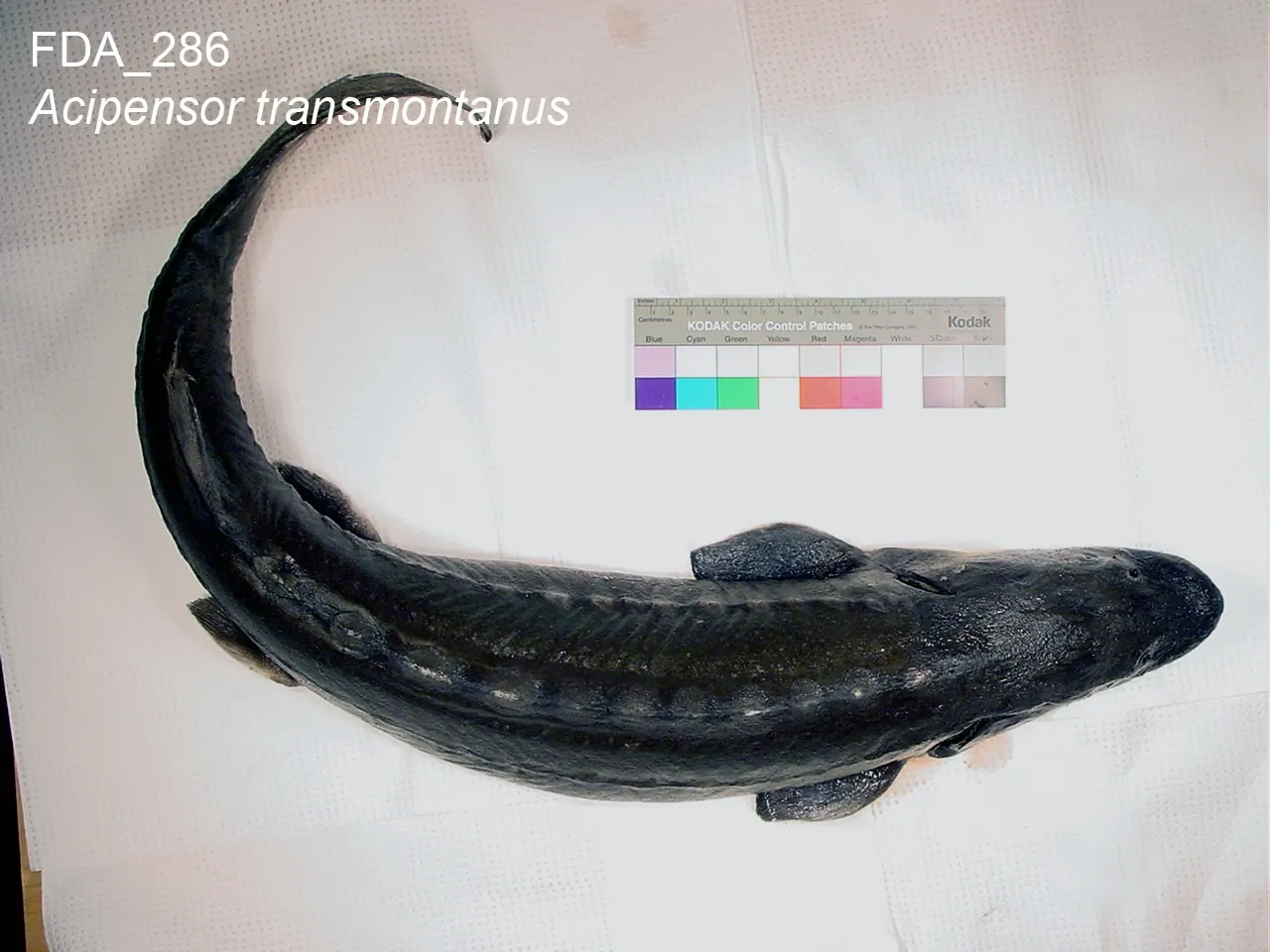
Specimen photograph · reviewed 2026-08-27
Federal reference-identification photograph. Population and conservation status are never inferred from morphology alone.
U.S. Food and Drug Administration / J. Deeds · U.S. Food and Drug Administration Reference Standard Sequence Library · Public Domain — U.S. federal government work Source
Before you target this fish
Regulated context — check the rules for the exact water
Where this applies Western North American white-sturgeon jurisdictions; legal opportunity and population status differ sharply among basins.
The reviewed context, unedited
Regulated-context record. Verify season, retention/catch-and-release status, size/slot rules, tags, legal methods, and protected populations. Kootenai context must be explicitly declared.
Rules for this fish change at a state line and sometimes inside one. Check the ones that apply to the exact water you are standing on before you act on anything here — this record is biology, not permission.
Take this somewhere
This page is the record. The reading is what happens when you add water, a season and a temperature to it — that is where the families below get ranked against each other instead of just listed.
Those three links carry the fish and nothing else. No conditions were declared on this page, so none travel, and the link says so rather than sending an empty reading.
The half nobody publishes
What this record does not know
Everything else on this page comes from a named agency or peer-reviewed source. This is the other side of that: the questions a reviewer went looking for an answer to and came back without, and the fields the record leaves empty because filling them would mean guessing.
It is here rather than at the bottom because a page that only shows what it knows is easy to read as a page that knows everything. For White sturgeon there are 22 of them.
Named by a reviewer
20Somebody looked for this and wrote down that they did not find it.
- Behaviour
Nobody has sourced:
- an adult feeding-activity diel rhythm; the day/night difference reached is a depth shift in juveniles and subadults in one system
- an adult thermal preference or avoidance study - the temperature numbers reached are reproductive
- territoriality and aggression - not described in any source reached
- cold-front / barometric response
- water-level and flow-change response outside the spawning and incubation context
- angling-pressure response
- cover use by adults
- Identification
Nobody has sourced:
- regional / vernacular names - no agency source reached supplied a list
- juvenile appearance as a distinct field character
- sexual dimorphism outside of size-at-maturity
- spawning coloration
- the ventral scute count disagrees between Fisheries and Oceans Canada (4-8) and Montana (9-12) and was not resolved
- a single continent-wide typical weight
- Forage
Nobody has sourced:
- quantified season-by-season adult diet - the seasonal statements reached are qualitative
- diet of landlocked populations specifically, as distinct from anadromous and impounded ones
- worms_annelids is carried in the catalog and named in the agency accounts only as an unresolved 'worms' category; no study reached quantifies it
- Season
Nobody has sourced:
- winter habitat and activity are described only in general terms in the sources reached - no depth, temperature or duration numbers
- seasonal habitat use of landlocked populations, which is likely to differ from the lower Columbia material this calendar leans on
- stillwater (lake and reservoir) seasonal structure, which the catalog carries but which no source reached describes season by season
- a seasonal feeding-intensity or thermal-activity curve for adults
Absent from the record
2No reviewer wrote a gap here. The field is simply empty, which is its own answer.
- Water temperature
No agency or peer-reviewed temperature band for White sturgeon was found that a review would accept. The reading runs without one rather than borrowing a number from a related fish.
- Population context
No regional population profile is registered. The species-level reading stands on its own; it does not silently become a local one.
Where the record puts it
Water and range
Flowing water
4 reviewed holding classes- Deep pool
- Run
- Current break
- Pool tail
Stillwater
5 reviewed holding classes- Basin
- Drop-off
- Inlet
- Outlet
- Riprap
DepthPredominantly bottom-associated in deep channels, pools, and connected lake/estuarine habitat; movement can be extensive and seasonal.
Moving waterLarge adults are bottom-oriented but use substantial river current and deep channel structure rather than slack-water-only habitat.
LightLow visibility is not a major barrier because barbels and nonvisual senses support benthic foraging; light is secondary to current, depth, substrate, and prey.
Thermal band
Temperature
No reviewed temperature band
Nobody publishes a preferred or active temperature range for White sturgeon that a review would accept. Borrowing one from a related fish would look like knowledge and behave like a guess, so the reading runs without it and says which parts of the answer that weakens.
How it uses water
Behaviour
Not a schooling species. Shared use of depositional bottom habitat is what the sources describe rather than shoaling. Spawning-period concentrations are treated as conservation context here and are neither located nor described.
A benthic suction feeder. The Canadian recovery strategy describes highly sensitive taste receptors on the barbels near the mouth locating prey in dark water, with the toothless protrusible mouth taking food by suction. Montana's account summarises the result as consuming almost any available organism on the bottom. Adults add fish where fish are available.
The one quantified diel pattern reached is vertical, not activity-based: the Oregon conservation plan reports juvenile and subadult white sturgeon in the lower Columbia averaging about 69 ft depth in daylight and about 49 ft at night. The Canadian recovery strategy notes nocturnal drift in early larval life. No source reached establishes an adult feeding-activity rhythm, so this class is entered as the least-committing value.
Seasonal activityThe Canadian recovery strategy describes localised, volitional movement in July-September with frequent short forays between shallow and deep water to feed; reduced activity and use of deeper, lower-velocity water in winter; spring and summer movement tied to staging, spawning and feeding; and fall movement following feeding opportunities. The Oregon plan adds that in the lower Columbia immature fish move upstream in fall and downstream in spring.
Temperature-driven behaviourThe best-sourced temperature numbers are reproductive rather than behavioural. The Oregon plan gives spring spawning at 50-64 F with optimal incubation near 57 F; the Northwest Power and Conservation Council gives spawning from about 50 F with a peak at 54-57 F in the lower Columbia and 47-54 F in the Kootenai, and reports embryo mortality at 8 C and at 20 C with 98% mortality at 18 C and above. The catalog's 50-68 F preferred band is consistent with those reproductive numbers but is not itself corroborated by an adult thermal-preference study in the sources reached.
Depth movementWide. The Canadian recovery strategy gives juvenile habitat across 2-58 m; the Oregon plan gives juveniles and subadults across 6-131 ft with a day-deep, night-shallow vertical shift. Shallower use in spring and summer alternates with short feeding forays into deeper water; winter use shifts to deeper, lower-velocity areas.
Facing the currentJuvenile habitat in the Canadian recovery strategy runs 0.1-1.2 m/s mean column velocity; the Oregon plan describes juveniles and subadults preferring low-velocity sandy habitat. High-velocity water in the sources reached is associated with spawning rather than with holding or feeding.
ClarityA barbel-and-taste feeder rather than a sight feeder, which the Canadian recovery strategy ties explicitly to locating prey in dark water. The Oregon plan notes spawning typically occurs at higher turbidity. No source reached describes a feeding or habitat response to clarity outside those contexts.
Open waterFacultatively anadromous where ocean access exists. The Northwest Power and Conservation Council reports lower Columbia fish recaptured in 23 separate locations outside the Columbia basin, including systems roughly 310 miles north and 560 miles south, and seasonal movements exceeding 100 km within systems. Landlocked populations do none of this and are confined to their own system.
Predator avoidanceEarly life stages hide in interstitial spaces among gravel and coarse substrate, which the Canadian recovery strategy names as the primary larval survival strategy. Nothing comparable is described for adults.
Spawning (conservation context)Spring spawner. Broadcast spawning occurs during the freshet over boulder, cobble and coarse gravel in deep, swift water - the Oregon plan gives depths exceeding 20 ft at average velocities of 1.1-5.6 mph, and the Canadian recovery strategy gives mean column velocities of 0.5-2.5 m/s. Temperature thresholds run from about 8.5 C to 14 C across populations. Females spawn only every 4-6 years and males every 2-4, so a small fraction of any population is reproductively active in a given year. Spawning substrate, staging concentrations and migration bottlenecks are conservation context and are neither located nor described in this record.
Where the general rule stops
- White sturgeon can live for many decades and local harvest/catch rules vary sharply; verify jurisdiction before any field action.
- The Kootenai River population is federally endangered. If that population is explicitly declared, this is context only — no presentation guidance.
What it can eat
Forage
- Mollusks
- Crustaceans
- Worms / annelids
- Small forage fish
- Larger prey fish
- Eggs
A bottom feeder that finds prey with taste receptors on its barbels and takes it by suction. Montana's account summarises the adult diet as almost any available organism, naming fish, crustaceans, mollusks, worms and plant material; Oregon Sea Grant names clams, mussels, crayfish, worms and fish eggs for juveniles and smelt, anchovies, lamprey, shad and salmon for adults; the Canadian recovery strategy names aquatic insects, isopods, mysids, clams, snails, small fishes and fish eggs for juveniles and states that adults feed predominantly on fish, particularly migratory salmonids where available, with crayfish and chironomids also taken. Capacity is not a current forage event.
- Feeding style
- Opportunistic
- Feeding zone
- Benthic
By life stage
- Young of year
- Amphipods (Corophium species), copepods and dipteran larvae after the switch to exogenous feeding at roughly 25-30 days; the Northwest Power and Conservation Council reports amphipods at 98% of the age-0 diet in some studies.
- Juvenile
- Aquatic insects, isopods, mysids, clams, snails, small fishes and fish eggs. In the upper Columbia the introduced opossum shrimp Mysis relicta became the most common prey of 1-2 year old juveniles.
- Adult
- Predominantly fish where fish are available - migratory salmonids, lamprey, shad and smelt-scale forage - with crayfish and chironomids still taken.
Prey sizePrey size tracks gape and life stage. The catalog's larger_prey_fish class belongs to large adults with ocean or large-river access, not to juveniles.
Ontogenetic shiftA clear shift from amphipod- and insect-scale benthic invertebrates in the first years to a fish-dominated adult diet where forage fish and migratory salmonids are available. Landlocked populations without those runs stay closer to the invertebrate end.
SubstitutionsStrongly system-specific. Where anadromous runs are present the adult diet is dominated by them; the Canadian recovery strategy ties fall movement to feeding opportunities created by spawning kokanee. In impounded and landlocked systems the diet stays benthic and invertebrate-led, and the upper Columbia example shows an introduced mysid becoming the dominant juvenile prey.
Diet capacity is not proof that a hatch or prey event is occurring. Observed current forage still comes from a user observation or Hatch Match.
Through the year
Season
Winter
- Where they sit
- Deep pool and current-break water in rivers; basin and drop-off in lakes and reservoirs. The Canadian recovery strategy describes reduced activity and use of deeper, lower-velocity areas.
- Depth
- Deeper than in spring and summer, in low-velocity water.
- Movement
- Reduced activity; localised.
What that changesWhere a jurisdiction authorises hook-and-line angling for white sturgeon at all - many do not, and the Kootenai population is ESA-listed - the feeding mechanics point only to bottom families: stationary bait or bottom-contact drift in flowing water, bottom contact or slow drag in stillwater. The fish finds food with barbel taste receptors on the substrate and takes it by suction, so anything held off the bottom is outside its feeding mode. Check the water's own rules first.
What would count against it
- assuming an open season or a legal size - jurisdictional rules govern and differ by pool and by river
- treating a scarcity of winter data as evidence of a winter pattern
Spring
- Where they sit
- Deep, swift coarse-substrate water during the freshet for spawning fish; shallower depositional habitat for fish that are not spawning. Immature fish in the lower Columbia move downstream in spring.
- Movement
- Spawning migration is the dominant spring movement in the sources reached, alongside downstream movement of immature fish.
- Temperature
- Spawning at 50-64 F with optimal incubation near 57 F (Oregon plan); a peak at 54-57 F in the lower Columbia and 47-54 F in the Kootenai (Northwest Power and Conservation Council). Embryo mortality reaches 98% at 18 C and above.
What would count against it
- reading the spawning migration as an opportunity
- using spawning substrate as holding water
Spring is the spawning period. Females spawn only every 4-6 years and males every 2-4, so the reproductively active fraction of a population is small in any year and disturbance costs are high. Spawning areas, staging concentrations and migration bottlenecks are not located or described in this record, and no presentation implication is given for this season. Some jurisdictions close areas seasonally to protect spawning fish.
Summer
- Where they sit
- Depositional bottom where food settles - basin, drop-off and run over sand and fine substrate; deep pool and current-break water in rivers. The Canadian recovery strategy describes localised movement with frequent short forays between shallow and deep water to feed.
- Depth
- Shallower overall than winter, with repeated short trips into deeper water. The Oregon plan gives juveniles and subadults across 6-131 ft, averaging about 69 ft in daylight and about 49 ft at night.
- Forage
- Benthic invertebrates for juveniles - amphipods, mysids, insects, clams and snails - with adults taking fish where fish are available.
- Light
- A day-deep, night-shallow vertical shift is documented for juveniles and subadults in the lower Columbia. This is a depth statement, not a feeding-rate statement.
What that changesSame mechanical constraint and the same jurisdictional gate as winter: where angling for the species is authorised, only bottom families match a barbel-and-suction benthic feeder - stationary bait or bottom-contact drift in flowing water, bottom contact or slow drag in stillwater.
What would count against it
- treating this as a mid-water or sight-feeding fish
- assuming an open season - jurisdictional rules govern
Fall
- Where they sit
- Depositional bottom and deep pool water; the Canadian recovery strategy ties fall movement to feeding opportunity rather than to a habitat change. In the lower Columbia immature fish move upstream in fall.
- Movement
- Feeding-driven movement; upstream movement of immature fish in the lower Columbia.
- Forage
- Where anadromous or adfluvial runs occur, the adult diet shifts toward them. This is documented feeding capacity, not a declared event.
What that changesUnchanged by season: bottom families only - stationary bait or bottom-contact drift in flowing water, bottom contact or slow drag in stillwater - and only where the jurisdiction authorises angling for the species. Season dates, slot limits and closures are set locally and are not inferable from this record.
What would count against it
- assuming an egg or carcass event from the calendar alone
- assuming an open season - jurisdictional rules govern
Spawning · Spring, Early summer
Spawning occurs in large-river current over suitable substrate; spawning reaches and endangered population habitat are excluded from target guidance.
Recorded as conservation context. No spawning site, staging concentration or migration bottleneck is named anywhere in this catalog, because naming one is how a population gets fished out.
Telling it apart
Identification
What to look at
- Barbels sit closer to the tip of the snout than to the mouth. This is the primary separation from green sturgeon, whose barbels sit midway between mouth and snout tip or nearer the mouth (Fisheries and Oceans Canada).
- Five rows of bony scutes. Fisheries and Oceans Canada gives 11-14 in the dorsal row, 38-48 in the lateral row and 4-8 in the ventral rows; Montana's account gives 11-14 dorsal, 36-48 lateral and 9-12 ventral. The ventral counts disagree between those two sources, so treat the lateral row (high thirties to high forties) as the workable count.
- No scutes behind the dorsal fin. Green sturgeon carries 1-2 there (Oregon Sea Grant).
- Vent sits near the tail rather than between the pelvic fins (Oregon Sea Grant).
- Three to four small pairs of pre-anal plates and one to two post-anal plates (Fisheries and Oceans Canada).
- Body is scaleless apart from the scute rows; mouth is toothless and works by suction.
- Average adult length
- Population-dependent. Washington's account gives fish growing to more than 10 ft; Oregon Sea Grant notes modern fish rarely exceed about 6 ft. In the lower Columbia the Oregon plan puts male maturity near 54 in fork length and female maturity near 65 in fork length. Montana's landlocked account gives fish to about 6 ft.
- Common angling size
- Set by regulation rather than by biology, and it differs by water. Where retention is allowed at all it is typically inside a fork-length slot with oversize fish released - the Oregon conservation plan describes a 38-54 in fork-length sport slot for the period it covers, with a one-fish daily and five-fish annual limit, and a catch-and-release fishery on oversize fish above that slot. Washington reports no recreational retention in several coastal and Puget Sound waters and catch-and-release only in selected rivers. Any size expectation must come from the current local rule set, not from this record.
- Typical weight
- Not reported as a single figure in the sources reviewed; weight tracks length and population. Montana gives landlocked Kootenai fish to over 80 lb with no reports over 200 lb, and Kootenay Lake fish exceeding 350 lb.
- Maximum documented
- Oregon Sea Grant gives a historical maximum near 20 ft and over 1,500 lb; the Canadian recovery strategy reports Fraser River fish over 6 m. Washington gives growth to more than 10 ft and hundreds of pounds. Modern fish are far smaller than the historical maxima.
- Longevity
- The Northwest Power and Conservation Council gives fish living to 82 years and occasionally beyond 100; Washington and Montana both give individuals to 100 years or older. Maturity is very late - males at roughly 10-20 years and females at 15-30 years - and females spawn only every 4-6 years, males every 2-4.
What it gets confused with
- Green sturgeon (Acipenser medirostris)
- The only sturgeon congener sharing Pacific drainages with white sturgeon. Barbels are midway between the mouth and the snout tip, or closer to the mouth, where white sturgeon's sit closer to the snout tip. Scute counts are much lower: 8-11 dorsal, 23-30 lateral, 1-4 ventral, against white sturgeon's 11-14, 38-48, 4-8. Green sturgeon also carries 1-2 scutes behind the dorsal fin, which white sturgeon lacks, and has olive-green colour with yellowish, sharp-tipped scutes rather than grey with a clean white belly.
- Lake sturgeon
- A separate catalog record and a separate set of drainages - lake sturgeon is a Great Lakes, Mississippi and St. Lawrence species, white sturgeon a Pacific-drainage species. The sources reached do not supply a shared field key for the two; where a fish must be assigned, use the jurisdiction's own key.
What follows from all of that
Presentation families
Flowing water
Stationary bait
Hold a scent or food form in one feeding station and wait for a fish to move to it.
- anchor the presentation
- keep bait in the pocket
- detect takes without sweeping
- refresh often
What it asks of the tackle
- Depth control
- High
- Sensitivity
- Moderate
- Casting distance
- Short
- Weight range
- 1/4–1 oz
- Cover resistance
- High
- Line visibility
- Moderate
- Retie frequency
- High
Bottom-contact drift
Tick or crawl a food form along the substrate through a feeding lane without snagging constantly.
- feel the bottom
- short hops
- reset after hang
- weight just enough
What it asks of the tackle
- Depth control
- High
- Sensitivity
- High
- Casting distance
- Moderate
- Weight range
- 1/8–3/8 oz
- Cover resistance
- Moderate
- Line visibility
- Low
- Retie frequency
- Moderate
Stillwater
Bottom contact
Keep a bait on or just above the substrate along a break, flat, or inside a weed edge.
- feel bottom
- drag or hop
- pause on the break
- stay in contact
What it asks of the tackle
- Depth control
- High
- Sensitivity
- High
- Casting distance
- Moderate
- Weight range
- 1/8–1/2 oz
- Cover resistance
- High
- Line visibility
- Low
- Retie frequency
- High
Slow drag
Move a bait along the bottom slowly enough that it stays in the feeding layer of inactive fish.
- continuous contact
- very slow travel
- pause at changes in bottom
- do not hop out of the zone
What it asks of the tackle
- Depth control
- High
- Sensitivity
- High
- Casting distance
- Moderate
- Weight range
- 1/8–3/8 oz
- Cover resistance
- Moderate
- Line visibility
- Low
- Retie frequency
- Moderate
Stationary bait
Hold a scent or food form in one feeding station and wait for a fish to move to it.
- anchor the presentation
- keep bait in the pocket
- detect takes without sweeping
- refresh often
What it asks of the tackle
- Depth control
- High
- Sensitivity
- Moderate
- Casting distance
- Short
- Weight range
- 1/4–1 oz
- Cover resistance
- High
- Line visibility
- Moderate
- Retie frequency
- High
What moves them for this fish
Reviewed rules that push particular families up when the conditions match. Each one names the conditions it needs and why it exists, so you can disagree with it.
White sturgeon are strongly bottom-oriented in large-river current; regulation and population status continue to gate whether guidance may be used.
When
Flowing water · Deep pool, Run, Current break, Pool tail
Moves up
Stationary bait, Bottom-contact drift
Reviewed 2026-08-27
Lake/impounded white sturgeon remain substrate-oriented; this delta does not relax jurisdiction or endangered-population policy.
When
Stillwater · Basin, Drop-off, Inlet, Outlet, Riprap
Moves up
Bottom contact, Slow drag, Stationary bait
Reviewed 2026-08-27
Where every sentence came from
Sources
Agency
Used for identification; behaviour; forage; season. Read 2026-08-30, next check 2026-11-14.
Agency
Used for identification; behaviour; forage; season. Read 2026-08-30, next check 2026-11-14.
Agency
Used for identification; behaviour; forage; season. Read 2026-08-30, next check 2026-11-14.
Agency
Used for identification; behaviour; forage; season. Read 2026-08-30, next check 2026-11-14.
Agency
Used for identification; behaviour; season. Read 2026-08-30, next check 2026-11-14.
Agency
U.S. Fish and Wildlife Service White Sturgeon species profile
Used for habitat, thermal band and presentation families. Read 2026-08-27, next check 2026-11-27.
Agency
U.S. Fish and Wildlife Service Kootenai River white sturgeon recovery materials
Used for habitat, thermal band and presentation families. Read 2026-08-27, next check 2026-11-27.
Agency
Used for identification. Read 2026-08-30, next check 2026-11-14.
Agency
USFWS species profile: White Sturgeon (Acipenser transmontanus) — Kootenai River population
Used for season. Read 2026-08-30, next check 2026-11-17.
Agency
Used for season. Read 2026-08-30, next check 2026-11-17.
Synthesis
Oregon Sea Grant (Oregon State University), Willamette River Field Guide — White Sturgeon
Used for identification; forage. Read 2026-08-30, next check 2026-11-14.
A source with no link predates the rule that one has to carry a URL. It is still a real citation and still checkable; it just takes a search rather than a click, and that is worth knowing before you rely on it.