Freshwater predator · Freshwater
Alligator gar
Atractosteus spatula
Giant long-lived gar native to Mississippi/Gulf drainages and Gulf coastal plain; strongly associated with large rivers, floodplains, backwaters, bayous, and connected lakes.
Also called gator gar, giant gar.
- Flowing water
- Stillwater
- Regulated context
- 4 of 4 overlays reviewed
- Reviewed 2026-08-27
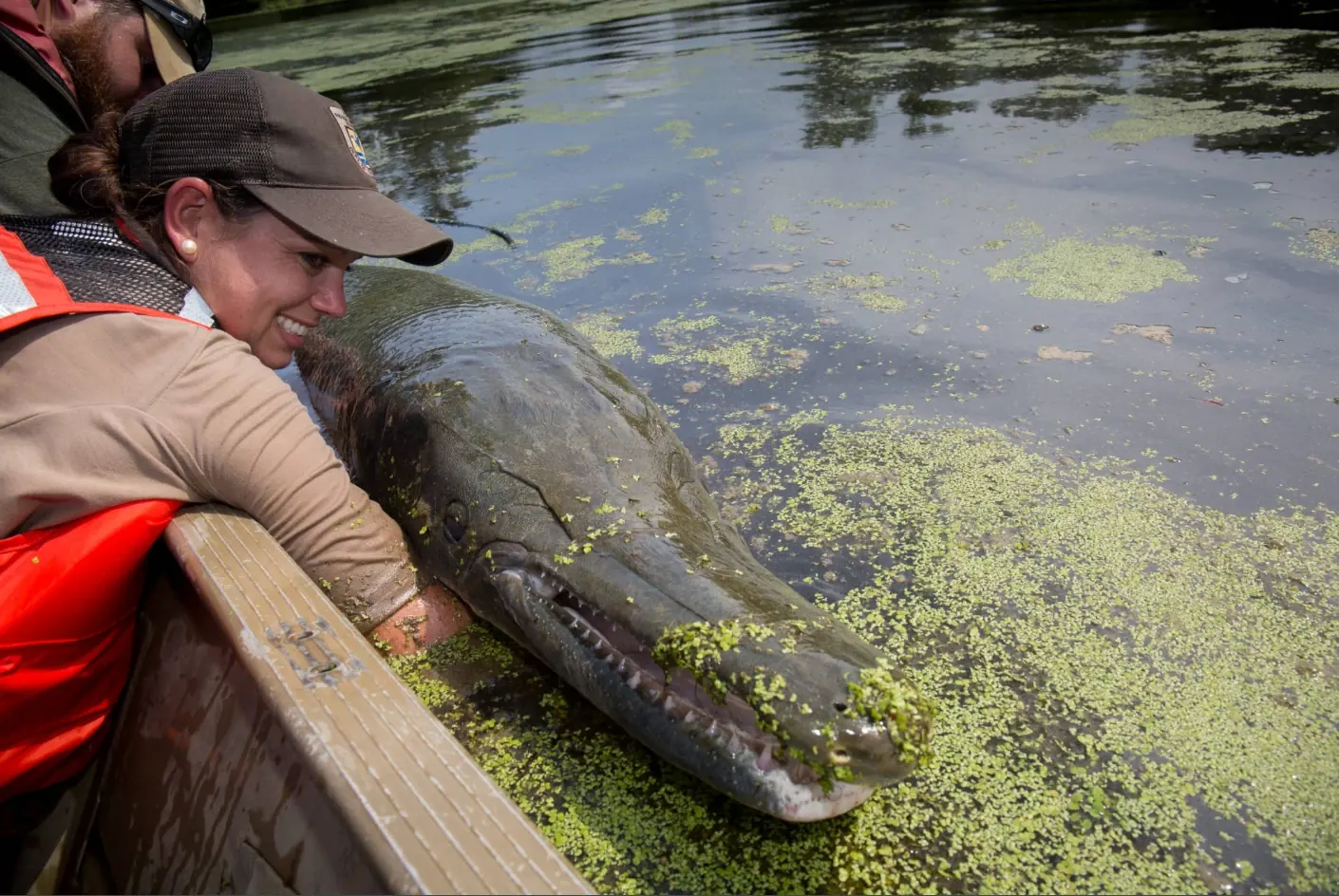
Field photograph · reviewed 2026-08-27
Authoritative full alligator gar field photograph. Human/boat context makes it a canonical fallback; replace only with a cleaner equally authoritative whole-fish image.
Ryan Hagerty / USFWS · U.S. Fish and Wildlife Service · Public Domain — U.S. federal government work Source
Before you target this fish
Regulated context — check the rules for the exact water
Where this applies Mississippi/Gulf drainage jurisdictions; harvest and trophy-fish protections vary substantially.
The reviewed context, unedited
Regulated-context record. Verify current legal methods, harvest rules, and local conservation status; flooded spawning habitat and spawning concentrations are not target layers.
Rules for this fish change at a state line and sometimes inside one. Check the ones that apply to the exact water you are standing on before you act on anything here — this record is biology, not permission.
Take this somewhere
This page is the record. The reading is what happens when you add water, a season and a temperature to it — that is where the families below get ranked against each other instead of just listed.
Those three links carry the fish and nothing else. No conditions were declared on this page, so none travel, and the link says so rather than sending an empty reading.
The half nobody publishes
What this record does not know
Everything else on this page comes from a named agency or peer-reviewed source. This is the other side of that: the questions a reviewer went looking for an answer to and came back without, and the fields the record leaves empty because filling them would mean guessing.
It is here rather than at the bottom because a page that only shows what it knows is easy to read as a page that knows everything. For Alligator gar there are 12 of them.
Named by a reviewer
10Somebody looked for this and wrote down that they did not find it.
- Behaviour
Nobody has sourced:
- species-specific angling-pressure response beyond general cover/light notes
- cold-front / barometric response with primary-source support
- system-specific movement literature without naming waters
- Identification
Nobody has sourced:
- longevity as a structured field
- Forage
Citation gap: “State and USFWS alligator gar life-history and floodplain recruitment literature” describes a source category rather than one resolvable document.
Nobody has sourced:
- complete regional forage-substitution table
- finer month-by-month diet inside a season, which is waterbody-specific
- Season
Citation gap: “State and USFWS alligator gar life-history and floodplain recruitment literature” describes a source category rather than one resolvable document.
Nobody has sourced:
- managed-population calendars
- month-by-month location changes inside a season, which are waterbody-specific
Absent from the record
2No reviewer wrote a gap here. The field is simply empty, which is its own answer.
- Water temperature
No agency or peer-reviewed temperature band for Alligator gar was found that a review would accept. The reading runs without one rather than borrowing a number from a related fish.
- Population context
No regional population profile is registered. The species-level reading stands on its own; it does not silently become a local one.
Where the record puts it
Water and range
Flowing water
5 reviewed holding classes- Deep pool
- Eddy
- Side channel
- Current break
- Submerged wood
Stillwater
6 reviewed holding classes- Basin
- Inlet
- Wood
- Weed edge
- Shallow flat
- Drop-off
DepthLarge fish can use deep main-channel pools and open water but shift into shallow connected habitat under favorable seasonal conditions.
Moving waterUses large-river pools, backwaters, side channels, and floodplain-connected habitat; generally favors lower-velocity feeding zones over the fastest current core.
LightSight and vibration-based predation can occur day or night; surface air-gulping is respiratory behavior and must not be interpreted as surface feeding.
Thermal band
Temperature
No reviewed temperature band
Nobody publishes a preferred or active temperature range for Alligator gar that a review would accept. Borrowing one from a related fish would look like knowledge and behave like a guess, so the reading runs without it and says which parts of the answer that weakens.
How it uses water
Behaviour
Large, typically solitary ambush/patrol predator. Grouping on a map would be a hotspot product and is refused.
Piscivorous ambush predator. Air-breathing is occupancy biology, not a feeding cue. USFWS notes family-level air breathing and lateral movements into connected water — without naming those waters.
Large-bodied visual predator capable of daylight feeding; low light and stain can reduce exposure.
Temperature-driven behaviourWarm, large-river and connected backwater fish. Low dissolved oxygen is less of a barrier than for many other large fishes because gars gulp air.
Depth movementCan occupy deeper channel water and still make shallow movements. Juvenile habitat is more vegetated and is a confusion risk with spotted gar, not a targeting layer.
Facing the currentLarge-river margins, oxbows, and slow connected water rather than high-gradient current.
CoverLarge woody and vegetated edges in connected off-channel water, plus channel margins. Exact sites are not listed.
Open waterAdults can patrol open large-river water; this is still not a pelagic forage-school species like striped bass.
Predator avoidanceSize, armor, and turbid large-river water.
Spawning (conservation context)Spawning and nursery habitat are conservation context only. Alligator gar is jurisdiction-gated in this catalog. Eggs of gars are toxic. No aggregation locations are published.
Where the general rule stops
- Air-gulping at the surface is not feeding evidence.
- Long lifespan, late maturity, episodic recruitment, and special harvest rules make local regulation/conservation context essential.
What it can eat
Forage
- Larger prey fish
- Small forage fish
- Crustaceans
- Amphibians
Apex freshwater piscivore. Adults take large fish; crustaceans and amphibians are secondary. Surface air-gulping is respiratory. Eggs and flooded spawning habitat are invalidators, not forage or target layers.
- Feeding style
- Specialized
- Feeding zone
- Mixed
Through the year
- Winter
- Deep main-channel pools; reduced feeding.
- Spring
- Fish in connected habitat as water warms. Flooded vegetated spawning is an invalidator.
- Summer
- Large fish in pools, backwaters, and open water.
- Fall
- Remaining large-fish prey as water cools.
By life stage
- Young of year
- Invertebrates and tiny fish in vegetated inundated habitat.
- Juvenile
- Small fish, crustaceans, and amphibians.
- Adult
- Larger prey fish as the energetic core.
Prey sizeAdults regularly take fish far larger than other gar diets. This is size ecology, not a sport rating.
Ontogenetic shiftInvertebrates in YOY to large-fish piscivory in adults.
SubstitutionsRiver fish assemblages vs reservoir forage. Do not invent a lure-family diet from this prey list.
Diet capacity is not proof that a hatch or prey event is occurring. Observed current forage still comes from a user observation or Hatch Match.
Through the year
Season
Winter
- Where they sit
- Deep main-channel pools.
What that changesStationary-bait and live-natural-bait suspension.
Spring
- Where they sit
- Connected side channels and backwaters as water warms.
What that changesStationary-bait and pulse-jig in lawful, non-closed water.
What would count against it
- using inundated spawning habitat as a target class
Successful spawning is linked to warm seasonal flooding and vegetated inundated habitat. Flooded spawning habitat is an invalidator, not a target map.
Summer
- Where they sit
- Deep pools, eddies, and open connected water.
- Light
- Surface air-gulping is respiratory behavior and must not be interpreted as surface feeding.
What that changesHorizontal retrieve, stop-and-go, and subsurface slow-roll.
Fall
- Where they sit
- Deep pools and drop-offs as water cools.
What that changesStationary-bait and live-natural-bait suspension.
Spawning · Spring, Early summer, Summer
Successful spawning is linked to warm seasonal flooding and vegetated inundated habitat. Flooded spawning habitat is an invalidator, not a target map.
Recorded as conservation context. No spawning site, staging concentration or migration bottleneck is named anywhere in this catalog, because naming one is how a population gets fished out.
Telling it apart
Identification
What to look at
- TPWD: distinct short, wide snout, alligator-like from above; much wider than longnose at the same length.
- Two rows of teeth in the upper jaw — unique among the common U.S. gars.
- FWC: torpedo body, diamond ganoid scales, fins set far back, rounded caudal fin.
- TPWD: juveniles can be confused with spotted gar without close examination.
- Average adult length
- Adults of several feet are typical where the species persists; this is not a panfish-scale gar.
- Common angling size
- 4–6 ft in fisheries where harvest is legal and populations persist.
- Typical weight
- Tens to more than 100 lb for large adults; highly system-dependent.
- Maximum documented
- TPWD: up to 10 ft and over 300 lb; Texas rod-and-reel record 279 lb; cited world record 327 lb. FWC: 8 ft and over 300 lb. Kentucky DFWR: to 9 ft and 300 lb. Use as documented maxima, not a typical fish.
What it gets confused with
- Longnose gar
- Longnose: needle snout more than twice the rest of the head, one tooth row, slimmer body.
- Spotted gar
- Spotted gar are much smaller as adults, with spots on the head/body/fins and one tooth row. Juvenile alligator gar are the confusion risk.
- Shortnose gar
- Shortnose are similar in snout shortness only at a glance; they lack the mass, alligator head, and double tooth row.
What follows from all of that
Presentation families
Flowing water
Stationary bait
Hold a scent or food form in one feeding station and wait for a fish to move to it.
- anchor the presentation
- keep bait in the pocket
- detect takes without sweeping
- refresh often
What it asks of the tackle
- Depth control
- High
- Sensitivity
- Moderate
- Casting distance
- Short
- Weight range
- 1/4–1 oz
- Cover resistance
- High
- Line visibility
- Moderate
- Retie frequency
- High
Cross-current retrieve
Represent mobile prey crossing or holding near a current boundary.
- horizontal travel
- intermittent pause
- depth retention
- controlled acceleration
What it asks of the tackle
- Depth control
- Moderate
- Sensitivity
- Moderate
- Casting distance
- Moderate
- Weight range
- 1/8–3/8 oz
- Cover resistance
- Moderate
- Line visibility
- Low
- Retie frequency
- Moderate
Pulse / jig
Lift and drop a compact bait so it occupies a pocket, seam, or head without leaving the water column.
- short lift
- controlled drop
- stay in the pocket
- repeat on the same piece
What it asks of the tackle
- Depth control
- High
- Sensitivity
- High
- Casting distance
- Short to moderate
- Weight range
- 1/8–3/8 oz
- Cover resistance
- Moderate
- Line visibility
- Low
- Retie frequency
- High
Stillwater
Live / natural bait suspension
Present a natural food form with enough life or scent to hold in a station without looking mechanical.
- keep it alive or fresh
- match the holding depth
- minimize hardware bulk
- detect without pulling it away
What it asks of the tackle
- Depth control
- High
- Sensitivity
- High
- Casting distance
- Short to moderate
- Weight range
- As light as conditions allow
- Cover resistance
- Moderate
- Line visibility
- Low
- Retie frequency
- High
Horizontal retrieve
Move a swimming bait through a chosen depth band along structure or open water.
- count down
- steady or pulsing retrieve
- keep the band
- cover the edge
What it asks of the tackle
- Depth control
- Moderate
- Sensitivity
- Moderate
- Casting distance
- Moderate to long
- Weight range
- 1/8–1/2 oz
- Cover resistance
- Moderate
- Line visibility
- Low
- Retie frequency
- Low
Stop-and-go
Imitate injured or hesitating prey by mixing travel with pauses that hold the bait in the strike zone.
- travel
- pause
- keep depth on the pause
- restart without jumping the band
What it asks of the tackle
- Depth control
- High
- Sensitivity
- High
- Casting distance
- Moderate
- Weight range
- 1/8–3/8 oz
- Cover resistance
- Moderate
- Line visibility
- Low
- Retie frequency
- Moderate
Subsurface slow-roll
Roll a bait just under the surface or just over the weed tops without breaking them.
- barely subsurface
- steady roll
- tick the tops
- speed just enough to stay up
What it asks of the tackle
- Depth control
- Moderate
- Sensitivity
- Moderate
- Casting distance
- Moderate to long
- Weight range
- 1/4–3/4 oz
- Cover resistance
- High
- Line visibility
- Moderate
- Retie frequency
- Moderate
Stationary bait
Hold a scent or food form in one feeding station and wait for a fish to move to it.
- anchor the presentation
- keep bait in the pocket
- detect takes without sweeping
- refresh often
What it asks of the tackle
- Depth control
- High
- Sensitivity
- Moderate
- Casting distance
- Short
- Weight range
- 1/4–1 oz
- Cover resistance
- High
- Line visibility
- Moderate
- Retie frequency
- High
What moves them for this fish
Reviewed rules that push particular families up when the conditions match. Each one names the conditions it needs and why it exists, so you can disagree with it.
Alligator gar are large prey-oriented ambush/interception predators in lower-velocity river and backwater habitat.
When
Deep pool, Eddy, Side channel, Submerged wood, Wood, Weed edge, Inlet · Small forage fish, Larger prey fish, Amphibians
Moves up
Live / natural bait suspension, Horizontal retrieve, Stop-and-go, Subsurface slow-roll, Stationary bait
Reviewed 2026-08-27
Gar surface air-gulping is respiratory behavior; RPC/SPO never convert a visible roll into a surface-feeding family.
When
Bright or Mixed or Low light
Moves up
Horizontal retrieve, Live / natural bait suspension
Reviewed 2026-08-27
Where every sentence came from
Sources
Agency
U.S. Fish and Wildlife Service Alligator Gar species profile
Used for habitat, thermal band and presentation families; forage; season. Read 2026-08-30, next check 2026-11-27.
Agency
USFWS All About Alligator Gar
Used for identification; behaviour. Read 2026-08-30, next check 2026-11-16.
Agency
State and USFWS alligator gar life-history and floodplain recruitment literature
Used for habitat, thermal band and presentation families. Read 2026-08-27, next check 2026-11-27.
Agency
Texas Parks and Wildlife how to identify alligator gar
Used for identification. Read 2026-08-30, next check 2026-11-16.
Agency
Florida Fish and Wildlife Conservation Commission alligator gar profile
Used for identification. Read 2026-08-30, next check 2026-11-16.
Agency
Florida Fish and Wildlife Conservation Commission alligator gar profile
Used for behaviour. Read 2026-08-30, next check 2026-11-16.
Agency
Texas Parks and Wildlife alligator gar identification and management pages
Used for behaviour. Read 2026-08-30, next check 2026-11-16.
A source with no link predates the rule that one has to carry a URL. It is still a real citation and still checkable; it just takes a search rather than a click, and that is worth knowing before you rely on it.