Freshwater predator · Freshwater
Northern pike
Esox lucius
Holarctic; native across northern North America, widely introduced south of that range.
Also called northern, pike, jack.
- Stillwater
- Flowing water
- Ordinary target
- 4 of 4 overlays reviewed
- Reviewed 2026-08-27
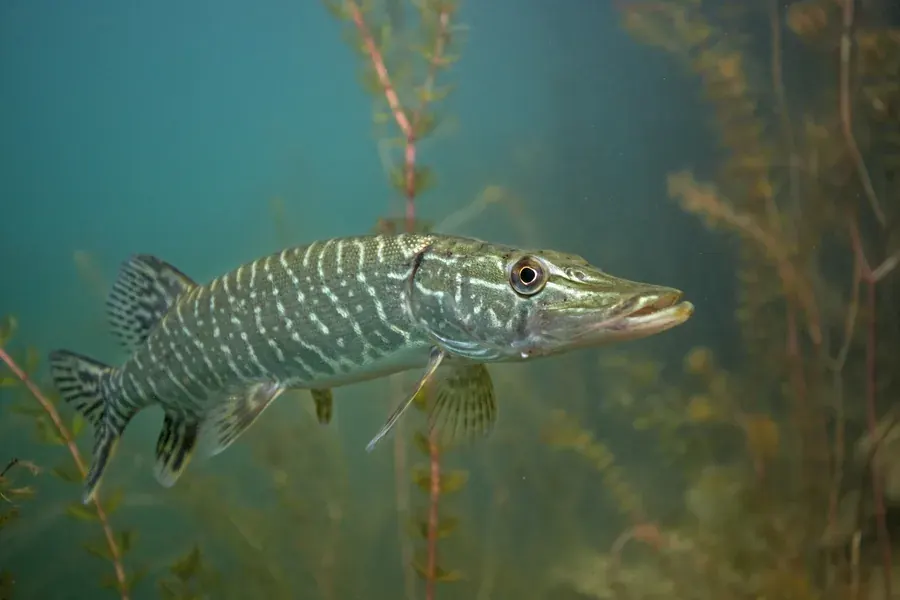
Field photograph · reviewed 2026-08-29
Full lateral adult among submerged weed. Identified on the duck-bill snout, pale bean-shaped spots on a dark green ground, and the single soft dorsal set far back — separating it from muskellunge, which carries dark markings on a pale ground. Weed is habitat context, not a location claim. Photographic.
Adobe Stock contributor · asset 165356927 · Adobe Stock · Adobe Stock Standard licence · Identified on review of diagnostic features Source
Take this somewhere
This page is the record. The reading is what happens when you add water, a season and a temperature to it — that is where the families below get ranked against each other instead of just listed.
Those three links carry the fish and nothing else. No conditions were declared on this page, so none travel, and the link says so rather than sending an empty reading.
The half nobody publishes
What this record does not know
Everything else on this page comes from a named agency or peer-reviewed source. This is the other side of that: the questions a reviewer went looking for an answer to and came back without, and the fields the record leaves empty because filling them would mean guessing.
It is here rather than at the bottom because a page that only shows what it knows is easy to read as a page that knows everything. For Northern pike there are 11 of them.
Named by a reviewer
9Somebody looked for this and wrote down that they did not find it.
- Behaviour
Nobody has sourced:
- species-specific angling-pressure response beyond general cover/light notes
- cold-front / barometric response with primary-source support
- water-level rise/fall response with primary-source support
- Identification
Nobody has sourced:
- a single continent-wide mean length
- grass pickerel meristics as a structured lookalike key
- Forage
Nobody has sourced:
- finer month-by-month diet inside a season, which is waterbody-specific
- complete regional forage-substitution table
- Season
Nobody has sourced:
- month-by-month location changes inside a season, which are waterbody-specific
- population-archetype calendars beyond the species-level overlay (see RPC)
Absent from the record
2No reviewer wrote a gap here. The field is simply empty, which is its own answer.
- Water temperature
No agency or peer-reviewed temperature band for Northern pike was found that a review would accept. The reading runs without one rather than borrowing a number from a related fish.
- Population context
No regional population profile is registered. The species-level reading stands on its own; it does not silently become a local one.
Where the record puts it
Water and range
Stillwater
6 reviewed holding classes- Weed edge
- Inside weedline
- Outside weedline
- Inlet
- Point
- Wood
Flowing water
5 reviewed holding classes- Eddy
- Side channel
- Submerged wood
- Current break
- Tributary mouth
DepthWeeds and shallows in cool water; deeper weed edges and thermocline as summer warms.
Moving waterAmbush from slack adjacent to a food lane, not the current core.
LightSight ambush predator; uses edges and low light but will eat in daylight in stained water.
Thermal band
Temperature
No reviewed temperature band
Nobody publishes a preferred or active temperature range for Northern pike that a review would accept. Borrowing one from a related fish would look like knowledge and behave like a guess, so the reading runs without it and says which parts of the answer that weakens.
How it uses water
Behaviour
A group of pike is coincidence of habitat, not a school. Overlap with muskellunge is a conservation and identification problem, not a combined targeting layer.
Michigan DNR: about 90 percent smaller fish — yellow perch, sunfishes, minnows, and suckers — plus frogs and other living prey the jaws can surround. Crayfish, waterfowl, and small mammals appear in that agency note but are not catalog forage classes here. Capacity is not a current event.
Sight ambush predator. Uses edges and low light, but will eat in daylight in stained water. Bright, clear, high-sky days often pin fish tighter to cover.
Seasonal activityMichigan DNR: spawn in the shallows right after ice leaves, and before muskellunge. That is conservation context. Summer is a deeper weed-edge and thermal problem. Catalog exception: warm, weedy southern water may hold pike that are thermally stressed, not feeding.
Temperature-driven behaviourPreferred band roughly 50–65°F. Cold edge near 36°F; warm edge near 75°F. Casselman’s thermal ecology and the catalog: as water warms, fish use deeper weed edges and cooler ambush structure.
Depth movementWeeds and shallows in cool water; deeper weed edges and thermocline as summer warms (Michigan DNR: retreat somewhat deeper in midsummer).
Facing the currentSlack adjacent to a food lane. Not a mid-channel current fish.
ClarityClear water increases cover dependence. Stain can allow more open-edge daylight feeding without a surface event.
CoverWeed edges, inside and outside weedlines, wood, inlets, points, side channels, and eddies.
Open waterNot an open-basin wanderer by default. Open water is a travel lane between ambush edges.
Predator avoidanceVegetation, wood, and depth. Bright shallow open water in midsummer is a poor default.
TerritoryAmbushes from slack adjacent to a food lane, not the current core. Vegetation, wood, and the slow side of a seam are typical lies.
AggressionCan have significant impact on prey species (Michigan DNR). That is ecology, not a catch claim.
Spawning (conservation context)Michigan DNR: Great Lakes-region pike spawn in the shallows in April or May, right after ice-out, and before muskellunge. Vegetated ice-out shallows are excluded from target guidance. Do not name marshes or tributary mouths as pins.
Where the general rule stops
- Warm, weedy southern water may hold pike that are thermally stressed, not 'on the chew'.
What it can eat
Forage
- Small forage fish
- Larger prey fish
- Amphibians
Michigan DNR: about 90 percent smaller fish — yellow perch, sunfishes, minnows, and suckers — plus frogs and other living prey the jaws can surround. Crayfish, waterfowl, and small mammals appear in that agency note but are not catalog forage classes here.
- Feeding style
- Opportunistic
- Feeding zone
- Mixed
Through the year
- Winter
- Fish in remaining cold, weedy, or wooded water. Activity compresses near the cold edge.
- Early spring
- Fish and amphibians as ice leaves. Spawning overlap is conservation context, not a frog-hatch declaration.
- Summer
- Fish along deeper weed edges. Warm weedy water can be a thermal stressor, not a feeding cue.
- Fall
- Forage fish as water cools back into the preferred band.
By life stage
- Young of year
- Michigan DNR: young pike grow rapidly. Invertebrates and tiny fish; invertebrates are not a catalog class here beyond later amphibians and fish.
- Juvenile
- Small forage fish.
- Adult
- Fish, including larger prey fish, plus amphibians.
Prey sizeGape supports large prey. Juvenile diets are not a proxy for adult ambush forage.
Ontogenetic shiftSmall fish to larger piscivory, with amphibians as a reviewed supplement.
SubstitutionsPerch, sunfish, minnow, and sucker substitutions are waterbody-specific. Do not invent a current bait from this list.
Diet capacity is not proof that a hatch or prey event is occurring. Observed current forage still comes from a user observation or Hatch Match.
Through the year
Season
Winter
- Where they sit
- Remaining weed edges, wood, and deeper slow water in the active band.
- Feeding
- Slow ambush of forage fish.
- Temperature
- Near the 36°F cold edge, activity compresses.
What that changesStop-and-go, subsurface slow-roll, and horizontal retrieve. Flowing water: cross-current retrieve and stationary bait.
Early spring
- Where they sit
- Weedy shallows, inlets, side channels, and eddies as ice leaves.
- Movement
- Fish redistribute into shallow vegetation. That vegetation is not a target class.
What that changesStop-and-go, horizontal retrieve, and cross-current retrieve.
What would count against it
- using ice-out vegetation as a named pin
Michigan DNR: spawn in the shallows right after ice-out, before muskellunge. Vegetated ice-out water is excluded from target guidance.
Summer
- Where they sit
- Outside weedlines, weed edges, points, and wood.
- Depth
- Deeper than the cool-water shallow default. Michigan DNR: retreat somewhat deeper in midsummer.
- Temperature
- Preferred 50–65°F. Warm edge near 75°F. Warm weedy southern water may be thermal stress, not feeding.
- Cover
- Deeper weed edges and cooler ambush structure.
What that changesSubsurface slow-roll, stop-and-go, and horizontal retrieve. Surface retrieve is not the summer default.
What would count against it
- forcing a bright shallow summer default
- treating thermally stressed southern pike as feeding fish
Fall
- Where they sit
- Weed edges, inside weedlines, inlets, and side channels as water cools.
- Forage
- Forage fish as water re-enters the preferred band.
What that changesStop-and-go, horizontal retrieve, subsurface slow-roll, and cross-current retrieve. Surface retrieve only as a reviewed stillwater family, not a new one.
Spawning · Early spring
Ice-out vegetated shallows; among the earliest spawners.
Recorded as conservation context. No spawning site, staging concentration or migration bottleneck is named anywhere in this catalog, because naming one is how a population gets fished out.
Telling it apart
Identification
What to look at
- Michigan DNR: light-colored spots on a darker body — light on dark, the reverse of muskellunge.
- Michigan DNR: entire cheek scaled; only the upper half of the gill cover (opercle) scaled.
- Michigan DNR: five to six submandibular pores on the underside of each lower jaw. Iowa DNR: five or fewer per side is pike; six or more is muskellunge.
- Iowa DNR: bluish-green ground with light, bean-shaped spots in horizontal rows. Juveniles show oblique light-and-dark bars, not an adult chain pattern.
- Tail lobes are more rounded than the pointed, more forked muskellunge tail (Iowa DNR).
- Average adult length
- Inland adults commonly 18–28 in; larger fish occur in fertile northern waters.
- Common angling size
- 20–30 in in many inland and Great Lakes fisheries.
- Typical weight
- Often 2–8 lb; large fish are much heavier. Michigan DNR notes continued weight gain after maturity, more slowly.
- Maximum documented
- Large northern waters produce fish far above typical inland size. Maxima are waterbody-specific.
- Longevity
- Michigan DNR: average life span six to eight years; some live as long as 15.
What it gets confused with
- Muskellunge
- Muskellunge have dark marks on a lighter ground, scales on only the upper half of the cheek and gill cover, and six or more pores per side (Michigan DNR). Pike are light-on-dark with a fully scaled cheek and five or fewer pores.
- Chain pickerel
- Chain pickerel have a chain-like dark pattern, a dark bar streaming down from the eye, and a fully scaled cheek and opercle. They are a smaller eastern vegetated-water esocid, not a light-spotted northern.
- Tiger muskellunge (northern pike × muskellunge hybrid)
- Tiger muskies mix both parents — often dark bars on a light ground with intermediate scaling and pores. Treat as a hybrid; do not force either parent record.
- Grass pickerel (Esox americanus vermiculatus)
- Michigan DNR lists grass pickerel as a pike-family cousin. It is a small, fully scaled, worm-marked esocid and is not this catalog record.
What follows from all of that
Presentation families
Stillwater
Subsurface slow-roll
Roll a bait just under the surface or just over the weed tops without breaking them.
- barely subsurface
- steady roll
- tick the tops
- speed just enough to stay up
What it asks of the tackle
- Depth control
- Moderate
- Sensitivity
- Moderate
- Casting distance
- Moderate to long
- Weight range
- 1/4–3/4 oz
- Cover resistance
- High
- Line visibility
- Moderate
- Retie frequency
- Moderate
Stop-and-go
Imitate injured or hesitating prey by mixing travel with pauses that hold the bait in the strike zone.
- travel
- pause
- keep depth on the pause
- restart without jumping the band
What it asks of the tackle
- Depth control
- High
- Sensitivity
- High
- Casting distance
- Moderate
- Weight range
- 1/8–3/8 oz
- Cover resistance
- Moderate
- Line visibility
- Low
- Retie frequency
- Moderate
Horizontal retrieve
Move a swimming bait through a chosen depth band along structure or open water.
- count down
- steady or pulsing retrieve
- keep the band
- cover the edge
What it asks of the tackle
- Depth control
- Moderate
- Sensitivity
- Moderate
- Casting distance
- Moderate to long
- Weight range
- 1/8–1/2 oz
- Cover resistance
- Moderate
- Line visibility
- Low
- Retie frequency
- Low
Surface retrieve
Work a floating bait across shade, weed edges, or low-light shallows.
- walk, pop, or crawl
- pause in holes
- keep it on top
- cover the edge
What it asks of the tackle
- Depth control
- Surface
- Sensitivity
- Low
- Casting distance
- Moderate
- Weight range
- 1/4–3/4 oz
- Cover resistance
- Moderate
- Line visibility
- Moderate
- Retie frequency
- Low
Flowing water
Cross-current retrieve
Represent mobile prey crossing or holding near a current boundary.
- horizontal travel
- intermittent pause
- depth retention
- controlled acceleration
What it asks of the tackle
- Depth control
- Moderate
- Sensitivity
- Moderate
- Casting distance
- Moderate
- Weight range
- 1/8–3/8 oz
- Cover resistance
- Moderate
- Line visibility
- Low
- Retie frequency
- Moderate
Upstream retrieve
Bring a bait back against current so it tracks a seam or bank the fish is already facing.
- cast down-and-across or down
- retrieve into the lane
- keep contact
- vary cadence at the head
What it asks of the tackle
- Depth control
- Moderate
- Sensitivity
- Moderate
- Casting distance
- Moderate
- Weight range
- 1/8–1/2 oz
- Cover resistance
- Moderate
- Line visibility
- Moderate
- Retie frequency
- Moderate
Stationary bait
Hold a scent or food form in one feeding station and wait for a fish to move to it.
- anchor the presentation
- keep bait in the pocket
- detect takes without sweeping
- refresh often
What it asks of the tackle
- Depth control
- High
- Sensitivity
- Moderate
- Casting distance
- Short
- Weight range
- 1/4–1 oz
- Cover resistance
- High
- Line visibility
- Moderate
- Retie frequency
- High
What moves them for this fish
Reviewed rules that push particular families up when the conditions match. Each one names the conditions it needs and why it exists, so you can disagree with it.
In cool workable water, pike commonly occupy shallower ambush edges and can support more mobile interception mechanics.
When
Early spring or Spring or Fall · preferred or active · Weed edge, Inside weedline, Inlet, Side channel, Eddy
Moves up
Stop-and-go, Horizontal retrieve, Subsurface slow-roll, Cross-current retrieve, Surface retrieve
Reviewed 2026-08-27
As water warms, pike use deeper weed edges and cooler ambush structure; reinforce subsurface edge travel.
When
Stillwater · Summer or Late summer · Outside weedline, Weed edge, Point, Wood
Moves up
Subsurface slow-roll, Stop-and-go, Horizontal retrieve, Surface retrieve
Reviewed 2026-08-27
Where every sentence came from
Sources
Agency
Michigan DNR northern pike species account
Used for behaviour; season. Read 2026-08-30, next check 2026-11-20.
Agency
Provincial / state esocid plans
Used for habitat, thermal band and presentation families. Read 2026-08-27, next check 2026-11-27.
Agency
Michigan DNR northern pike species account (light spots on dark, full cheek scales, 5–6 pores)
Used for identification. Read 2026-08-30, next check 2026-12-10.
Agency
Iowa DNR pike vs muskellunge identification (pores, cheek scales, tail shape, color reverse)
Used for identification. Read 2026-08-30, next check 2026-12-10.
Agency
Michigan DNR northern pike species account (90 percent fish; perch, sunfish, minnow, sucker, frogs)
Used for forage. Read 2026-08-30, next check 2026-11-20.
Peer reviewed
Casselman pike thermal ecology
Used for habitat, thermal band and presentation families; identification; behaviour; forage; season. Read 2026-08-30, next check 2026-11-27.
A source with no link predates the rule that one has to carry a URL. It is still a real citation and still checkable; it just takes a search rather than a click, and that is worth knowing before you rely on it.