Freshwater predator · Freshwater
Walleye
Sander vitreus
Native to the Great Lakes / Mississippi / Ohio; widely stocked in reservoirs.
Also called walleyed pike, marble-eye.
- Stillwater
- Flowing water
- Ordinary target
- 4 of 4 overlays reviewed
- Reviewed 2026-08-27
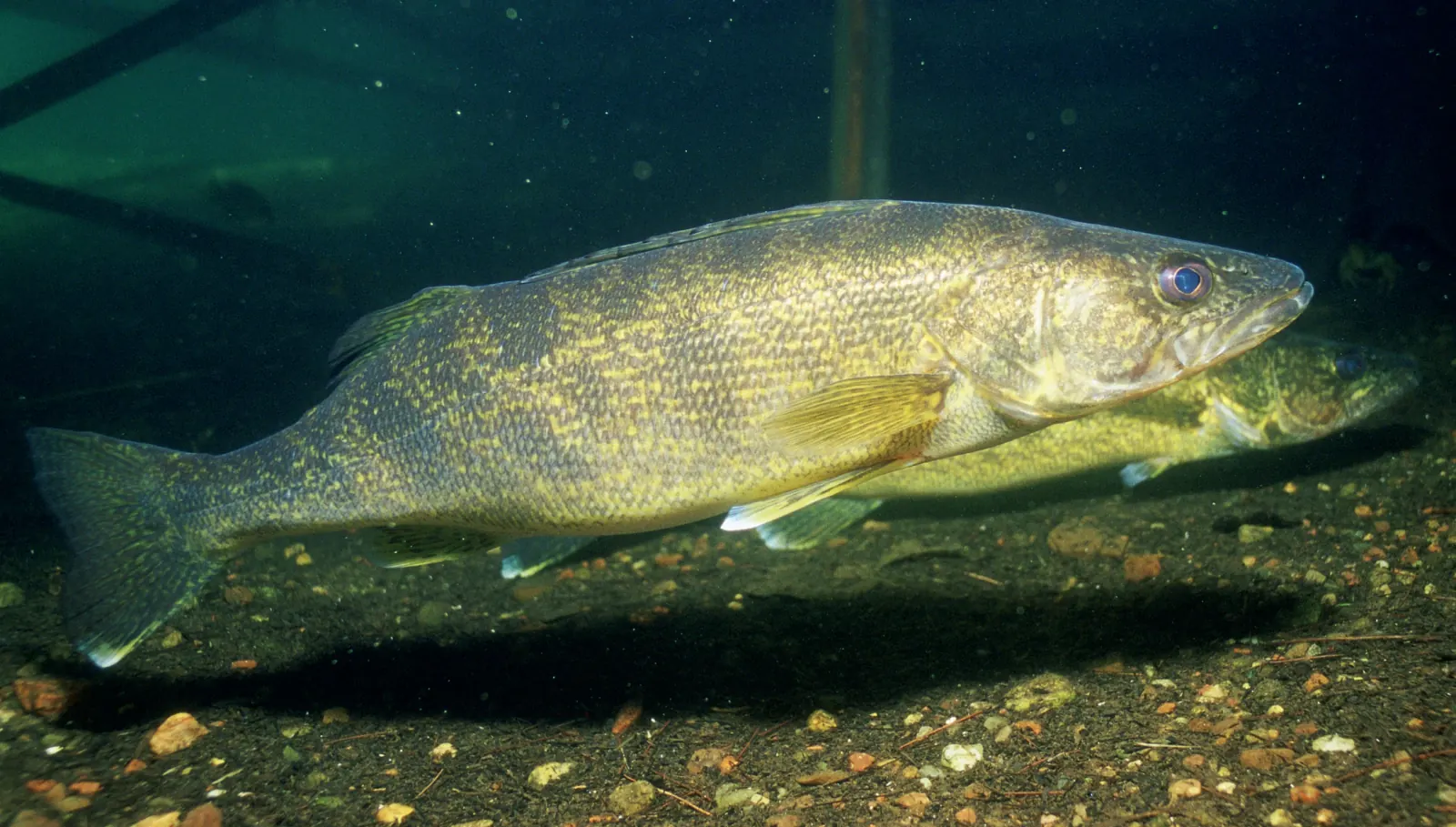
Photograph · reviewed 2026-09-08
USFWS species-labeled walleye photograph with the full lateral body visible. The large pearlescent eye, elongate percid form, separate dorsal fins and caudal profile are unobstructed; no size, location or population claim is inferred from the image.
Eric Engbretson / USFWS · U.S. Fish and Wildlife Service · Public Domain — U.S. federal government work · Identified by the publishing body Source
Take this somewhere
This page is the record. The reading is what happens when you add water, a season and a temperature to it — that is where the families below get ranked against each other instead of just listed.
Those three links carry the fish and nothing else. No conditions were declared on this page, so none travel, and the link says so rather than sending an empty reading.
The half nobody publishes
What this record does not know
Everything else on this page comes from a named agency or peer-reviewed source. This is the other side of that: the questions a reviewer went looking for an answer to and came back without, and the fields the record leaves empty because filling them would mean guessing.
It is here rather than at the bottom because a page that only shows what it knows is easy to read as a page that knows everything. For Walleye there are 13 of them.
Named by a reviewer
12Somebody looked for this and wrote down that they did not find it.
- Behaviour
Citation gap: “Great Lakes / state walleye assessments” describes a source category rather than one resolvable document.
Nobody has sourced:
- cold-front / barometric response with primary-source support
- species-specific angling-pressure response beyond general cover/light notes
- water-level rise/fall response with primary-source support
- Identification
Citation gap: “Great Lakes / state walleye assessments” describes a source category rather than one resolvable document.
Nobody has sourced:
- a single continent-wide mean length
- saugeye meristics as a structured hybrid key
- Forage
Nobody has sourced:
- finer month-by-month diet inside a season, which is waterbody-specific
- complete regional forage-substitution table
- Season
Citation gap: “Great Lakes / state walleye assessments” describes a source category rather than one resolvable document.
Nobody has sourced:
- month-by-month location changes inside a season, which are waterbody-specific
- northern natural-lake vs large-river calendars (RPC)
Absent from the record
1No reviewer wrote a gap here. The field is simply empty, which is its own answer.
- Water temperature
No agency or peer-reviewed temperature band for Walleye was found that a review would accept. The reading runs without one rather than borrowing a number from a related fish.
Where the record puts it
Water and range
Stillwater
7 reviewed holding classes- Point
- Drop-off
- Breakline
- Rocky shoreline
- Inlet
- Thermocline edge
- Basin
Flowing water
6 reviewed holding classes- Current break
- Tailwater
- Run
- Pool head
- Tributary mouth
- Deep pool
DepthFollows the light-food compromise: deeper in bright clear water, shallower in stain, wind, and low light.
Moving waterUses current and current-washed structure; not a slack-water ambush fish.
LightStrong low-light and night feeding; tapetum-adapted. Bright midday in clear water is often a poor feeding window, not a location problem.
Thermal band
Temperature
No reviewed temperature band
Nobody publishes a preferred or active temperature range for Walleye that a review would accept. Borrowing one from a related fish would look like knowledge and behave like a guess, so the reading runs without it and says which parts of the answer that weakens.
How it uses water
Behaviour
A group on a breakline is a forage-and-light problem, not a named pin. Northern natural-lake vs large-river calendars are RPC overlays and must be declared.
Minnesota DNR: fish-eaters, preying heavily on yellow perch, which cannot see as well in low light. Insects and crustaceans remain capacity, especially in younger fish. Capacity is not a current forage event.
Minnesota DNR: usually feed in shallow water at dawn and dusk; daylight sends them into shade of structure or into deeper water. Turbidity, wave chop, or clouds can keep them active through the day. Catalog exception: dusk is metabolically and optically more plausible — it does not imply a bite.
Seasonal activityEarly-spring spawning on rock and current-washed gravel is conservation context. Summer is a light and thermal-depth problem. Fall follows forage and cooling water.
Temperature-driven behaviourPreferred band roughly 55–68°F. Cold edge near 42°F; warm edge near 76°F. Southern reservoirs depend on a cool hypolimnion and forage. Warm, bright surface water is a down-move, not a shallow default.
Depth movementFollows the light-food compromise. Minnesota DNR: may suspend over deep water to feed on open-water species.
Facing the currentUses current and current-washed structure; not a slack-water ambush fish. Large-river vs lake-resident positioning is RPC.
ClarityClear bright water increases depth and shade use. Stain and chop can extend daylight feeding without proving a surface event.
CoverPoints, drop-offs, breaklines, rocky shoreline, current breaks, tailwater, and thermocline edges. Wood and weeds are shade, not a pike-style ambush default.
Open waterCan suspend over basins when forage is pelagic. That is still not a white-bass school. RPC lake vs river must be declared.
Predator avoidanceDepth, shade, and turbidity. Bright midday in clear water is often a poor feeding window, not a location problem.
TerritoryNot a hole-bound trout. Position follows the light-food compromise: deeper in bright clear water, shallower in stain, wind, and low light.
Spawning (conservation context)Minnesota DNR: spawn over rock, rubble, or gravel in rivers or windswept shallows as water leaves freezing, peaking near 42–50°F. Neither parent cares for eggs. Spawning substrate and any spring concentration are excluded from target guidance. Do not name reefs or reaches.
Where the general rule stops
- Does not imply fish will bite at dusk. It implies dusk is metabolically and optically more plausible.
What it can eat
Forage
- Small forage fish
- Larger prey fish
- Aquatic insects
- Crustaceans
Minnesota DNR: walleye are fish-eaters, preying heavily on yellow perch. Insects and crustaceans remain capacity, especially before the shift to fish. Observed forage still has to be declared.
- Feeding style
- Opportunistic
- Feeding zone
- Mixed
Through the year
- Winter
- Forage fish in the remaining active band. Shallower relative to bright summer without becoming a perch-school diet.
- Spring
- Fish remain primary. Insects and crustaceans are capacity for smaller fish. Spawning overlap is conservation context, not a forage map.
- Summer
- Piscivory on the usable light and thermal layer. Perch and other forage fish where they occur. Do not infer a current bait event.
- Fall
- Forage fish continue as water cools. Fall is not an egg-forage prescription.
By life stage
- Young of year
- Zooplankton-scale and insect prey before the fish shift. Zooplankton is not a catalog forage class on this record.
- Juvenile
- Aquatic insects, crustaceans, and small forage fish.
- Adult
- Primarily fish, including yellow perch where they occur; larger prey fish as gape allows.
Prey sizePrey length tracks gape. The larger_prey_fish class belongs to adults, not to young-of-year.
Ontogenetic shiftInvertebrates and small fish to primarily piscivory.
SubstitutionsLake forage (perch, cisco-scale pelagic fish) differs from large-river forage. RPC lake vs river overlays that split; this species diet does not auto-select them.
Diet capacity is not proof that a hatch or prey event is occurring. Observed current forage still comes from a user observation or Hatch Match.
Through the year
Season
Winter
- Where they sit
- Basins, drop-offs, breaklines, and deep river pools in the remaining active band.
- Depth
- Deeper in daylight; shallower in low light.
- Feeding
- Slow, lower-column intercept of forage fish.
- Temperature
- Near or below the 42°F cold edge, activity compresses.
What that changesVertical jig, slow drag, and bottom contact in still water; bottom-contact drift and pulse / jig in current.
What would count against it
- treating winter as a surface-weed problem
Early spring
- Where they sit
- Current-washed rock, points, and river runs as water leaves freezing.
- Movement
- Fish redistribute with temperature and flow. Rock and gravel are not a target class.
- Temperature
- Leaving the cold edge toward the 48–72°F active band. Minnesota DNR: spawning peaks near 42–50°F.
What that changesBottom-contact drift, pulse / jig, and cross-current retrieve in flow; slow drag and bottom contact in still water.
What would count against it
- using spawning substrate as holding water
Early-spring spawning overlap is caution. Spawning substrate is excluded from target guidance. Do not name reefs.
Spring
- Where they sit
- Points, drop-offs, rocky shoreline, inlets, current breaks, and tailwater.
- Forage
- Forage fish where they occur. Do not infer a perch event from the calendar.
What that changesTrolling, slow drag, and vertical jig in still water; bottom-contact drift and downstream retrieve in flow.
Summer
- Where they sit
- Breaklines, thermocline edges, basins, and current-washed structure.
- Depth
- Deeper in bright clear water; shallower in stain, wind, and low light.
- Temperature
- Preferred 55–68°F. Warm edge near 76°F. Southern reservoirs depend on a cool hypolimnion.
- Light
- Strong low-light and night feeding. Bright midday in clear water is often a poor feeding window, not a location problem.
What that changesVertical jig, trolling, and slow drag on the usable layer; live / natural bait suspension where the band is known. Flowing water: pulse / jig and bottom-contact drift.
What would count against it
- forcing a bright shallow default in clear water
- collapsing lake-resident and large-river calendars
Fall
- Where they sit
- Points, rocky shoreline, inlets, and current breaks as water cools.
- Forage
- Forage fish continue. Fall is not an egg-forage prescription.
What that changesTrolling, slow drag, and cross-current retrieve. Do not convert cooling water into an unreviewed family.
Spawning · Early spring, Spring
Early spring on rock and current; often the first big movement of the year.
Recorded as conservation context. No spawning site, staging concentration or migration bottleneck is named anywhere in this catalog, because naming one is how a population gets fished out.
Telling it apart
Identification
What to look at
- Minnesota DNR: the lower tip of the caudal fin — the tail — is white. Sauger’s lower lobe is dark, or the white mark is reduced.
- Minnesota DNR: the spinous dorsal is dusky and lacks rows of dark spots, except for a dark splotch at the rear base of that fin — a mark sauger does not have.
- Pearlescent eye from the tapetum lucidum, a reflective layer that aids night and turbid-water vision (Minnesota DNR).
- Olive-brown to yellowish gold with brassy flecks. Sides lack the distinct dark saddle blotches of sauger.
- Canine teeth in the jaws. Yellow perch of similar size have no canines and carry regular vertical bars.
- Average adult length
- Commonly 15–22 in in inland waters; many fisheries produce larger fish.
- Common angling size
- 16–22 in in most inland and Great Lakes fisheries.
- Typical weight
- Minnesota DNR: averages 1 to 2 lb in most waters; fish over 10 lb occur.
- Maximum documented
- Large lake and river fish far exceed the 1–2 lb average. Maxima are waterbody-specific and are not a single catalog number.
- Longevity
- Related Missouri DNR life-cycle notes put typical walleye longevity around 7–10 years; older fish occur.
What it gets confused with
- Sauger
- Sauger have rows of dark spots on the first dorsal, distinct saddle blotches on the sides, and no (or a reduced) white lower tail tip. Walleye have the white tail tip, a rear-base dorsal blotch rather than spotted rows, and lack those saddles. Missouri DNR: sauger cheeks are scaled; hybrids exist.
- Saugeye (walleye × sauger hybrid)
- Saugeye mix both parents — often a spotted dorsal plus a white tail mark. Missouri DNR: identification can be difficult. Do not force the hybrid into either parent record.
- Yellow perch
- Yellow perch have about seven blackish vertical bars, no canine teeth, and a smaller eye. Walleye are larger-mouthed percids with canines and no regular bar pattern.
- White bass
- White bass are temperate bass with horizontal stripes, a deeper body, and no tapetum eye. They are not percids.
What follows from all of that
Presentation families
Stillwater
Slow drag
Move a bait along the bottom slowly enough that it stays in the feeding layer of inactive fish.
- continuous contact
- very slow travel
- pause at changes in bottom
- do not hop out of the zone
What it asks of the tackle
- Depth control
- High
- Sensitivity
- High
- Casting distance
- Moderate
- Weight range
- 1/8–3/8 oz
- Cover resistance
- Moderate
- Line visibility
- Low
- Retie frequency
- Moderate
Trolling
Cover a depth contour or basin at a controlled speed to intercept mobile fish.
- speed control
- depth control
- follow the contour
- turn to change action
What it asks of the tackle
- Depth control
- High
- Sensitivity
- Low
- Casting distance
- Boat
- Weight range
- Varies with speed and depth
- Cover resistance
- Low
- Line visibility
- Moderate
- Retie frequency
- Low
Bottom contact
Keep a bait on or just above the substrate along a break, flat, or inside a weed edge.
- feel bottom
- drag or hop
- pause on the break
- stay in contact
What it asks of the tackle
- Depth control
- High
- Sensitivity
- High
- Casting distance
- Moderate
- Weight range
- 1/8–1/2 oz
- Cover resistance
- High
- Line visibility
- Low
- Retie frequency
- High
Vertical jig
Work a compact bait up and down through a marked depth, basin, or timber pocket.
- stay over the target
- measured lift
- controlled drop
- watch slack
What it asks of the tackle
- Depth control
- High
- Sensitivity
- High
- Casting distance
- Vertical
- Weight range
- 1/8–3/4 oz
- Cover resistance
- Moderate
- Line visibility
- Low
- Retie frequency
- Moderate
Live / natural bait suspension
Present a natural food form with enough life or scent to hold in a station without looking mechanical.
- keep it alive or fresh
- match the holding depth
- minimize hardware bulk
- detect without pulling it away
What it asks of the tackle
- Depth control
- High
- Sensitivity
- High
- Casting distance
- Short to moderate
- Weight range
- As light as conditions allow
- Cover resistance
- Moderate
- Line visibility
- Low
- Retie frequency
- High
Flowing water
Bottom-contact drift
Tick or crawl a food form along the substrate through a feeding lane without snagging constantly.
- feel the bottom
- short hops
- reset after hang
- weight just enough
What it asks of the tackle
- Depth control
- High
- Sensitivity
- High
- Casting distance
- Moderate
- Weight range
- 1/8–3/8 oz
- Cover resistance
- Moderate
- Line visibility
- Low
- Retie frequency
- Moderate
Cross-current retrieve
Represent mobile prey crossing or holding near a current boundary.
- horizontal travel
- intermittent pause
- depth retention
- controlled acceleration
What it asks of the tackle
- Depth control
- Moderate
- Sensitivity
- Moderate
- Casting distance
- Moderate
- Weight range
- 1/8–3/8 oz
- Cover resistance
- Moderate
- Line visibility
- Low
- Retie frequency
- Moderate
Pulse / jig
Lift and drop a compact bait so it occupies a pocket, seam, or head without leaving the water column.
- short lift
- controlled drop
- stay in the pocket
- repeat on the same piece
What it asks of the tackle
- Depth control
- High
- Sensitivity
- High
- Casting distance
- Short to moderate
- Weight range
- 1/8–3/8 oz
- Cover resistance
- Moderate
- Line visibility
- Low
- Retie frequency
- High
Downstream retrieve
Move a bait with the current, then add just enough speed to give it a swimming job.
- cast upstream
- recover slack
- match or slightly beat current
- pause in pockets
What it asks of the tackle
- Depth control
- Moderate
- Sensitivity
- Moderate
- Casting distance
- Moderate
- Weight range
- 1/16–3/8 oz
- Cover resistance
- Low
- Line visibility
- Low
- Retie frequency
- Moderate
What moves them for this fish
Reviewed rules that push particular families up when the conditions match. Each one names the conditions it needs and why it exists, so you can disagree with it.
Bright clear conditions strengthen the walleye depth/structure tradeoff; reinforce deeper controlled mechanics.
When
Stillwater · Drop-off, Breakline, Basin, Thermocline edge · Bright
Moves up
Vertical jig, Bottom contact, Slow drag, Trolling
Reviewed 2026-08-27
Walleye's low-light advantage supports shallower and more mobile feeding mechanics on structure and current edges.
When
Point, Rocky shoreline, Inlet, Run, Current break · Low light or Night
Moves up
Trolling, Slow drag, Bottom-contact drift, Cross-current retrieve, Downstream retrieve
Reviewed 2026-08-27
Not every population is the same fish
Regional population context
Northern natural lake
- Lake resident
- Native or established
- Stillwater
Rock, points, breaklines, basin edges, light penetration, and forage depth define the lake frame; low light can move fish shallower without changing the population archetype.
This profile strengthens structure/depth mechanics for lake-resident walleye without turning low-light biology into a bite prediction.
- Natural-lake recruitment and forage communities vary sharply among waters; do not infer abundance from habitat quality.
- Spawning reefs and spring concentrations remain excluded from target guidance.
Large-river / current population
- River resident or migratory
- Native or established
- Flowing water
Current-washed rock, deep runs, channel edges, and velocity breaks outrank reservoir-style basin searching in this declared population context.
Large-river walleye use hard bottom, current breaks, and deeper current habitat differently from lake-resident populations.
- Navigation structures and dams may create concentrations; this profile does not name those locations.
- Spring migration/spawning concentrations are explicitly excluded from target guidance.
Where every sentence came from
Sources
Agency
Minnesota DNR walleye biology
Used for behaviour; season. Read 2026-08-30, next check 2026-12-04.
Agency
GLFC / state walleye assessments
Used for habitat, thermal band and presentation families. Read 2026-08-27, next check 2026-11-27.
Agency
Used for identification. Read 2026-08-30, next check 2026-12-11.
Agency
Minnesota DNR walleye biology (piscivory, yellow perch as primary prey)
Used for forage. Read 2026-08-30, next check 2026-12-11.
Agency
Great Lakes / state walleye assessments
Used for population context. Read 2026-08-27.
Agency
Missouri Department of Conservation Upper Mississippi walleye habitat guidance
Used for population context. Read 2026-08-27.
Peer reviewed
Colby et al. walleye biology
Used for habitat, thermal band and presentation families; identification; behaviour; forage; season; population context. Read 2026-08-30, next check 2026-11-27.
A source with no link predates the rule that one has to carry a URL. It is still a real citation and still checkable; it just takes a search rather than a click, and that is worth knowing before you rely on it.