Trout & salmon · Freshwater
Arctic char
Salvelinus alpinus
Circumpolar coldwater char. This reviewed North American seed emphasizes the documented lake-resident Alaska form; anadromous Eurasian forms are outside this record.
Also called Arctic charr, char, blueback trout.
- Stillwater
- Ordinary target
- 4 of 4 overlays reviewed
- Reviewed 2026-08-27
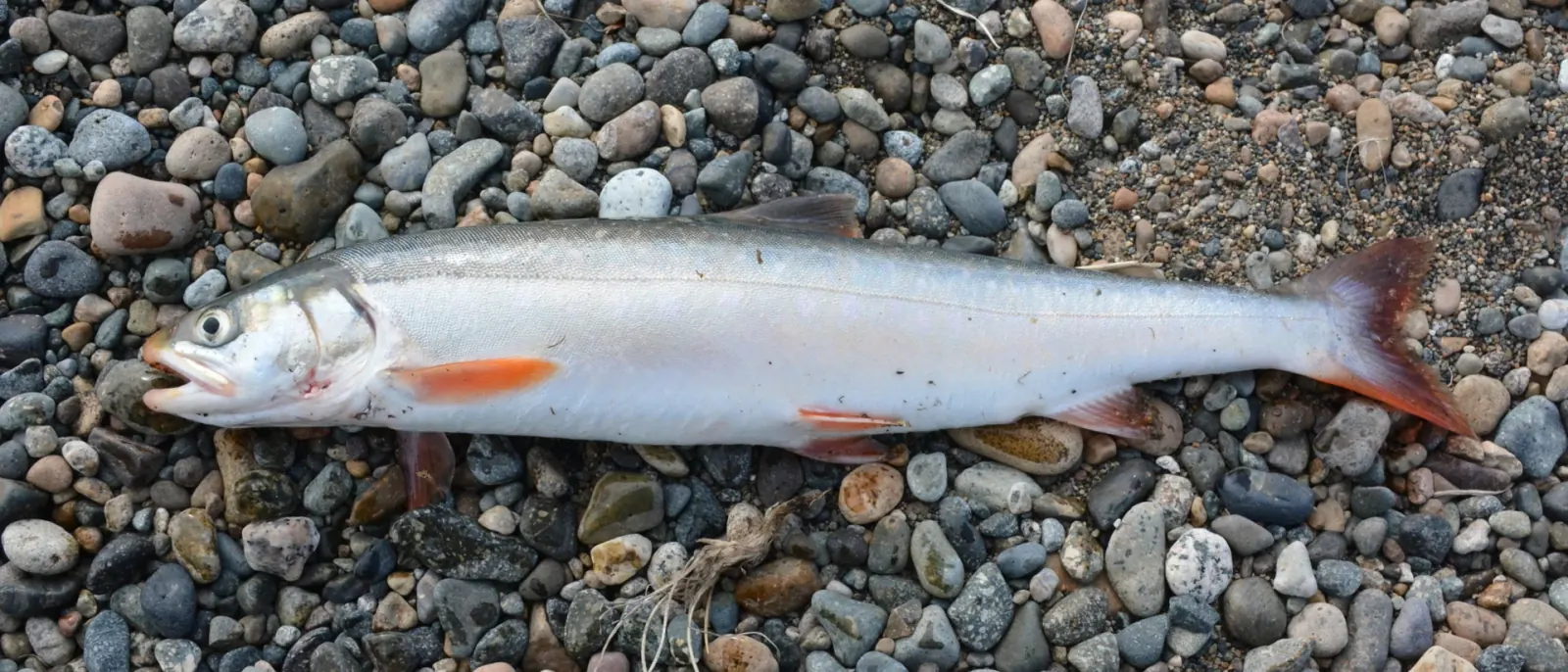
Photograph · reviewed 2026-08-27
Lateral char photograph with body pattern and fin profile visible; retained separately from Dolly Varden identity imagery.
Igor Zagrebin · iNaturalist / Wikimedia Commons · CC0 1.0 Public Domain Dedication Source
Take this somewhere
This page is the record. The reading is what happens when you add water, a season and a temperature to it — that is where the families below get ranked against each other instead of just listed.
Those three links carry the fish and nothing else. No conditions were declared on this page, so none travel, and the link says so rather than sending an empty reading.
The half nobody publishes
What this record does not know
Everything else on this page comes from a named agency or peer-reviewed source. This is the other side of that: the questions a reviewer went looking for an answer to and came back without, and the fields the record leaves empty because filling them would mean guessing.
It is here rather than at the bottom because a page that only shows what it knows is easy to read as a page that knows everything. For Arctic char there are 19 of them.
Named by a reviewer
17Somebody looked for this and wrote down that they did not find it.
- Behaviour
Nobody has sourced:
- diel activity pattern — no primary source found
- cold-front / barometric response — no primary source found
- angling-pressure response — no primary source found
- predator avoidance and cover use beyond depth and habitat zone
- water-clarity response — not described in the sources reviewed
- winter under-ice depth and activity for lake-resident populations
- Identification
Nobody has sourced:
- a quantitative spot-size threshold that separates Arctic char from Dolly Varden without dissection — the agency keys give 'larger/smaller than the pupil' and 'fewer/more', which overlap in practice
- dwarf vs normal form appearance within a single lake, which Alaska documents but does not describe morphologically
- sea-run vs landlocked colour map as a structured field
- Forage
Nobody has sourced:
- the catalog's emerging_insects class is only indirectly supported — Maine records charr taking prey at the water surface, but no source reviewed itemises emergences
- the catalog's larger_prey_fish class rests on adult piscivory generally; no source reviewed gives a prey-size ceiling
- winter and under-ice diet
- prey-size shifts against gape as a measured relationship
- Season
Nobody has sourced:
- early_spring and late_summer entries — no sourced material specific to those sub-seasons
- light sensitivity by season, which matters at high latitude and was not resolved by any source reviewed
- depth figures outside Maine — the 20–30 ft summer thermocline range is a Maine observation and should not be treated as a range-wide number
- flowing-water use: the catalog gives this species no riverHolding classes, and no flowing-water calendar is written here
Absent from the record
2No reviewer wrote a gap here. The field is simply empty, which is its own answer.
- Water temperature
No agency or peer-reviewed temperature band for Arctic char was found that a review would accept. The reading runs without one rather than borrowing a number from a related fish.
- Population context
No regional population profile is registered. The species-level reading stands on its own; it does not silently become a local one.
Where the record puts it
Water and range
Stillwater
6 reviewed holding classes- Basin
- Drop-off
- Rocky shoreline
- Submerged hump
- Thermocline edge
- Inlet
DepthHighly population- and season-dependent; can range from littoral/insect feeding to deep cold basin use, with larger fish often becoming more piscivorous.
Moving waterReviewed here as a lake-resident fish; basin circulation and coldwater structure matter more than river current classes.
LightClear water and bright conditions can reinforce deeper positioning; insect availability can pull smaller/feeding fish higher.
Thermal band
Temperature
No reviewed temperature band
Nobody publishes a preferred or active temperature range for Arctic char that a review would accept. Borrowing one from a related fish would look like knowledge and behave like a guess, so the reading runs without it and says which parts of the answer that weakens.
How it uses water
Behaviour
Not a schooling pelagic species in the sense of a baitfish shoal. Structure is by size and feeding niche within a lake rather than by defended territory.
Maine describes charr taking prey from the surface, through the water column, and off the bottom of lakes and ponds — a whole-column generalist. Juveniles are near-exclusive planktivores; adults add benthos (snails, clams, insect larvae) and fish. In larger Greenland lakes, catches were higher in littoral and profundal zones than in the pelagic zone, so bottom-associated feeding dominates where a lake offers it.
Recorded as a non-claim. The agency and peer-reviewed sources reviewed here do not resolve a diel activity pattern for Arctic char, and high-latitude light regimes make any borrowed pattern suspect. 'mixed' is entered because the field is required; the gap is listed rather than filled.
Seasonal activityForm-specific. In northern Alaska all known Arctic char populations are lake-resident and spawn, overwinter and reside in lakes year-round. The Canadian anadromous form is different: it enters salt water for only 4–8 weeks in summer, first migrating at age 4–5 at 150–250 mm, and returns to fresh water from mid-August to mid-September to overwinter. Statements about sea entry apply only to the anadromous form.
Temperature-driven behaviourA cold-water specialist. Maine's management plan puts preference below 10°C (50°F), which is why charr are usually captured near lake bottoms, and the species page gives a preference below 55°F. When temperature allows they occupy the whole water column. The catalog's 39–50°F band sits inside that.
Depth movementMaine describes a seasonal depth pattern: after ice-out charr are found at a range of depths, and by summer they move to deeper water near the thermocline, typically 20–30 ft. They occupy the full column only when temperature permits it.
CoverStructure use is depth and substrate rather than woody cover — oligotrophic, deep, cold, well-oxygenated lakes; littoral and profundal zones carried higher catches than open pelagic water in the larger of two Greenland study lakes.
Open waterReliance on open pelagic water is a function of lake shape. In a smaller lake with a proportionally larger littoral zone, charr leaned on littoral macroinvertebrates; in a larger, deeper lake the expanded pelagic zone pushed them toward zooplankton.
Predator avoidanceNot described in the sources reviewed.
Spawning (conservation context)Fall spawner over gravel or rocky substrate. Alaska records spawning between August and October with individuals usually spawning only every other year; Fisheries and Oceans Canada gives September–October with females spawning every 2–3 years; Maine's landlocked populations spawn from late October through November as broadcast spawners that build no nest. Eggs incubate roughly six months beneath ice in the Canadian Arctic. Spawning substrate and any spawning-period holding water are excluded from target guidance.
Where the general rule stops
- Arctic char are exceptionally polymorphic among lakes; body size, diet, depth use, and color can differ substantially within the species.
- Dolly Varden and Arctic char are commonly confused; identification should be visually verified rather than inferred from geography alone.
What it can eat
Forage
- Zooplankton
- Aquatic insects
- Emerging insects
- Crustaceans
- Small forage fish
- Larger prey fish
A whole-column generalist that shifts with size. Juveniles are near-exclusive planktivores; adults add benthic invertebrates — snails, clams, insect larvae — and fish. Fisheries and Oceans Canada names freshwater shrimp and insect larvae for juveniles; Greenland work found charr over 20 cm mainly piscivorous on three-spined stickleback while smaller fish took chironomid larvae, zooplankton and benthic invertebrates. In large Alaskan lakes char feed on outmigrating juvenile salmon in late spring and early summer. Capacity is not a current hatch.
- Feeding style
- Opportunistic
- Feeding zone
- Mixed
Through the year
- Spring
- In large Alaskan lakes, outmigrating juvenile salmon become available from late May into early July where salmon systems exist. That is a system-specific subsidy, not a universal spring pattern.
- Summer
- Benthic invertebrates and zooplankton dominate for small fish; larger fish take forage fish. The balance between littoral macroinvertebrates and pelagic zooplankton tracks lake shape rather than the calendar.
By life stage
- Juvenile
- Almost exclusively plankton in Maine populations; freshwater shrimp and insect larvae in Canadian Arctic populations.
- Adult
- Benthic organisms including snails, clams and insect larvae, plus small fish. At sea the anadromous form feeds on invertebrates and fishes.
Ontogenetic shiftPlanktivory to a mixed benthic-invertebrate diet, with fish becoming the dominant item above roughly 20 cm in the Greenland populations studied.
SubstitutionsLake-specific. Where a lake holds a small forage fish (stickleback in Greenland, juvenile salmon in Alaskan salmon systems) larger charr become piscivorous; where it does not, they stay on benthos and zooplankton.
Diet capacity is not proof that a hatch or prey event is occurring. Observed current forage still comes from a user observation or Hatch Match.
Through the year
Season
Winter
- Where they sit
- Lake basin and adjacent drop-offs beneath ice; lake-resident populations remain in the lake year-round, and the anadromous form has already returned to fresh water to overwinter.
- Temperature
- The whole column is within thermal preference under ice, so temperature stops being the constraint it is in summer.
What that changesVertical jig, drop presentation and bottom contact are the reviewed stillwater families that work a basin and a drop-off edge; live/natural bait suspension is the other reviewed family matched to a stationary column presentation.
What would count against it
- assuming the summer thermocline depth still applies once the lake is isothermal under ice
Eggs from the previous fall are incubating in substrate through the winter — roughly six months beneath ice in Canadian Arctic populations. Spawning substrate is excluded from target guidance.
Spring
- Where they sit
- Rocky shoreline, drop-offs and submerged humps; after ice-out charr are found across a range of depths rather than pinned deep.
- Depth
- Spread through the column after ice-out.
- Forage
- Zooplankton and benthic invertebrates; in large Alaskan lakes on salmon systems, outmigrating juvenile salmon become available from late May.
- Temperature
- Surface water is still inside the sub-10°C preference, which is what releases charr from the deep.
What that changesHorizontal retrieve, subsurface slow roll and stop-and-go cover a column that is thermally open top to bottom; trolling covers water when fish are scattered across depths.
What would count against it
- carrying a summer thermocline depth back into an ice-out lake
- assuming a salmon-smolt subsidy in a lake with no salmon run
Summer
- Where they sit
- Thermocline edge, basin and deep drop-offs. Maine puts summer charr in deeper water near the thermocline, typically 20–30 ft.
- Depth
- Deep. Preference below 10°C (50°F) is the reason charr are usually captured near lake bottoms.
- Forage
- Benthic invertebrates and zooplankton for smaller fish; forage fish for larger fish. Whether littoral macroinvertebrates or pelagic zooplankton dominate is set by lake shape.
- Temperature
- The 55°F / 10°C preference edge is the summer constraint; warm surface water is unusable.
- Cover
- Depth and bottom association rather than woody or weedy cover; littoral and profundal zones carried higher catch than open pelagic water in the larger of two Greenland study lakes.
What that changesVertical jig, bottom contact and slow drag work the deep zones; suspend-pause and trolling address fish holding at a thermocline edge rather than on the bottom.
What would count against it
- fishing warm surface water above the thermal preference
- treating a small, shallow lake's littoral pattern as transferable to a large deep lake
Fall
- Where they sit
- Rocky and gravel substrate as spawning approaches; feeding water elsewhere in the lake.
- Temperature
- Cooling surface water reopens shallower depths.
What that changesHorizontal retrieve, stop-and-go and subsurface slow roll in remaining feeding water. Do not convert spawning colour into a new family.
What would count against it
- using spawning substrate as holding water
- reading the spawning migration of the anadromous form onto a lake-resident population
Fall spawner — August to October in Alaska, September to October in the Canadian Arctic — and most individuals spawn only every other year (females every 2–3 years in the Canadian Arctic). Spawning substrate and any spawning-period holding water are excluded from target guidance. Anadromous fish return to fresh water from mid-August to mid-September.
Late fall
- Where they sit
- Spawning overlap continues in southern landlocked populations, then lake basin as ice forms.
What that changesBottom contact and drop presentation in remaining feeding water as the lake cools.
Maine's landlocked charr spawn from late October through November; late-fall spawning overlap remains caution across the range.
Spawning · Late summer, Fall
Alaska lake populations spawn over gravel/rubble shoals from August into October. Spawning shoals are not emitted as target locations.
Recorded as conservation context. No spawning site, staging concentration or migration bottleneck is named anywhere in this catalog, because naming one is how a population gets fished out.
Telling it apart
Identification
What to look at
- Char pattern, not trout pattern: light spots on a dark ground. Spots are pink to red and, in Alaska's key, usually LARGER than the fish's pupil.
- Spots are fewer and larger than Dolly Varden's, and the caudal peduncle (tail base) is narrower.
- Tail is more deeply forked than Dolly Varden's.
- Paired and lower fins carry a bright white leading edge.
- No worm-like vermiculations on the back or dorsal fin — that pattern belongs to brook trout.
- Internal meristics separate it from Dolly Varden where external characters overlap: 23–30 gill rakers, short and blunt, and 40–50 pyloric caeca. These require a sacrificed or dissected fish and are not a live-release field character.
- Juveniles carry 10–15 parr marks along the side (Maine populations).
- Average adult length
- Strongly lake-dependent. Maine fish reach about 20 in, most much smaller; Alaska lakes produce fish to about 38 in. There is no single meaningful mean across the species' range.
- Common angling size
- Lake-specific. Maine treats a fish over 2 lb as significant; Alaska lake populations vary from dwarf forms to fish of many pounds in the same drainage.
- Typical weight
- Fisheries and Oceans Canada gives sea-run fish 2.3–4.5 kg (5–10 lb) and freshwater-resident fish 0.2–2.3 kg (0.4–5 lb). Maine's landlocked charr are usually well under 3 lb.
- Maximum documented
- Alaska reports fish to 38 in and 15 lb; productivity varies greatly by lake. A single global maximum is not treated as a catalog number.
- Longevity
- Fisheries and Oceans Canada gives 20–40 years; Maine's landlocked populations live to about 15 years. Maturity at 6–9 years in Alaska, 8–15 years in the Canadian Arctic.
What it gets confused with
- Dolly Varden
- The hardest separation. Externally: Arctic char have fewer, larger spots (usually larger than the pupil), a narrower caudal peduncle and a more deeply forked tail; Dolly Varden have smaller, more numerous spots (usually smaller than the pupil), a wider tail base and a squarer tail, and a longer head and snout. Meristics decide it when the fish is in hand and can be sacrificed: Arctic char 23–30 short blunt gill rakers and 40–50 pyloric caeca; Dolly Varden 16–23 long straight gill rakers and 21–30 pyloric caeca. Life history helps in northern Alaska, where all known Arctic char are lake-resident while Dolly Varden also occur as stream-resident and anadromous fish.
- Lake trout (Salvelinus namaycush)
- Lake trout carry spots on the face and tail — Alaska's key states no other Alaskan char has spots on face and tail — and have a deeply forked tail. Arctic char have an unspotted head and tail and only a moderate fork.
- Brook trout
- Brook trout have worm-like vermiculations across the back and dorsal fin and red spots ringed with blue halos. Arctic char have no vermiculations and its pink-to-red spots lack halos. Where the two share a Maine lake they also separate by depth, brook trout shallow and charr deep.
- Bull trout
- Bull trout have a comparatively large, broad, flattened head and a more slender, ventrally flattened body, with a proportionally larger upper jaw and more anal-fin and branchiostegal rays than Dolly Varden or Arctic char. Range overlap with Arctic char is minimal, but treat any big-headed char in bull trout country as a bull trout question, not an Arctic char one.
What follows from all of that
Presentation families
Stillwater
Vertical jig
Work a compact bait up and down through a marked depth, basin, or timber pocket.
- stay over the target
- measured lift
- controlled drop
- watch slack
What it asks of the tackle
- Depth control
- High
- Sensitivity
- High
- Casting distance
- Vertical
- Weight range
- 1/8–3/4 oz
- Cover resistance
- Moderate
- Line visibility
- Low
- Retie frequency
- Moderate
Slow drag
Move a bait along the bottom slowly enough that it stays in the feeding layer of inactive fish.
- continuous contact
- very slow travel
- pause at changes in bottom
- do not hop out of the zone
What it asks of the tackle
- Depth control
- High
- Sensitivity
- High
- Casting distance
- Moderate
- Weight range
- 1/8–3/8 oz
- Cover resistance
- Moderate
- Line visibility
- Low
- Retie frequency
- Moderate
Drop presentation
Let a bait fall on a controlled line into cover, along a wall, or through a hole in vegetation.
- place then fall
- watch the line
- hold at depth
- short hop only after the fall
What it asks of the tackle
- Depth control
- High
- Sensitivity
- High
- Casting distance
- Short
- Weight range
- 1/16–3/8 oz
- Cover resistance
- High
- Line visibility
- Low
- Retie frequency
- High
Horizontal retrieve
Move a swimming bait through a chosen depth band along structure or open water.
- count down
- steady or pulsing retrieve
- keep the band
- cover the edge
What it asks of the tackle
- Depth control
- Moderate
- Sensitivity
- Moderate
- Casting distance
- Moderate to long
- Weight range
- 1/8–1/2 oz
- Cover resistance
- Moderate
- Line visibility
- Low
- Retie frequency
- Low
Trolling
Cover a depth contour or basin at a controlled speed to intercept mobile fish.
- speed control
- depth control
- follow the contour
- turn to change action
What it asks of the tackle
- Depth control
- High
- Sensitivity
- Low
- Casting distance
- Boat
- Weight range
- Varies with speed and depth
- Cover resistance
- Low
- Line visibility
- Moderate
- Retie frequency
- Low
Surface retrieve
Work a floating bait across shade, weed edges, or low-light shallows.
- walk, pop, or crawl
- pause in holes
- keep it on top
- cover the edge
What it asks of the tackle
- Depth control
- Surface
- Sensitivity
- Low
- Casting distance
- Moderate
- Weight range
- 1/4–3/4 oz
- Cover resistance
- Moderate
- Line visibility
- Moderate
- Retie frequency
- Low
What moves them for this fish
Reviewed rules that push particular families up when the conditions match. Each one names the conditions it needs and why it exists, so you can disagree with it.
Smaller/insect-oriented Arctic char can move toward littoral and upper-column food when that forage is actually observed.
When
Stillwater · Rocky shoreline, Inlet, Drop-off · Aquatic insects, Emerging insects, Zooplankton
Moves up
Drop presentation, Surface retrieve, Slow drag, Vertical jig
Reviewed 2026-08-27
Large piscivorous Arctic char can become depth- and fish-prey oriented; lake polymorphism is preserved rather than averaged away.
When
Basin, Drop-off, Thermocline edge · Small forage fish, Larger prey fish
Moves up
Trolling, Horizontal retrieve, Vertical jig, Slow drag, Surface retrieve
Reviewed 2026-08-27
Where every sentence came from
Sources
Agency
Alaska Department of Fish and Game — Arctic Char species profile
Used for identification; behaviour; forage; season. Read 2026-08-30, next check 2026-11-17.
Agency
Alaska Department of Fish and Game — Arctic Char (Wildlife Notebook Series)
Used for identification; behaviour; forage; season. Read 2026-08-30, next check 2026-11-17.
Agency
Fisheries and Oceans Canada — Arctic Char (Salvelinus alpinus) species profile
Used for identification; behaviour; forage; season. Read 2026-08-30, next check 2026-11-17.
Agency
Maine Department of Inland Fisheries and Wildlife — Arctic Charr species information
Used for identification; behaviour; forage; season. Read 2026-08-30, next check 2026-11-17.
Agency
Used for identification; behaviour; season. Read 2026-08-30, next check 2026-11-17.
Agency
Maine Department of Inland Fisheries and Wildlife — Arctic Charr Management Plan
Used for behaviour; forage; season. Read 2026-08-30, next check 2026-11-30.
Agency
Alaska Department of Fish and Game Arctic Char species profile
Used for habitat, thermal band and presentation families. Read 2026-08-27, next check 2026-11-27.
Agency
Used for identification. Read 2026-08-30, next check 2026-11-17.
Agency
Maine 2025 Wildlife Action Plan — Arctic Charr (Salvelinus alpinus oquassa) SGCN report
Used for identification. Read 2026-08-30, next check 2026-11-17.
Agency
Colorado Parks and Wildlife — Arctic Char species page
Used for identification. Read 2026-08-30, next check 2026-11-17.
Peer reviewed
Used for behaviour; forage; season. Read 2026-08-30, next check 2026-11-30.
A source with no link predates the rule that one has to carry a URL. It is still a real citation and still checkable; it just takes a search rather than a click, and that is worth knowing before you rely on it.