Trout & salmon · Freshwater
Dolly Varden
Salvelinus malma
Pacific/arctic char with resident and sea-run forms; Alaska populations show strong regional and life-history variation.
Also called Dolly, sea-run Dolly Varden, northern form Dolly Varden, southern form Dolly Varden, dollies.
- Flowing water
- Stillwater
- Ordinary target
- 4 of 4 overlays reviewed
- Reviewed 2026-08-27
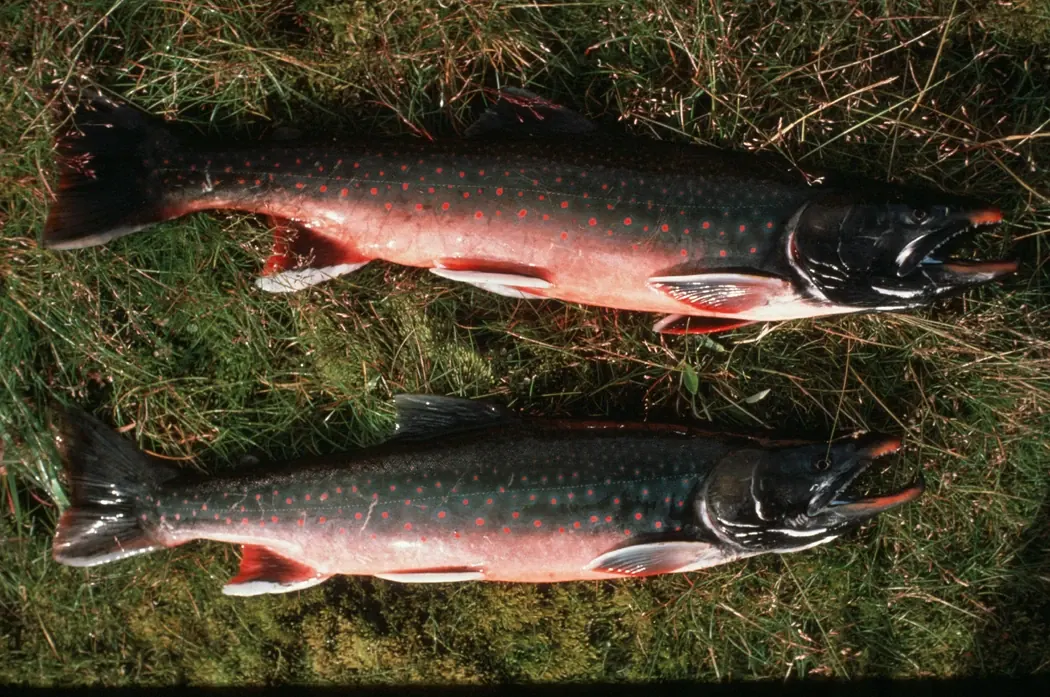
Photograph · reviewed 2026-08-27
USFWS-labeled Dolly Varden with lateral pattern visible. Identification is not inferred from geography.
Jim Gaither / USFWS · U.S. Fish and Wildlife Service · Public Domain — U.S. federal government work Source
Take this somewhere
This page is the record. The reading is what happens when you add water, a season and a temperature to it — that is where the families below get ranked against each other instead of just listed.
Those three links carry the fish and nothing else. No conditions were declared on this page, so none travel, and the link says so rather than sending an empty reading.
The half nobody publishes
What this record does not know
Everything else on this page comes from a named agency or peer-reviewed source. This is the other side of that: the questions a reviewer went looking for an answer to and came back without, and the fields the record leaves empty because filling them would mean guessing.
It is here rather than at the bottom because a page that only shows what it knows is easy to read as a page that knows everything. For Dolly Varden there are 19 of them.
Named by a reviewer
17Somebody looked for this and wrote down that they did not find it.
- Behaviour
Nobody has sourced:
- diel activity pattern — no primary source found
- cold-front / barometric response — no primary source found
- angling-pressure response — no primary source found
- water-level, flow-change and clarity response with primary-source support
- how lake-resident and lake-wintering fish distribute within a lake (depth, structure)
- territoriality — not described in the sources reviewed
- Identification
Nobody has sourced:
- a field character that separates Dolly Varden from bull trout without ray counts — the published protocol relies on meristics and proportions, so no reliable single field mark exists where ranges overlap
- northern vs southern form appearance in the field; the forms are defined by vertebral and chromosome counts, not by external marks
- maximum documented age
- Forage
Nobody has sourced:
- the catalog's emerging_insects class is not itemised separately in the sources reviewed — 'insects' is the level of detail the agency accounts give
- the catalog's larger_prey_fish class rests on general piscivory; no prey-size ceiling was found
- marine-phase diet composition for anadromous fish
- winter diet and whether feeding largely ceases during freshwater overwintering — not resolved by the sources reviewed
- Season
Nobody has sourced:
- winter feeding level and activity — no primary source found, so the winter entry carries habitat and caution only and no presentation implication
- depth tendency in any season — not described in the sources reviewed
- light sensitivity — not resolved at these latitudes by any source reviewed
- how lake-resident and lake-wintering fish use stillwater structure, which the catalog's stillHolding classes imply but the sources reviewed do not describe
Absent from the record
2No reviewer wrote a gap here. The field is simply empty, which is its own answer.
- Water temperature
No agency or peer-reviewed temperature band for Dolly Varden was found that a review would accept. The reading runs without one rather than borrowing a number from a related fish.
- Population context
No regional population profile is registered. The species-level reading stands on its own; it does not silently become a local one.
Where the record puts it
Water and range
Flowing water
6 reviewed holding classes- Run
- Seam
- Pool head
- Pool tail
- Deep pool
- Current break
Stillwater
5 reviewed holding classes- Inlet
- Outlet
- Rocky shoreline
- Drop-off
- Basin
DepthResident stream fish use pools and drift lanes; lake/wintering forms may use deeper water, while sea-run fish move through river and coastal transitions.
Moving waterResident and migratory fish use cold rivers, streams, connected lakes, and estuarine transitions; current use depends strongly on life-history form.
LightClear cold water rewards cover/depth under bright conditions, while drift and low light can allow shallower feeding positions.
Thermal band
Temperature
No reviewed temperature band
Nobody publishes a preferred or active temperature range for Dolly Varden that a review would accept. Borrowing one from a related fish would look like knowledge and behave like a guess, so the reading runs without it and says which parts of the answer that weakens.
How it uses water
Behaviour
Not a defended-lie species in the brown trout sense, and not a schooling pelagic species. Distribution within a system is driven by food availability and by size-structured predation risk.
Opportunistic carnivore. Alaska describes them as more scavenger than predator, primarily taking drifting salmon eggs where salmon are present, alongside insects, crustaceans and fish. Where salmon are absent the same fish work aquatic invertebrates in flowing water.
Recorded as a non-claim. No agency or peer-reviewed source reviewed here resolves a diel activity pattern for Dolly Varden, and the high-latitude light regime across most of its range makes a borrowed pattern unreliable. 'mixed' is entered because the field is required; the gap is listed.
Seasonal activityStrongly form-specific and worth stating separately. Anadromous fish: juveniles rear in streams for 2–4 years (sometimes six), smolt, and migrate seaward in May–June, with some going as late as September–October; they return to fresh water from July onward to forage, spawn and overwinter. Southern-form sea-run fish winter in lakes after leaving the ocean; northern-form anadromous fish spawn and overwinter in rivers. Stream-resident and lake-resident populations do not make the marine migration at all and stay in fresh water year-round.
Temperature-driven behaviourA cold-water specialist — the British Columbia species account gives a ceiling near 15°C (59°F). The catalog's 42–55°F preferred band sits below that ceiling.
Facing the currentA flowing-water char in its resident and returning forms; the British Columbia account places it on gravel and cobble reaches of smaller, lower-order streams of low gradient (roughly 1.0–1.5%).
CoverThe British Columbia habitat account names undercut banks, debris jams, pools and overhanging vegetation as the cover forms associated with Dolly Varden stream habitat.
Open waterLake-resident and lake-wintering populations occur across the range, but the sources reviewed do not describe how these fish distribute within a lake.
Spawning (conservation context)Fall spawner, September through November across Alaska and late September or October in Southcentral Alaska, in gravel streambeds. Unlike Pacific salmon they survive to spawn again — males up to twice, females up to three times — and females deposit roughly 600–6,000 eggs. Fry emerge from the gravel in April–May after overwintering as alevins. Spawning substrate and any spawning-period holding water are excluded from target guidance.
Where the general rule stops
- Southern and northern forms differ, and resident versus sea-run life histories should be declared through RPC rather than inferred from a water name.
- Egg feeding is plausible in mixed salmon systems but must never be used to target active spawning aggregations or redds.
What it can eat
Forage
- Aquatic insects
- Emerging insects
- Eggs
- Crustaceans
- Small forage fish
- Larger prey fish
Opportunistic carnivore taking insects, crustaceans, fish and salmon eggs. Alaska characterises them as more scavenger than predator, primarily consuming drifting eggs where salmon are present. A southwestern Alaska study documented the sequence directly: heavy feeding on sockeye fry while fry were available, an almost exclusive shift to eggs once salmon spawning began, then blowfly larvae colonising carcasses later in the season, with growth rates rising as those subsidies appeared. In systems without salmon, none of that applies and the fish work invertebrates. Capacity is not a current hatch, and the presence of this species does not mean an egg event is occurring.
- Feeding style
- Opportunistic
- Feeding zone
- Mixed
Through the year
- Spring
- Juvenile salmon where present — sockeye fry were the dominant item before salmon spawning began in the studied system. Aquatic invertebrates otherwise.
- Summer
- Aquatic invertebrates in fresh water; anadromous fish at sea feed in the marine environment over a summer that Alaska describes as beginning with a May–June seaward migration.
- Fall
- Where salmon spawn, drifting eggs dominate, followed later by blowfly larvae from carcasses. This is a system-specific subsidy tied to another species' spawning and is not an instruction to fish spawning substrate.
By life stage
- Young of year
- Too small to handle salmon eggs and fry; in the studied system young-of-year occupied small tributary streams with fewer spawning salmon, feeding on invertebrate-scale prey.
- Adult
- Insects, crustaceans, fish, and salmon eggs where available; large anadromous fish add marine prey during the sea phase.
Ontogenetic shiftInvertebrate-scale prey to a mixed invertebrate, egg and fish diet as gape allows; the shift onto eggs and fry is gated by body size, not by season alone.
SubstitutionsSystem-specific. Salmon-bearing systems substitute eggs, fry and carcass-associated larvae for part of the year; systems without salmon runs, and stream-resident dwarf populations, stay on aquatic invertebrates.
Diet capacity is not proof that a hatch or prey event is occurring. Observed current forage still comes from a user observation or Hatch Match.
Through the year
Season
Spring
- Where they sit
- Runs, pool heads and seams in gravel and cobble reaches of smaller, low-gradient streams; lake inlets and outlets for lake-associated fish.
- Movement
- Anadromous form: smolts migrate seaward in May–June. Resident forms stay put. Fry from the previous fall's spawning emerge from gravel in April–May.
- Forage
- Aquatic invertebrates; juvenile salmon where a salmon system supplies them.
- Temperature
- Well inside the sub-15°C ceiling.
What that changesDead drift and tight-line drift match a fish taking drifting food in flowing water; swing and cross-current retrieve cover a run or seam when prey is fish-sized rather than insect-sized.
What would count against it
- applying the anadromous seaward migration to a stream-resident or lake-resident population
- assuming a salmon-fry subsidy in a system with no salmon run
Summer
- Where they sit
- Runs, seams, pool heads and pool tails with current breaks in low-gradient gravel-and-cobble streams; undercut banks, debris jams and pools are the cover forms the British Columbia account associates with this species.
- Movement
- Anadromous fish are at sea for the summer; Alaska's Southcentral account has Dolly Varden present in the great majority of freshwater streams from July through early September as returning and resident fish.
- Forage
- Aquatic invertebrates in fresh water.
- Temperature
- The 15°C (59°F) ceiling is the constraint; the catalog's 42–55°F preferred band sits below it.
- Cover
- Undercut banks, debris jams and pools.
What that changesDead drift and bottom-contact drift through runs and seams; swing and downstream retrieve where the fish are on fish-sized prey. Surface families only when a surface event is observed, not assumed.
What would count against it
- fishing water above the thermal ceiling
- treating the summer stream population as the same fish that are still at sea
Fall
- Where they sit
- Runs, deep pools and current breaks in fresh water; gravel as spawning approaches.
- Movement
- Anadromous fish return to fresh water from July onward to forage, spawn and overwinter, with some individuals entering as late as September–October.
- Forage
- Where salmon spawn, drifting eggs dominate the diet, followed by carcass-associated blowfly larvae. That is diet capacity in a salmon system, not an instruction to fish spawning gravel.
What that changesDead drift and bottom-contact drift remain the matched flowing families. Do not convert spawning colour or an egg subsidy into a new family.
What would count against it
- using either species' spawning substrate as holding water
- assuming an egg event from the calendar alone
Fall spawner, September–November (late September or October in Southcentral Alaska). Dolly Varden spawning substrate is excluded from target guidance, and so is the spawning substrate of the salmon whose eggs supply the autumn subsidy.
Late fall
- Where they sit
- Spawning overlap continues, then overwintering water — rivers for the northern anadromous form, lakes for southern-form fish that winter in fresh water after leaving the ocean.
- Movement
- Movement toward overwintering water. Form matters: northern anadromous Dolly Varden spawn and overwinter in rivers; southern-form sea-run fish winter in lakes.
What that changesBottom-contact drift and dead drift in remaining feeding water.
Late-fall spawning overlap remains caution across much of the range.
Winter
- Where they sit
- Deep pools and current breaks in rivers for the northern anadromous form; lake basins and drop-offs for southern-form fish wintering in lakes. Alevins from the fall spawning are in the gravel through the winter.
- Temperature
- Cold end of the range; the sources reviewed do not describe a winter activity or feeding level for this species.
What would count against it
- assuming the same winter behaviour for anadromous, stream-resident and lake-resident fish
- assuming a feeding level that no source reviewed establishes
Overwintering eggs and alevins are in spawning substrate through the winter; that substrate is excluded from target guidance.
Spawning · Fall, Late fall
Generally spawns September through November. Known spawning reaches and concentrations are excluded from target guidance.
Recorded as conservation context. No spawning site, staging concentration or migration bottleneck is named anywhere in this catalog, because naming one is how a population gets fished out.
Telling it apart
Identification
What to look at
- Char pattern, not trout pattern: light spots (white, yellow, orange or red) on a dark body — the reverse of a rainbow's dark spots on a light body.
- Spots are small and numerous, usually SMALLER than the fish's pupil, and there are no spots on the head or the tail.
- Caudal peduncle is thick and the tail is squared off rather than deeply forked.
- Pelvic and anal fins carry white leading edges.
- Head and snout are longer than Arctic char's.
- Internal meristics decide it against Arctic char when external characters overlap: 16–23 gill rakers, long and straight, and 21–30 pyloric caeca. These require a dissected fish and are not a live-release field character.
- Spawning males develop a pronounced, large kype.
- Average adult length
- Form-dependent. Alaska's northern form exceeds 30 in; the southern form runs to about 28 in; dwarf freshwater residents mature at 3–6 in and stay there. There is no single meaningful species mean.
- Common angling size
- Population-specific. Sea-run fish of the southern form are commonly caught well under the 28 in maximum; dwarf resident populations never reach angling size in the usual sense.
- Typical weight
- Not given as a typical figure in the agency accounts reviewed. Alaska reports maxima of 20+ lb for the northern form and about 10 lb for the southern form.
- Maximum documented
- Northern form over 30 in and 20 or more pounds; southern form about 28 in and 10 lb.
- Longevity
- Sea-run fish mature at ages 5–9 after 2–6 years of stream rearing, and spawn more than once — males up to twice and females up to three times in Southcentral Alaska. A maximum age was not given in the accounts reviewed.
What it gets confused with
- Arctic char
- The hardest separation. Dolly Varden have smaller, more numerous spots (usually smaller than the pupil), a wider caudal peduncle, a squarer tail and a longer head and snout; Arctic char have fewer, larger spots (usually larger than the pupil), a narrower tail base, a deeper fork and a shorter head. Meristics settle it in hand: Dolly Varden 16–23 long straight gill rakers and 21–30 pyloric caeca; Arctic char 23–30 short blunt gill rakers and 40–50 pyloric caeca. Life history helps in northern Alaska, where Arctic char are exclusively lake-resident while Dolly Varden occur as anadromous, stream-resident and lake-resident fish.
- Bull trout
- Bull trout have a comparatively large, broad and flattened head with a proportionally larger upper jaw, and a more slender, ventrally flattened body; they carry more anal-fin rays and more branchiostegal rays than Dolly Varden. The published identification protocol uses branchiostegal ray count, anal fin ray count, upper jaw length relative to body length, and total length — that is, no single field mark separates them reliably where the ranges overlap. Treat a big-headed char in bull trout country as a bull trout question and handle it accordingly; bull trout is a conservation-sensitive catalog record.
- Lake trout (Salvelinus namaycush)
- Lake trout have a deeply forked tail and spots on the face and tail — Alaska's key states no other Alaskan char has spots on face and tail. Dolly Varden have an unspotted head and tail and a squarish tail.
- Brook trout
- Brook trout carry worm-like vermiculations over the back and dorsal fin and red spots ringed with blue halos. Dolly Varden have no vermiculations and no blue halos.
- Rainbow trout
- Rainbow is a trout: dark spots on a light body, spots on the tail, and a pinkish lateral band. Dolly Varden is a char: light spots on a dark body and no spots on the tail. Alaska's regulations key uses exactly this reversal as the first cut.
What follows from all of that
Presentation families
Flowing water
Dead drift
Allow a food-form imitation to move at or near current speed through a defined feeding lane.
- controlled depth
- minimal drag
- short-to-medium presentation lane
- occasional repositioning
What it asks of the tackle
- Depth control
- High
- Sensitivity
- High
- Casting distance
- Short to moderate
- Weight range
- 1/64–1/8 oz or unweighted fly
- Cover resistance
- Low
- Line visibility
- Low
- Retie frequency
- Moderate
Swing
Let current carry a bait or fly across a lane so it broadens and lifts at the hang.
- downstream quartering
- controlled belly
- hang-down pause
- slow lift
What it asks of the tackle
- Depth control
- Moderate
- Sensitivity
- Moderate
- Casting distance
- Moderate
- Weight range
- Unweighted to 1/4 oz
- Cover resistance
- Low
- Line visibility
- Moderate
- Retie frequency
- Low
Bottom-contact drift
Tick or crawl a food form along the substrate through a feeding lane without snagging constantly.
- feel the bottom
- short hops
- reset after hang
- weight just enough
What it asks of the tackle
- Depth control
- High
- Sensitivity
- High
- Casting distance
- Moderate
- Weight range
- 1/8–3/8 oz
- Cover resistance
- Moderate
- Line visibility
- Low
- Retie frequency
- Moderate
Cross-current retrieve
Represent mobile prey crossing or holding near a current boundary.
- horizontal travel
- intermittent pause
- depth retention
- controlled acceleration
What it asks of the tackle
- Depth control
- Moderate
- Sensitivity
- Moderate
- Casting distance
- Moderate
- Weight range
- 1/8–3/8 oz
- Cover resistance
- Moderate
- Line visibility
- Low
- Retie frequency
- Moderate
Pulse / jig
Lift and drop a compact bait so it occupies a pocket, seam, or head without leaving the water column.
- short lift
- controlled drop
- stay in the pocket
- repeat on the same piece
What it asks of the tackle
- Depth control
- High
- Sensitivity
- High
- Casting distance
- Short to moderate
- Weight range
- 1/8–3/8 oz
- Cover resistance
- Moderate
- Line visibility
- Low
- Retie frequency
- High
Stillwater
Horizontal retrieve
Move a swimming bait through a chosen depth band along structure or open water.
- count down
- steady or pulsing retrieve
- keep the band
- cover the edge
What it asks of the tackle
- Depth control
- Moderate
- Sensitivity
- Moderate
- Casting distance
- Moderate to long
- Weight range
- 1/8–1/2 oz
- Cover resistance
- Moderate
- Line visibility
- Low
- Retie frequency
- Low
Vertical jig
Work a compact bait up and down through a marked depth, basin, or timber pocket.
- stay over the target
- measured lift
- controlled drop
- watch slack
What it asks of the tackle
- Depth control
- High
- Sensitivity
- High
- Casting distance
- Vertical
- Weight range
- 1/8–3/4 oz
- Cover resistance
- Moderate
- Line visibility
- Low
- Retie frequency
- Moderate
Slow drag
Move a bait along the bottom slowly enough that it stays in the feeding layer of inactive fish.
- continuous contact
- very slow travel
- pause at changes in bottom
- do not hop out of the zone
What it asks of the tackle
- Depth control
- High
- Sensitivity
- High
- Casting distance
- Moderate
- Weight range
- 1/8–3/8 oz
- Cover resistance
- Moderate
- Line visibility
- Low
- Retie frequency
- Moderate
Suspend / pause
Leave a neutrally buoyant bait hanging in place where fish are already holding.
- reach the band
- long pause
- tiny pulse only if needed
- do not leave the zone
What it asks of the tackle
- Depth control
- High
- Sensitivity
- High
- Casting distance
- Moderate
- Weight range
- 1/8–3/8 oz suspending
- Cover resistance
- Low
- Line visibility
- Low
- Retie frequency
- Low
Trolling
Cover a depth contour or basin at a controlled speed to intercept mobile fish.
- speed control
- depth control
- follow the contour
- turn to change action
What it asks of the tackle
- Depth control
- High
- Sensitivity
- Low
- Casting distance
- Boat
- Weight range
- Varies with speed and depth
- Cover resistance
- Low
- Line visibility
- Moderate
- Retie frequency
- Low
What moves them for this fish
Reviewed rules that push particular families up when the conditions match. Each one names the conditions it needs and why it exists, so you can disagree with it.
Resident Dolly Varden use cold drift lanes and pools; verified insect forage should preserve drift mechanics.
When
Flowing water · Run, Seam, Pool head, Pool tail · Aquatic insects, Emerging insects
Moves up
Dead drift, Bottom-contact drift, Swing, Pulse / jig
Reviewed 2026-08-27
Fish-prey observations support more mobile piscivorous mechanics in both migratory and lake-connected Dolly Varden forms.
When
Small forage fish, Larger prey fish
Moves up
Cross-current retrieve, Swing, Horizontal retrieve, Trolling, Vertical jig
Reviewed 2026-08-27
Where every sentence came from
Sources
Agency
Alaska Department of Fish and Game — Dolly Varden species profile
Used for identification; behaviour; forage; season. Read 2026-08-30, next check 2026-11-16.
Agency
Alaska Department of Fish and Game — Dolly Varden (Wildlife Notebook Series)
Used for identification; behaviour; forage; season. Read 2026-08-30, next check 2026-11-16.
Agency
Alaska Department of Fish and Game, Southcentral Region — Dolly Varden life history publication
Used for identification; behaviour; forage; season. Read 2026-08-30, next check 2026-11-16.
Agency
Used for identification; behaviour; season. Read 2026-08-30, next check 2026-11-16.
Agency
Province of British Columbia — Dolly Varden (Salvelinus malma) species account, BC Timber Sales
Used for behaviour; season. Read 2026-08-30, next check 2026-12-07.
Agency
Alaska Department of Fish and Game Dolly Varden species profile
Used for habitat, thermal band and presentation families. Read 2026-08-27, next check 2026-11-27.
Agency
Used for identification. Read 2026-08-30, next check 2026-11-16.
Agency
Used for identification. Read 2026-08-30, next check 2026-11-16.
Peer reviewed
Used for behaviour; forage; season. Read 2026-08-30, next check 2026-12-07.
A source with no link predates the rule that one has to carry a URL. It is still a real citation and still checkable; it just takes a search rather than a click, and that is worth knowing before you rely on it.