Trout & salmon · Freshwater
Sheefish
Stenodus leucichthys
Large northern coregonine predator with resident and exceptionally long-distance migratory populations in Alaska and arctic North America.
Also called Inconnu, shee.
- Flowing water
- Stillwater
- Regulated context
- 4 of 4 overlays reviewed
- Reviewed 2026-08-27
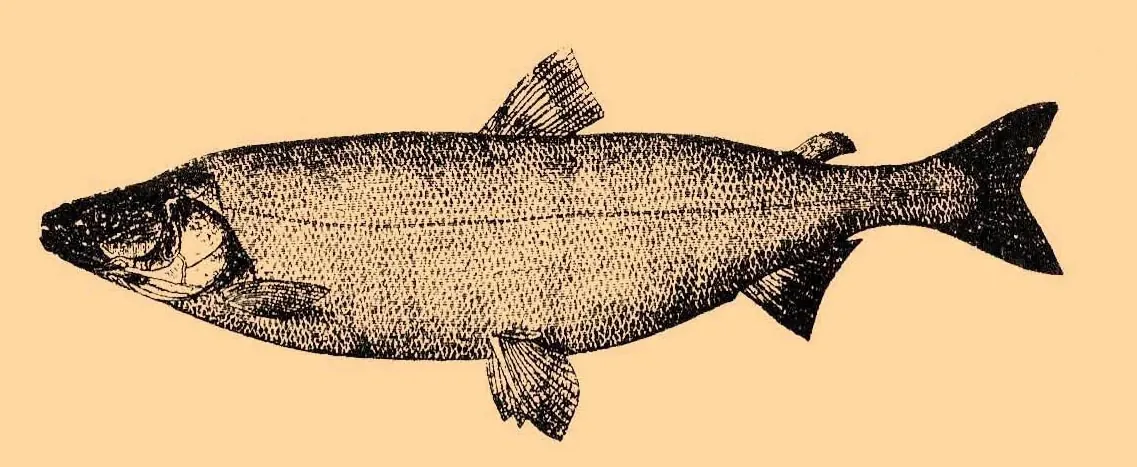
Scientific illustration · reviewed 2026-08-27
Full-lateral sheefish illustration chosen instead of a spawning-population field photograph so identity art does not encourage aggregation targeting.
Historical scientific illustration · Brockhaus and Efron Encyclopedic Dictionary / Wikimedia Commons · Public Domain — pre-1907 historical work Source
Before you target this fish
Regulated context — check the rules for the exact water
Where this applies Northern Alaska and Canadian river/lake systems with local sport, subsistence, and conservation rules.
The reviewed context, unedited
Regulated-context record. Long-distance migrations and relatively discrete spawning areas must not become aggregation or location guidance.
Rules for this fish change at a state line and sometimes inside one. Check the ones that apply to the exact water you are standing on before you act on anything here — this record is biology, not permission.
Take this somewhere
This page is the record. The reading is what happens when you add water, a season and a temperature to it — that is where the families below get ranked against each other instead of just listed.
Those three links carry the fish and nothing else. No conditions were declared on this page, so none travel, and the link says so rather than sending an empty reading.
The half nobody publishes
What this record does not know
Everything else on this page comes from a named agency or peer-reviewed source. This is the other side of that: the questions a reviewer went looking for an answer to and came back without, and the fields the record leaves empty because filling them would mean guessing.
It is here rather than at the bottom because a page that only shows what it knows is easy to read as a page that knows everything. For Sheefish there are 22 of them.
Named by a reviewer
20Somebody looked for this and wrote down that they did not find it.
- Behaviour
Nobody has sourced:
- diel activity pattern — no primary source found
- cold-front / barometric response — no primary source found
- angling-pressure response — no primary source found
- water-level and flow-change response with primary-source support
- current-facing behaviour and holding position within a run — not described in the sources reviewed
- cover use and predator avoidance
- social structure outside migration
- Identification
Nobody has sourced:
- juvenile appearance and any parr-stage markings
- sexual dimorphism and spawning coloration — not described in the sources reviewed
- regional colour variation between stocks
- the taxonomic relationship between North American sheefish and the Caspian Sea population carried under the same species name
- Forage
Nobody has sourced:
- the catalog's aquatic_insects class belongs to juveniles; no source reviewed shows adults relying on insects
- prey-size relationship against predator gape
- seasonal diet composition through the freshwater feeding season
- winter feeding rate in estuarine overwintering areas
- Season
Nobody has sourced:
- no winter presentation implication is written — the sources reviewed do not establish a winter feeding level or holding pattern in enough detail
- depth tendency by season beyond the general under-30-m envelope
- light sensitivity, which is hard to source at these latitudes
- current use and holding position within a run — the catalog's riverHolding classes are not independently confirmed by a habitat study in the sources reviewed
- early_spring, early_summer and late_summer entries — no material specific to those sub-seasons
Absent from the record
2No reviewer wrote a gap here. The field is simply empty, which is its own answer.
- Water temperature
No agency or peer-reviewed temperature band for Sheefish was found that a review would accept. The reading runs without one rather than borrowing a number from a related fish.
- Population context
No regional population profile is registered. The species-level reading stands on its own; it does not silently become a local one.
Where the record puts it
Water and range
Flowing water
6 reviewed holding classes- Run
- Deep pool
- Current break
- Pool head
- Pool tail
- Tributary mouth
Stillwater
5 reviewed holding classes- Suspended / open water
- Inlet
- Outlet
- Drop-off
- Basin
DepthAdult position is strongly forage- and migration-linked and can range from deep channels to pelagic feeding zones.
Moving waterMigratory adults use large-river travel corridors and forage transitions; resident fish can remain in freshwater lake/river systems year-round.
LightTurbidity and northern seasonal light reduce the usefulness of a simple day/night rule; forage position and current often matter more.
Thermal band
Temperature
No reviewed temperature band
Nobody publishes a preferred or active temperature range for Sheefish that a review would accept. Borrowing one from a related fish would look like knowledge and behave like a guess, so the reading runs without it and says which parts of the answer that weakens.
How it uses water
Behaviour
The sources reviewed describe sheefish as migratory and locally abundant during runs but do not describe a defined school or a defended lie. 'loose_aggregation' is the closest supported reading; treat it as weakly evidenced and see the gap list.
Adults are generalist piscivores. Alaska says adults feed almost exclusively on other fish — herring, smelt and juvenile outmigrants depending on season and location — and an account of one northwestern Alaskan stock adds lamprey and juvenile salmon and sheefish, so cannibalism is on the menu. Yukon River work describes them as generalist piscivores taking a wide variety of smaller fish including their own young, and pelagic invertebrates to a much lesser extent. Juveniles start on plankton and benthic invertebrates.
Recorded as a non-claim. No source reviewed resolves a diel activity pattern for sheefish, and much of the range is under continuous summer daylight. 'mixed' is entered because the field is required; the gap is listed.
Seasonal activityForm-specific and the difference is large. Estuarine-anadromous stocks overwinter in brackish bays, coastal waters and lower river, then move upstream through the summer — fish of one northwestern Alaskan stock migrate gradually from June through August. Freshwater-resident stocks (a large Canadian lake population, and stocks Alaska calls 'residents') never enter brackish water at all. Yukon River work adds a third pattern, partial anadromy, in which fish use the estuary early in life and then stay in fresh water. Spring feeding migrations into tributaries occur in late May through June. Post-spawn fish descend fast — 72.5 km/day on the Yukon against 22.5 km/day going up.
Temperature-driven behaviourCold water throughout. Spawning occurs at 0.5–5.5°C (40°F or colder). Fisheries and Oceans Canada places inconnu in cold water shallower than 40 m and preferentially under 30 m. The catalog's 45–58°F band is a feeding-season band, well above the spawning temperatures.
Depth movementFisheries and Oceans Canada gives a depth envelope of less than 40 m and preferentially less than 30 m. Finer depth structure was not found in the sources reviewed.
ClarityAlaska notes sheefish favour glacial, silt-laden rivers, and that spawning occurs in both clear and silty tributaries — heavy glacial turbidity is normal habitat for this species rather than a disturbance.
Open waterOverwintering is in estuary and coastal water for anadromous stocks, where Yukon River work notes food resources are more available than in upstream fresh water. Freshwater-resident stocks overwinter in large lakes.
Spawning (conservation context)Fall spawner, late September to early October, in cold shallow water over gravel. Sheefish are broadcast spawners — eggs and milt are released into the water column and no nest is built. Most fish spawn biennially or less often; Fisheries and Oceans Canada gives every 2–4 years, and Yukon River work found most individuals spawn only once in a lifetime, with about 23% of one population spawning in consecutive years. Fecundity is high — a 50 lb female carries nearly 400,000 eggs. Juveniles hatched in the spring drift long distances downstream to rearing habitat; Yukon River juveniles cover 1,600–1,700 km in 40–60 days. Spawning substrate and any spawning-period holding water are excluded from target guidance.
Where the general rule stops
- Adults are strongly piscivorous, while juvenile diet is more invertebrate-oriented; do not average those stages into one forage assumption.
- ADF&G documents migrations exceeding 1,000 miles in some populations; named migration chokepoints and spawning areas are not target layers.
What it can eat
Forage
- Small forage fish
- Larger prey fish
- Aquatic insects
Adults are generalist piscivores — Alaska states they feed almost exclusively on other fish, naming herring, smelt and juvenile outmigrants, with lamprey and juvenile salmon and sheefish added for one northwestern Alaskan stock. Yukon River work describes a wide variety of smaller fish including their own young, plus pelagic invertebrates to a much lesser extent. Juveniles are the invertebrate feeders: plankton first, then insect larvae and small fish by the second year, and Canadian work on a large-lake freshwater-resident stock records a switch from benthic invertebrates to fish at about age 4. Capacity is not a current hatch.
- Feeding style
- Opportunistic
- Feeding zone
- Mixed
By life stage
- Young of year
- Plankton, then benthic invertebrates.
- Juvenile
- Insect larvae and small fish by the second year; a freshwater-resident Canadian stock switched from benthic invertebrates to fish at about age 4.
- Adult
- Almost exclusively fish, taken opportunistically from whatever the system holds, including conspecific young.
Ontogenetic shiftPlankton to benthic invertebrates to near-obligate piscivory, with the switch reported around age 4 in one freshwater-resident stock and by the second year in Alaskan accounts. The shift is what drives the species' rapid growth.
SubstitutionsStock- and system-specific. Estuarine and coastal wintering fish take marine and estuarine forage fish; upstream fish take whatever small fish the river holds, including juvenile salmon in salmon systems and their own young.
Diet capacity is not proof that a hatch or prey event is occurring. Observed current forage still comes from a user observation or Hatch Match.
Through the year
Season
Spring
- Where they sit
- Tributary mouths, runs and current breaks in the main river; lower-river and estuarine water for stocks that have not yet moved up.
- Movement
- Yukon River work records spring feeding migrations into tributaries in late May through June. Freshwater-resident stocks do not make an estuarine migration at all.
- Forage
- Smaller fish; juvenile outmigrants where a system produces them.
What that changesSwing and cross-current retrieve present a fish-sized profile across a run or a tributary-mouth seam; suspended drift and pulse jig work the same water at depth. This is a piscivore — insect-scale families do not match adult feeding.
What would count against it
- applying the anadromous spring movement to a freshwater-resident stock
- reading a spring feeding migration as a spawning movement — spawning is in the fall
Summer
- Where they sit
- Runs, deep pools, pool heads and current breaks in large main-stem rivers, much of it glacial and silt-laden; lake basins and suspended open water for lake-resident stocks.
- Movement
- Upstream migration through the summer — one Alaskan stock moves gradually from June through August, and Alaska reports fish covering over 1,600 km within a single summer. Upstream rate on the Yukon averaged 22.5 km/day.
- Forage
- Fish. Adults feed almost exclusively on other fish.
- Temperature
- The catalog's 45–58°F band applies to the feeding season; spawning temperatures are far colder.
What that changesSwing, cross-current retrieve and downstream retrieve cover moving water; pulse jig and suspended drift reach fish holding deeper in a run or pool head. In lakes, trolling, horizontal retrieve and subsurface slow roll are the reviewed families matched to a roaming piscivore.
What would count against it
- treating silty water as unfishable habitat for this species
- assuming the fish are stationary — this is a species moving hundreds of kilometres through a season
Fall
- Where they sit
- Upper-river runs and gravel reaches as spawning approaches, then a rapid descent through main-stem runs and pools.
- Movement
- Spawning migration completes in late summer and early fall; post-spawn fish descend fast, at 72.5 km/day on the Yukon, toward lower-river and estuarine overwintering water.
- Temperature
- Spawning occurs at 0.5–5.5°C (40°F or colder).
What would count against it
- using spawning substrate as holding water
- assuming the general bag limit applies in a drainage with a special regulation
Fall spawner, late September to early October. Broadcast spawner over gravel, most individuals spawning biennially or less often — every 2–4 years in Canada, and most Yukon River fish only once in a lifetime. Combined with maturity at ages 5–12, this is a slow-turnover population: spawning substrate and any spawning-period holding water are excluded from target guidance, and drainage-specific bag limits apply, which in some drainages drop from 10 per day to 2 per day.
Winter
- Where they sit
- Brackish bays, coastal water and lower river for estuarine-anadromous stocks; large lake basins for freshwater-resident stocks.
- Movement
- Anadromous fish are in estuarine and coastal overwintering areas, where Yukon River work notes food is more available than in upstream fresh water.
What would count against it
- assuming upstream river reaches still hold anadromous fish in winter
- assuming a freshwater-resident stock behaves like an estuarine one
Spawning · Fall
Broadcast spawns in late September to early October in very cold flowing water. The few known spawning areas are explicitly excluded from target guidance.
Recorded as conservation context. No spawning site, staging concentration or migration bottleneck is named anywhere in this catalog, because naming one is how a population gets fished out.
Telling it apart
Identification
What to look at
- Strong, projecting lower jaw that extends beyond the upper jaw. Every other Alaskan whitefish has either a small inferior (bottom-facing) mouth or a small terminal one.
- Largest species in the whitefish subfamily — an adult sheefish is not size-confusable with a cisco or a round whitefish.
- Small, densely packed teeth in the jaws.
- Large scales and an overall silvery body; Alaska's notebook describes a phosphorescent purple sheen on a fish just taken from the water.
- Fins are dark-tipped (Fisheries and Oceans Canada), and the caudal fin is forked.
- Average adult length
- Fisheries and Oceans Canada gives a typical range of 450–760 mm (18–30 in), occasionally to 1.1 m. Alaskan stocks in the northwest exceed 1 m; interior Alaskan fish run smaller.
- Common angling size
- Stock-dependent. Alaska's notebook contrasts northwestern fish reaching 60 lb with interior fish that typically stay under 25 lb.
- Typical weight
- Interior Alaskan fish typically under 25 lb; northwestern Alaskan fish commonly much heavier, to about 60 lb at the extreme. Canadian fish of 450–760 mm are correspondingly lighter.
- Maximum documented
- Up to 27 kg (about 60 lb) and over 1 m in northwestern Alaska; the sport record from that region was 24 kg (53 lb).
- Longevity
- Fisheries and Oceans Canada gives up to 21 years in some regions; Alaska reports northwestern fish exceeding 20 years; otolith work on Yukon River fish gives longevity beyond 40 years. Maturity is late — ages 5–9 for males and 7–12 for females in one Alaskan stock, ages 7–10 in Canada, 5–12 across the Yukon River.
What it gets confused with
- Humpback whitefish and broad whitefish (Coregonus spp.)
- Both have a small inferior, bottom-facing mouth under a short blunt snout, built for picking clams, snails and insect larvae off the bottom. Sheefish has a large mouth with the lower jaw projecting beyond the upper. Broad and humpback whitefish also top out far smaller.
- Round whitefish (Prosopium cylindraceum)
- Round whitefish has a tiny pointed snout and an inferior mouth, and seldom exceeds 16 in. No projecting lower jaw.
- Least cisco (Coregonus sardinella)
- Least cisco does have a superior mouth with the lower jaw projecting, so the jaw character alone is not enough. Size settles it: least cisco reaches about 14 in in lakes and 19 in and 4.5 lb at the extreme, against a sheefish that exceeds a metre. The cisco is also slender and herring-like rather than deep-bodied.
- Bering cisco and Arctic cisco (Coregonus laurettae, C. autumnalis)
- Both have a terminal mouth — jaws even — rather than a projecting lower jaw, are silvery with white pectoral and pelvic fins, and reach only about 14–17 in.
What follows from all of that
Presentation families
Flowing water
Cross-current retrieve
Represent mobile prey crossing or holding near a current boundary.
- horizontal travel
- intermittent pause
- depth retention
- controlled acceleration
What it asks of the tackle
- Depth control
- Moderate
- Sensitivity
- Moderate
- Casting distance
- Moderate
- Weight range
- 1/8–3/8 oz
- Cover resistance
- Moderate
- Line visibility
- Low
- Retie frequency
- Moderate
Downstream retrieve
Move a bait with the current, then add just enough speed to give it a swimming job.
- cast upstream
- recover slack
- match or slightly beat current
- pause in pockets
What it asks of the tackle
- Depth control
- Moderate
- Sensitivity
- Moderate
- Casting distance
- Moderate
- Weight range
- 1/16–3/8 oz
- Cover resistance
- Low
- Line visibility
- Low
- Retie frequency
- Moderate
Pulse / jig
Lift and drop a compact bait so it occupies a pocket, seam, or head without leaving the water column.
- short lift
- controlled drop
- stay in the pocket
- repeat on the same piece
What it asks of the tackle
- Depth control
- High
- Sensitivity
- High
- Casting distance
- Short to moderate
- Weight range
- 1/8–3/8 oz
- Cover resistance
- Moderate
- Line visibility
- Low
- Retie frequency
- High
Swing
Let current carry a bait or fly across a lane so it broadens and lifts at the hang.
- downstream quartering
- controlled belly
- hang-down pause
- slow lift
What it asks of the tackle
- Depth control
- Moderate
- Sensitivity
- Moderate
- Casting distance
- Moderate
- Weight range
- Unweighted to 1/4 oz
- Cover resistance
- Low
- Line visibility
- Moderate
- Retie frequency
- Low
Stillwater
Horizontal retrieve
Move a swimming bait through a chosen depth band along structure or open water.
- count down
- steady or pulsing retrieve
- keep the band
- cover the edge
What it asks of the tackle
- Depth control
- Moderate
- Sensitivity
- Moderate
- Casting distance
- Moderate to long
- Weight range
- 1/8–1/2 oz
- Cover resistance
- Moderate
- Line visibility
- Low
- Retie frequency
- Low
Vertical jig
Work a compact bait up and down through a marked depth, basin, or timber pocket.
- stay over the target
- measured lift
- controlled drop
- watch slack
What it asks of the tackle
- Depth control
- High
- Sensitivity
- High
- Casting distance
- Vertical
- Weight range
- 1/8–3/4 oz
- Cover resistance
- Moderate
- Line visibility
- Low
- Retie frequency
- Moderate
Trolling
Cover a depth contour or basin at a controlled speed to intercept mobile fish.
- speed control
- depth control
- follow the contour
- turn to change action
What it asks of the tackle
- Depth control
- High
- Sensitivity
- Low
- Casting distance
- Boat
- Weight range
- Varies with speed and depth
- Cover resistance
- Low
- Line visibility
- Moderate
- Retie frequency
- Low
Suspend / pause
Leave a neutrally buoyant bait hanging in place where fish are already holding.
- reach the band
- long pause
- tiny pulse only if needed
- do not leave the zone
What it asks of the tackle
- Depth control
- High
- Sensitivity
- High
- Casting distance
- Moderate
- Weight range
- 1/8–3/8 oz suspending
- Cover resistance
- Low
- Line visibility
- Low
- Retie frequency
- Low
What moves them for this fish
Reviewed rules that push particular families up when the conditions match. Each one names the conditions it needs and why it exists, so you can disagree with it.
Adult sheefish are strongly piscivorous; verified fish prey in large-river habitat reinforces mobile interception rather than benthic whitefish logic.
When
Flowing water · Run, Deep pool, Current break, Pool head, Pool tail · Small forage fish, Larger prey fish
Moves up
Cross-current retrieve, Downstream retrieve, Pulse / jig, Swing
Reviewed 2026-08-27
Resident/lake-connected sheefish remain mobile fish predators; pelagic and depth-band jobs outrank bottom-oriented whitefish defaults.
When
Stillwater · Suspended / open water, Drop-off, Basin, Inlet, Outlet · Small forage fish, Larger prey fish
Moves up
Horizontal retrieve, Trolling, Vertical jig, Suspend / pause
Reviewed 2026-08-27
Where every sentence came from
Sources
Agency
Alaska Department of Fish and Game — Sheefish species profile
Used for identification; behaviour; forage; season. Read 2026-08-30, next check 2026-11-22.
Agency
Alaska Department of Fish and Game — Sheefish (Wildlife Notebook Series)
Used for identification; behaviour; forage; season. Read 2026-08-30, next check 2026-11-22.
Agency
Fisheries and Oceans Canada — Inconnu (Stenodus leucichthys) species profile
Used for identification; behaviour; forage; season. Read 2026-08-30, next check 2026-11-22.
Agency
Used for behaviour; forage; season. Read 2026-08-30, next check 2026-11-27.
Agency
Used for behaviour; season. Read 2026-08-30, next check 2026-11-27.
Agency
Alaska Department of Fish and Game Sheefish species profile
Used for habitat, thermal band and presentation families. Read 2026-08-27, next check 2026-11-27.
Agency
Used for identification. Read 2026-08-30, next check 2026-11-22.
Peer reviewed
Used for behaviour; forage; season. Read 2026-08-30, next check 2026-11-27.
A source with no link predates the rule that one has to carry a URL. It is still a real citation and still checkable; it just takes a search rather than a click, and that is worth knowing before you rely on it.