Bass & panfish · Freshwater
Flier
Centrarchus macropterus
Southeastern/coastal-plain sunfish of swampy backwaters, sloughs, oxbows, slow creeks, and heavily vegetated low-gradient water.
Also called flier sunfish.
- Stillwater
- Flowing water
- Ordinary target
- 4 of 4 overlays reviewed
- Reviewed 2026-08-27
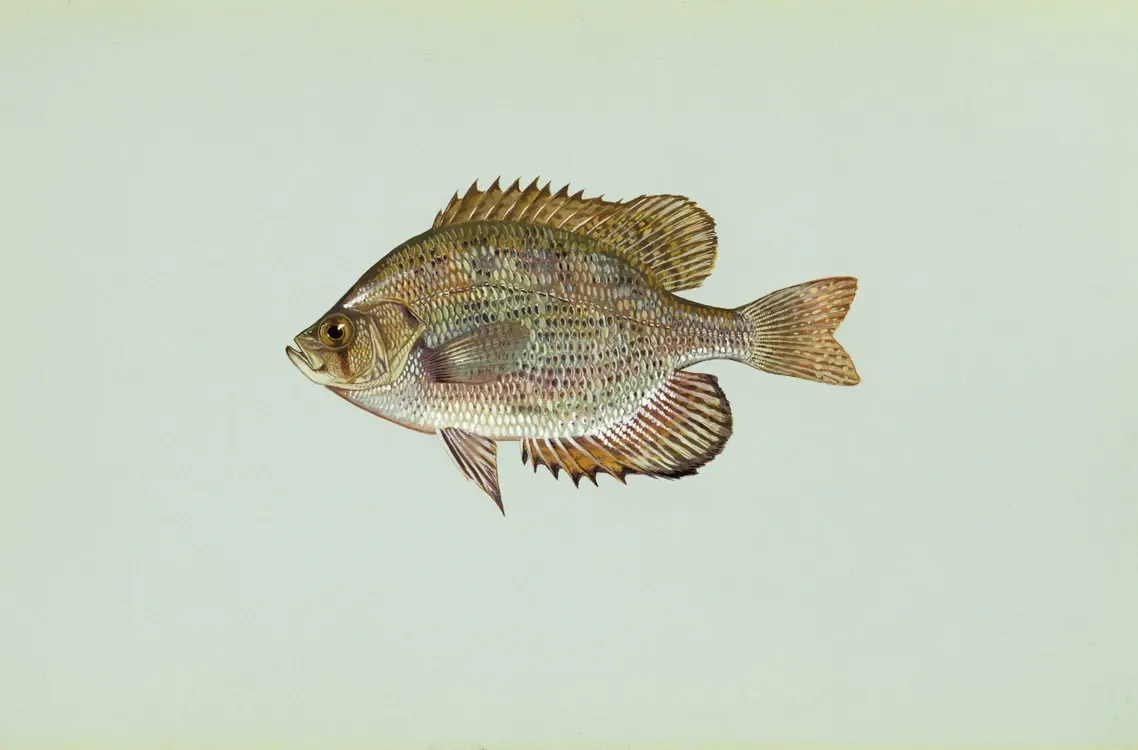
Scientific illustration · reviewed 2026-08-27
USFWS-labeled full-lateral flier illustration with unobstructed deep body and fin morphology.
Duane Raver / USFWS · U.S. Fish and Wildlife Service · Public Domain — U.S. federal government work Source
Take this somewhere
This page is the record. The reading is what happens when you add water, a season and a temperature to it — that is where the families below get ranked against each other instead of just listed.
Those three links carry the fish and nothing else. No conditions were declared on this page, so none travel, and the link says so rather than sending an empty reading.
The half nobody publishes
What this record does not know
Everything else on this page comes from a named agency or peer-reviewed source. This is the other side of that: the questions a reviewer went looking for an answer to and came back without, and the fields the record leaves empty because filling them would mean guessing.
It is here rather than at the bottom because a page that only shows what it knows is easy to read as a page that knows everything. For Flier there are 11 of them.
Named by a reviewer
9Somebody looked for this and wrote down that they did not find it.
- Behaviour
Nobody has sourced:
- species-specific angling-pressure response beyond general cover/light notes
- cold-front / barometric response with primary-source support
- water-level rise/fall response with primary-source support
- Identification
Nobody has sourced:
- a single continent-wide mean length
- black vs white crappie confusion tables by drainage
- Forage
Nobody has sourced:
- finer month-by-month diet inside a season, which is waterbody-specific
- complete regional forage-substitution table
- Season
Nobody has sourced:
- month-by-month location changes inside a season, which are waterbody-specific
- population-archetype calendars beyond the species-level overlay (see RPC)
Absent from the record
2No reviewer wrote a gap here. The field is simply empty, which is its own answer.
- Water temperature
No agency or peer-reviewed temperature band for Flier was found that a review would accept. The reading runs without one rather than borrowing a number from a related fish.
- Population context
No regional population profile is registered. The species-level reading stands on its own; it does not silently become a local one.
Where the record puts it
Water and range
Stillwater
6 reviewed holding classes- Weed edge
- Inside weedline
- Wood
- Shallow flat
- Inlet
- Dock / shade
Flowing water
4 reviewed holding classes- Eddy
- Side channel
- Submerged wood
- Deep pool
DepthUsually shallow-to-mid around vegetation, wood, and protected backwater structure.
Moving waterStrongest fit is slack to very slow, vegetated, tannic or clear backwater rather than sustained current.
LightCover and tannic water reduce high-sun exposure; insect/invertebrate feeding remains plausible throughout daylight in protected habitat.
Thermal band
Temperature
No reviewed temperature band
Nobody publishes a preferred or active temperature range for Flier that a review would accept. Borrowing one from a related fish would look like knowledge and behave like a guess, so the reading runs without it and says which parts of the answer that weakens.
How it uses water
Behaviour
Catalog exception: habitat is low-gradient backwater; do not apply generic river-current sunfish mechanics simply because the water is technically flowing. South Carolina DNR nests are often in groups; grouped nests are never a targeting recommendation.
South Carolina DNR: small aquatic insects and small fishes. Illinois DNR: insects, fishes, and crustaceans. Catalog also lists mollusks, worms, and zooplankton as capacity. Observed forage still outranks an assumed single prey class.
Cover and tannic water reduce high-sun exposure; insect and invertebrate feeding remains plausible throughout daylight in protected habitat.
Seasonal activitySouth Carolina DNR: spawning begins earlier than most sunfish, around March to May at about 55–65°F. Illinois DNR: spawns in April. Conservation context. Summer remains a vegetated backwater problem, not a river-current sunfish problem.
Temperature-driven behaviourPreferred band roughly 62–76°F. Cold edge near 46°F; warm edge near 86°F. Cooler and earlier than most Lepomis spawn calendars.
Depth movementUsually shallow-to-mid around vegetation, wood, and protected backwater structure.
Facing the currentStrongest fit is slack to very slow, vegetated backwater. South Carolina DNR: swamps, creeks, ponds, backwaters, sloughs, and low-flowing streams. Not a sustained current fish.
CoverWeed edges, inside weedlines, wood, shallow flats, inlets, dock shade, eddies, side channels, and deep pools as slack, not as current.
Open waterNot a pelagic schooler and not a crappie basin fish.
Predator avoidanceWeeds, wood, and tannic cover. Bright open water is a poor default.
TerritoryVegetation, wood, and protected backwater. Nesting males build and defend nests (South Carolina DNR).
Spawning (conservation context)South Carolina DNR: males build and defend nests which are often in groups; females deposit 20,000–35,000 eggs. Illinois DNR: male fans a nest. Grouped nests are excluded from target guidance.
Where the general rule stops
- Flier habitat is low-gradient backwater; do not apply generic river-current sunfish mechanics simply because the water is technically flowing.
- Young and adult diet breadth is high; observed forage should outrank an assumed single prey class.
What it can eat
Forage
- Aquatic insects
- Worms / annelids
- Mollusks
- Crustaceans
- Small forage fish
- Zooplankton
South Carolina DNR: small aquatic insects and small fishes. Illinois DNR: insects, fishes, and crustaceans. Catalog also lists mollusks, worms, and zooplankton as capacity; they are not treated as primary without a matching agency emphasis. Observed forage still outranks an assumed single prey class.
- Feeding style
- Opportunistic
- Feeding zone
- Mixed
Through the year
- Winter
- Remaining insects and small fish in vegetated backwater.
- Spring
- Aquatic insects, crustaceans, and small fish as water warms. Early spawning overlap is conservation context.
- Summer
- Insects, crustaceans, and small forage fish in weeds and wood.
- Fall
- Insects and remaining small fish along vegetated edges.
By life stage
- Young of year
- Small aquatic insects. Zooplankton is catalog capacity, not a sourced primary class here.
- Juvenile
- Insects and small crustaceans.
- Adult
- Insects, crustaceans, and small forage fish.
Ontogenetic shiftSmall insects to mixed insect–fish in vegetated backwater.
SubstitutionsTannic swamps substitute different insects than clear oxbows. Do not import a crappie plankton-and-schooling diet wholesale.
Diet capacity is not proof that a hatch or prey event is occurring. Observed current forage still comes from a user observation or Hatch Match.
Through the year
Season
Winter
- Where they sit
- Vegetated backwater, wood, and remaining slack in the usable band.
- Feeding
- Slow intercept of remaining insects and small fish.
What that changesDrop presentation, slow drag, and live / natural bait suspension. Flowing slack: dead drift and stationary bait.
Spring
- Where they sit
- Weeds, wood, sloughs, and protected backwater as water holds in the mid-50s to mid-60s.
What that changesDrop presentation, pulse / jig, and live / natural bait suspension. Dead drift in slack.
What would count against it
- using grouped nests as holding water
South Carolina DNR: spawning begins earlier than most sunfish, around March to May at about 55–65°F; nests often in groups. Grouped nests are excluded from target guidance.
Summer
- Where they sit
- Weed edges, inside weedlines, wood, sloughs, and low-flowing vegetated water.
- Temperature
- Preferred 62–76°F. Slack, tannic or clear backwater — not a river-current sunfish problem.
- Cover
- Vegetation and wood first. Open current is a mismatch.
What that changesDrop presentation, slow drag, and live / natural bait suspension. Surface retrieve along cover when terrestrials are observed. Flowing slack: pulse / jig and dead drift.
What would count against it
- treating flier as crappie
- importing a river-current sunfish default into backwater
Fall
- Where they sit
- Weeds, wood, and remaining backwater as water cools.
What that changesDrop presentation, slow drag, and live / natural bait suspension.
Spawning · Spring
Early spring nesting begins around low-to-upper 60s °F in southern waters. Nests and spawning groups are excluded from targeting logic.
Recorded as conservation context. No spawning site, staging concentration or migration bottleneck is named anywhere in this catalog, because naming one is how a population gets fished out.
Telling it apart
Identification
What to look at
- South Carolina DNR: a distinct, large black teardrop-shaped marking below the eye. Florida Museum: a large black teardrop.
- South Carolina DNR: the most dorsal-fin spines of any sunfish, usually 11–13. Georgia DNR: long anal fin with 7–8 anal spines. Crappie have 5–8 dorsal spines and three anal spines — not this count.
- South Carolina DNR / Florida Museum: interrupted rows of black spots along the side. Georgia DNR: scales marked with a brown spot forming a series of horizontal lines.
- Young fliers have a dark spot outlined in an orange ring on the dorsal fin; these spots fade and disappear with age (South Carolina DNR). Do not use the juvenile dorsal spot as an adult key.
- Operculum lobe is black (South Carolina DNR). The body is olive green to silver, not a Lepomis ear-flap sunfish and not a Pomoxis speckle pattern.
- Average adult length
- South Carolina DNR: average about 5 in. Illinois DNR: averages about 7 in.
- Common angling size
- 4–7 in in vegetated coastal-plain backwater.
- Typical weight
- South Carolina DNR: average about 3 oz. Georgia DNR: most less than ½ lb.
- Maximum documented
- South Carolina DNR notes a state record of 1 lb 4 oz (1977). Large fish remain small compared with adult crappie. Maxima are waterbody-specific.
- Longevity
- South Carolina DNR: approximately 8 years.
What it gets confused with
- Crappie
- Crappie have 5–8 dorsal spines and a concave Pomoxis forehead, without a black teardrop under the eye. Fliers have 11–13 dorsal spines, 7–8 anal spines, and the teardrop. They are not this crappie complex.
- Bluegill
- Bluegill have a small mouth, a dark ear flap, a soft-dorsal spot, and three anal spines. Fliers are almost circular, carry a teardrop, and have 11–13 dorsal spines.
- Warmouth
- Warmouth are thick, large-mouthed, and mottled, with tongue teeth and three anal spines. Fliers are round, teardrop-marked, and high-spined.
What follows from all of that
Presentation families
Stillwater
Drop presentation
Let a bait fall on a controlled line into cover, along a wall, or through a hole in vegetation.
- place then fall
- watch the line
- hold at depth
- short hop only after the fall
What it asks of the tackle
- Depth control
- High
- Sensitivity
- High
- Casting distance
- Short
- Weight range
- 1/16–3/8 oz
- Cover resistance
- High
- Line visibility
- Low
- Retie frequency
- High
Slow drag
Move a bait along the bottom slowly enough that it stays in the feeding layer of inactive fish.
- continuous contact
- very slow travel
- pause at changes in bottom
- do not hop out of the zone
What it asks of the tackle
- Depth control
- High
- Sensitivity
- High
- Casting distance
- Moderate
- Weight range
- 1/8–3/8 oz
- Cover resistance
- Moderate
- Line visibility
- Low
- Retie frequency
- Moderate
Live / natural bait suspension
Present a natural food form with enough life or scent to hold in a station without looking mechanical.
- keep it alive or fresh
- match the holding depth
- minimize hardware bulk
- detect without pulling it away
What it asks of the tackle
- Depth control
- High
- Sensitivity
- High
- Casting distance
- Short to moderate
- Weight range
- As light as conditions allow
- Cover resistance
- Moderate
- Line visibility
- Low
- Retie frequency
- High
Surface retrieve
Work a floating bait across shade, weed edges, or low-light shallows.
- walk, pop, or crawl
- pause in holes
- keep it on top
- cover the edge
What it asks of the tackle
- Depth control
- Surface
- Sensitivity
- Low
- Casting distance
- Moderate
- Weight range
- 1/4–3/4 oz
- Cover resistance
- Moderate
- Line visibility
- Moderate
- Retie frequency
- Low
Flowing water
Stationary bait
Hold a scent or food form in one feeding station and wait for a fish to move to it.
- anchor the presentation
- keep bait in the pocket
- detect takes without sweeping
- refresh often
What it asks of the tackle
- Depth control
- High
- Sensitivity
- Moderate
- Casting distance
- Short
- Weight range
- 1/4–1 oz
- Cover resistance
- High
- Line visibility
- Moderate
- Retie frequency
- High
Pulse / jig
Lift and drop a compact bait so it occupies a pocket, seam, or head without leaving the water column.
- short lift
- controlled drop
- stay in the pocket
- repeat on the same piece
What it asks of the tackle
- Depth control
- High
- Sensitivity
- High
- Casting distance
- Short to moderate
- Weight range
- 1/8–3/8 oz
- Cover resistance
- Moderate
- Line visibility
- Low
- Retie frequency
- High
Dead drift
Allow a food-form imitation to move at or near current speed through a defined feeding lane.
- controlled depth
- minimal drag
- short-to-medium presentation lane
- occasional repositioning
What it asks of the tackle
- Depth control
- High
- Sensitivity
- High
- Casting distance
- Short to moderate
- Weight range
- 1/64–1/8 oz or unweighted fly
- Cover resistance
- Low
- Line visibility
- Low
- Retie frequency
- Moderate
What moves them for this fish
Reviewed rules that push particular families up when the conditions match. Each one names the conditions it needs and why it exists, so you can disagree with it.
Flier are low-gradient backwater sunfish; precise protected-cover mechanics outrank open/current searching.
When
Eddy, Side channel, Submerged wood, Weed edge, Inside weedline, Wood, Shallow flat, Dock / shade
Moves up
Stationary bait, Pulse / jig, Dead drift, Drop presentation, Slow drag, Live / natural bait suspension, Surface retrieve
Reviewed 2026-08-27
Where every sentence came from
Sources
Agency
South Carolina DNR flier account
Used for behaviour; season. Read 2026-08-30, next check 2026-11-27.
Agency
Illinois Department of Natural Resources flier account
Used for behaviour; season. Read 2026-08-30, next check 2026-11-27.
Agency
South Carolina Department of Natural Resources Flier species account
Used for habitat, thermal band and presentation families. Read 2026-08-27, next check 2026-11-27.
Agency
Used for identification. Read 2026-08-30, next check 2026-12-10.
Agency
Used for identification. Read 2026-08-30, next check 2026-12-10.
Agency
Florida Museum flier species profile (large black teardrop, interrupted rows of black spots)
Used for identification. Read 2026-08-30, next check 2026-12-10.
Agency
Used for identification. Read 2026-08-30, next check 2026-12-10.
Agency
Georgia DNR freshwater fish identification (sluggish lowland habitat)
Used for behaviour. Read 2026-08-30, next check 2026-11-27.
Agency
South Carolina DNR flier account (small aquatic insects and small fishes)
Used for forage. Read 2026-08-30, next check 2026-12-03.
Agency
Illinois Department of Natural Resources flier account (insects, fishes, crustaceans)
Used for forage. Read 2026-08-30, next check 2026-12-03.
Agency
Georgia DNR freshwater fish identification
Used for season. Read 2026-08-30, next check 2026-11-17.
Synthesis
Southeastern state flier life-history syntheses
Used for habitat, thermal band and presentation families. Read 2026-08-27, next check 2026-11-27.
A source with no link predates the rule that one has to carry a URL. It is still a real citation and still checkable; it just takes a search rather than a click, and that is worth knowing before you rely on it.