Bass & panfish · Freshwater
Longear sunfish
Lepomis megalotis
Colorful central/eastern North American sunfish strongly associated with clear permanent-flowing streams, pools, rocky/sandy substrate, and aquatic vegetation.
Also called creek perch, sun perch, longear.
- Flowing water
- Stillwater
- Ordinary target
- 4 of 4 overlays reviewed
- Reviewed 2026-08-27
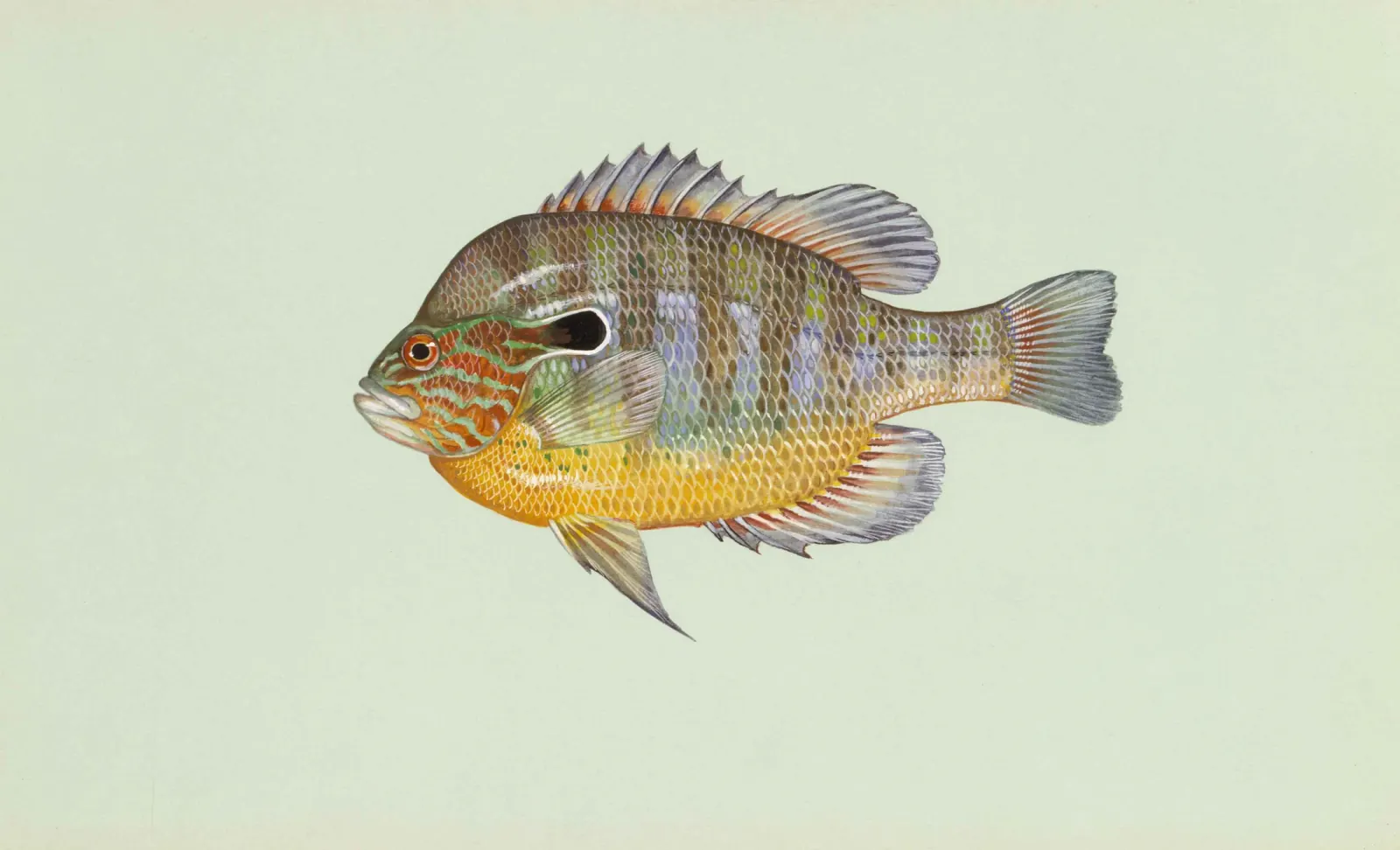
Scientific illustration · reviewed 2026-08-27
Large full-lateral USFWS illustration clearly showing the opercular flap and deep-bodied Lepomis morphology.
Duane Raver / USFWS · U.S. Fish and Wildlife Service National Digital Library · Public Domain Source
Take this somewhere
This page is the record. The reading is what happens when you add water, a season and a temperature to it — that is where the families below get ranked against each other instead of just listed.
Those three links carry the fish and nothing else. No conditions were declared on this page, so none travel, and the link says so rather than sending an empty reading.
The half nobody publishes
What this record does not know
Everything else on this page comes from a named agency or peer-reviewed source. This is the other side of that: the questions a reviewer went looking for an answer to and came back without, and the fields the record leaves empty because filling them would mean guessing.
It is here rather than at the bottom because a page that only shows what it knows is easy to read as a page that knows everything. For Longear sunfish there are 11 of them.
Named by a reviewer
9Somebody looked for this and wrote down that they did not find it.
- Behaviour
Nobody has sourced:
- species-specific angling-pressure response beyond general cover/light notes
- cold-front / barometric response with primary-source support
- water-level rise/fall response with primary-source support
- Identification
Nobody has sourced:
- eastern vs interior subspecies / form tables as a structured field
- a single continent-wide mean length
- Forage
Nobody has sourced:
- finer month-by-month diet inside a season, which is waterbody-specific
- complete regional forage-substitution table
- Season
Nobody has sourced:
- month-by-month location changes inside a season, which are waterbody-specific
- population-archetype calendars beyond the species-level overlay (see RPC)
Absent from the record
2No reviewer wrote a gap here. The field is simply empty, which is its own answer.
- Water temperature
No agency or peer-reviewed temperature band for Longear sunfish was found that a review would accept. The reading runs without one rather than borrowing a number from a related fish.
- Population context
No regional population profile is registered. The species-level reading stands on its own; it does not silently become a local one.
Where the record puts it
Water and range
Flowing water
5 reviewed holding classes- Eddy
- Side channel
- Current break
- Pool tail
- Submerged wood
Stillwater
5 reviewed holding classes- Weed edge
- Shallow flat
- Rocky shoreline
- Wood
- Inlet
DepthPrimarily shallow-to-mid littoral/pool fish around rock, sand, vegetation, and current relief.
Moving waterStream-oriented but avoids strong current; favors pools, inlets, overflow water, and protected edges adjacent to moving water.
LightStrongly daytime-active sight feeder; clear water and structure support visual insect/crustacean feeding.
Thermal band
Temperature
No reviewed temperature band
Nobody publishes a preferred or active temperature range for Longear sunfish that a review would accept. Borrowing one from a related fish would look like knowledge and behave like a guess, so the reading runs without it and says which parts of the answer that weakens.
How it uses water
Behaviour
Missouri DNR: nests in colonies, often so close that rims nearly touch. Colonial nests are never a targeting recommendation. Catalog exception: more stream-associated than bluegill but still avoids the fastest current core.
Missouri DNR: carnivorous, feeding on insects, small crustaceans, and some small fish. Illinois DNR: follows turtles and suckers as they feed on the bottom, eating organisms dislodged from the substrate. That is a feeding mechanic, not a current event and not a recommendation to work nesting colonies of other sunfish.
Missouri DNR: most active in daytime. Clear water and structure support visual insect and crustacean feeding.
Seasonal activityMissouri DNR: nests in colonies from mid-May to early or mid-August. Illinois DNR: spawns May through August. Conservation context. Summer remains a clear-stream pool problem.
Temperature-driven behaviourPreferred band roughly 68–80°F. Cold edge near 50°F; warm edge near 90°F. Clear permanent-flow water is the default, not a weedy bluegill pond.
Depth movementPrimarily shallow-to-mid littoral and pool water around rock, sand, vegetation, and current relief.
Facing the currentMissouri DNR: avoids strong currents. Occurs in reservoirs, ponds, and in pools, inlets, and overflow waters adjacent to stream channels. Favors clear, permanent-flowing streams with sandy or rocky bottoms and aquatic vegetation.
CoverEddy, side channel, current break, pool tail, submerged wood, weed edge, shallow flat, rocky shoreline, and inlets.
Open waterNot a pelagic schooler.
Predator avoidancePools, vegetation, and current relief. The fastest open lane is a poor default.
TerritoryPools, inlets, and protected edges. Nesting males remain with the nest for more than two weeks (Missouri DNR).
Spawning (conservation context)Missouri DNR: evenly rounded nests nearly always fanned over small chert gravel; rims often nearly touch; the male stays with the nest for more than two weeks until fry have hatched and dispersed. Colonies are excluded from target guidance.
Where the general rule stops
- Longear sunfish are more stream-associated than bluegill but still avoid the fastest current core.
- Spawning males can be unusually visible and territorial; nest visibility is not a recommendation to target colonies.
What it can eat
Forage
- Aquatic insects
- Terrestrial insects
- Crustaceans
- Small forage fish
Missouri DNR: insects, small crustaceans, and some small fish. Illinois DNR: insects, fishes, and crayfish. Mollusks are not a catalog class on this record — do not import a pumpkinseed or redear snail diet. Capacity is not a current hatch.
- Feeding style
- Opportunistic
- Feeding zone
- Mixed
Through the year
- Winter
- Remaining insects and crustaceans in deeper pools.
- Spring
- Aquatic insects and crustaceans as water warms.
- Summer
- Insects, terrestrials, crayfish, and some small forage fish in clear stream pools. Surface foods are capacity when observed.
- Late summer
- Insects and remaining terrestrials along pool edges. Nesting overlap may continue; that is conservation context.
- Fall
- Insects and remaining small fish along cover.
By life stage
- Young of year
- Small aquatic insects and crustaceans.
- Juvenile
- Insects and small crustaceans.
- Adult
- Insects, terrestrials, crayfish-scale crustaceans, and some small forage fish.
Ontogenetic shiftSmall invertebrates to mixed insect–crustacean, with small fish where gape allows.
SubstitutionsClear rocky streams substitute crayfish and insects. Do not import a mollusk specialist diet this record does not have.
Diet capacity is not proof that a hatch or prey event is occurring. Observed current forage still comes from a user observation or Hatch Match.
Through the year
Season
Winter
- Where they sit
- Deeper pools and remaining current relief in the usable band.
- Feeding
- Slow intercept of remaining insects and crustaceans.
What that changesDrop presentation, slow drag, and live / natural bait suspension. Flowing water: dead drift and stationary bait.
Early summer
- Where they sit
- Clear stream pools, inlets, overflow water, and vegetated rocky or sandy margins.
What that changesDrop presentation, pulse / jig, and dead drift in slack.
What would count against it
- using nesting colonies as holding water
Missouri DNR: nests in colonies from mid-May to early or mid-August; rims often nearly touch. Colonies are excluded from target guidance.
Summer
- Where they sit
- Pools, inlets, overflow water, weed edges, and rocky shoreline adjacent to moving water.
- Temperature
- Preferred 68–80°F. Missouri DNR: most active in daytime. Avoids strong currents.
- Light
- Clear water increases visual feeding and shade use at high sun.
What that changesDrop presentation and slow drag. Surface retrieve only when terrestrials are observed. Flowing water: dead drift, pulse / jig, and stationary bait.
What would count against it
- collapsing longear into redbreast
- forcing a still-water bluegill pond default
Late summer
- Where they sit
- Pools and vegetated edges. Nesting overlap may continue into August.
What that changesDrop presentation, slow drag, and live / natural bait suspension.
Missouri DNR: male remains with the nest for more than two weeks. Nesting remains caution.
Fall
- Where they sit
- Pools, inlets, and remaining wood as water cools.
What that changesDrop presentation, slow drag, and dead drift.
Spawning · Early summer, Summer, Late summer
Colonial nesting can extend from mid-May into August. Nest colonies are conservation/ethics context, not a targeting recommendation.
Recorded as conservation context. No spawning site, staging concentration or migration bottleneck is named anywhere in this catalog, because naming one is how a population gets fished out.
Telling it apart
Identification
What to look at
- Missouri DNR: the ear (gill) flap is elongated, black, and often bordered in white. Illinois DNR: the black flap on the gill cover is very long and white-edged.
- Missouri DNR / Illinois DNR: pectoral fin is rounded and short — not the long pointed bluegill or pumpkinseed pectoral.
- Missouri DNR: side of the head olive or light orange with sky-blue vermiculations (undulating, worm-like markings).
- Back and sides blue-green speckled with yellow and emerald; belly yellow or orange (Missouri DNR). Breeding males show a bright red-orange belly (Illinois DNR).
- The long flap is the namesake mark, but the white edge plus short rounded pectorals split this fish from redbreast, whose flap is entirely black.
- Average adult length
- Missouri DNR: total length commonly 5–6 in. Illinois DNR: typically about 6–7 in.
- Common angling size
- 4–7 in in clear rocky or sandy streams and connected pools.
- Typical weight
- Missouri DNR: maximum about 7 in and 4.5 oz in that account. Typical fish are lighter.
- Maximum documented
- Large longear exceed the 5–7 in band in some waters but remain smaller than trophy bluegill or redear. Maxima are waterbody-specific.
- Longevity
- Missouri DNR: individuals can live for 6 years.
What it gets confused with
- Redbreast sunfish
- Redbreast flaps are entirely black and no wider than the eye; the body is more elongated. Longear flaps are often white-edged; pectorals are short and rounded; the body is deep and slab-sided.
- Pumpkinseed
- Pumpkinseed have a short flap with a discrete red-orange spot and a white margin, plus long pectorals. Longear have a much longer, often white-edged flap and short rounded pectorals.
- Bluegill
- Bluegill have a short plain black flap, a soft-dorsal spot, and long pointed pectorals. Longear have a very long white-edged flap and rounded pectorals.
- Green sunfish
- Green sunfish have a large mouth and an elongated body. Longear mouths are moderate; the body is deep and slab-sided.
What follows from all of that
Presentation families
Flowing water
Dead drift
Allow a food-form imitation to move at or near current speed through a defined feeding lane.
- controlled depth
- minimal drag
- short-to-medium presentation lane
- occasional repositioning
What it asks of the tackle
- Depth control
- High
- Sensitivity
- High
- Casting distance
- Short to moderate
- Weight range
- 1/64–1/8 oz or unweighted fly
- Cover resistance
- Low
- Line visibility
- Low
- Retie frequency
- Moderate
Stationary bait
Hold a scent or food form in one feeding station and wait for a fish to move to it.
- anchor the presentation
- keep bait in the pocket
- detect takes without sweeping
- refresh often
What it asks of the tackle
- Depth control
- High
- Sensitivity
- Moderate
- Casting distance
- Short
- Weight range
- 1/4–1 oz
- Cover resistance
- High
- Line visibility
- Moderate
- Retie frequency
- High
Pulse / jig
Lift and drop a compact bait so it occupies a pocket, seam, or head without leaving the water column.
- short lift
- controlled drop
- stay in the pocket
- repeat on the same piece
What it asks of the tackle
- Depth control
- High
- Sensitivity
- High
- Casting distance
- Short to moderate
- Weight range
- 1/8–3/8 oz
- Cover resistance
- Moderate
- Line visibility
- Low
- Retie frequency
- High
Stillwater
Drop presentation
Let a bait fall on a controlled line into cover, along a wall, or through a hole in vegetation.
- place then fall
- watch the line
- hold at depth
- short hop only after the fall
What it asks of the tackle
- Depth control
- High
- Sensitivity
- High
- Casting distance
- Short
- Weight range
- 1/16–3/8 oz
- Cover resistance
- High
- Line visibility
- Low
- Retie frequency
- High
Slow drag
Move a bait along the bottom slowly enough that it stays in the feeding layer of inactive fish.
- continuous contact
- very slow travel
- pause at changes in bottom
- do not hop out of the zone
What it asks of the tackle
- Depth control
- High
- Sensitivity
- High
- Casting distance
- Moderate
- Weight range
- 1/8–3/8 oz
- Cover resistance
- Moderate
- Line visibility
- Low
- Retie frequency
- Moderate
Surface retrieve
Work a floating bait across shade, weed edges, or low-light shallows.
- walk, pop, or crawl
- pause in holes
- keep it on top
- cover the edge
What it asks of the tackle
- Depth control
- Surface
- Sensitivity
- Low
- Casting distance
- Moderate
- Weight range
- 1/4–3/4 oz
- Cover resistance
- Moderate
- Line visibility
- Moderate
- Retie frequency
- Low
Live / natural bait suspension
Present a natural food form with enough life or scent to hold in a station without looking mechanical.
- keep it alive or fresh
- match the holding depth
- minimize hardware bulk
- detect without pulling it away
What it asks of the tackle
- Depth control
- High
- Sensitivity
- High
- Casting distance
- Short to moderate
- Weight range
- As light as conditions allow
- Cover resistance
- Moderate
- Line visibility
- Low
- Retie frequency
- High
What moves them for this fish
Reviewed rules that push particular families up when the conditions match. Each one names the conditions it needs and why it exists, so you can disagree with it.
Longear sunfish are strongly stream-associated but avoid the current core; protected-edge insect/crustacean delivery is diagnostic.
When
Flowing water · Eddy, Side channel, Current break, Pool tail, Submerged wood · Aquatic insects, Terrestrial insects, Crustaceans
Moves up
Dead drift, Pulse / jig, Stationary bait
Reviewed 2026-08-27
Day-active longear sunfish remain shallow/littoral around rock and vegetation when moved out of stream context.
When
Stillwater · Weed edge, Shallow flat, Rocky shoreline, Wood, Inlet
Moves up
Drop presentation, Slow drag, Surface retrieve, Live / natural bait suspension
Reviewed 2026-08-27
Where every sentence came from
Sources
Agency
Missouri Department of Conservation Longear Sunfish field guide
Used for habitat, thermal band and presentation families; behaviour; season. Read 2026-08-30, next check 2026-11-27.
Agency
Illinois Department of Natural Resources longear sunfish account
Used for behaviour; season. Read 2026-08-30, next check 2026-11-18.
Agency
Used for identification. Read 2026-08-30, next check 2026-12-13.
Agency
Used for identification. Read 2026-08-30, next check 2026-12-13.
Agency
Missouri Department of Conservation longear sunfish field guide (insects, small crustaceans, some small fish)
Used for forage. Read 2026-08-30, next check 2026-12-13.
Agency
Illinois Department of Natural Resources longear sunfish account (insects, fishes, crayfish)
Used for forage. Read 2026-08-30, next check 2026-12-13.
A source with no link predates the rule that one has to carry a URL. It is still a real citation and still checkable; it just takes a search rather than a click, and that is worth knowing before you rely on it.