Trout & salmon · Freshwater
Sockeye salmon
Oncorhynchus nerka
Anadromous Pacific salmon native to the North Pacific. This record is explicitly separate from landlocked kokanee.
Also called Red salmon, blueback, redfish, sockeye.
- Flowing water
- Stillwater
- Regulated context
- 4 of 4 overlays reviewed
- Reviewed 2026-08-27
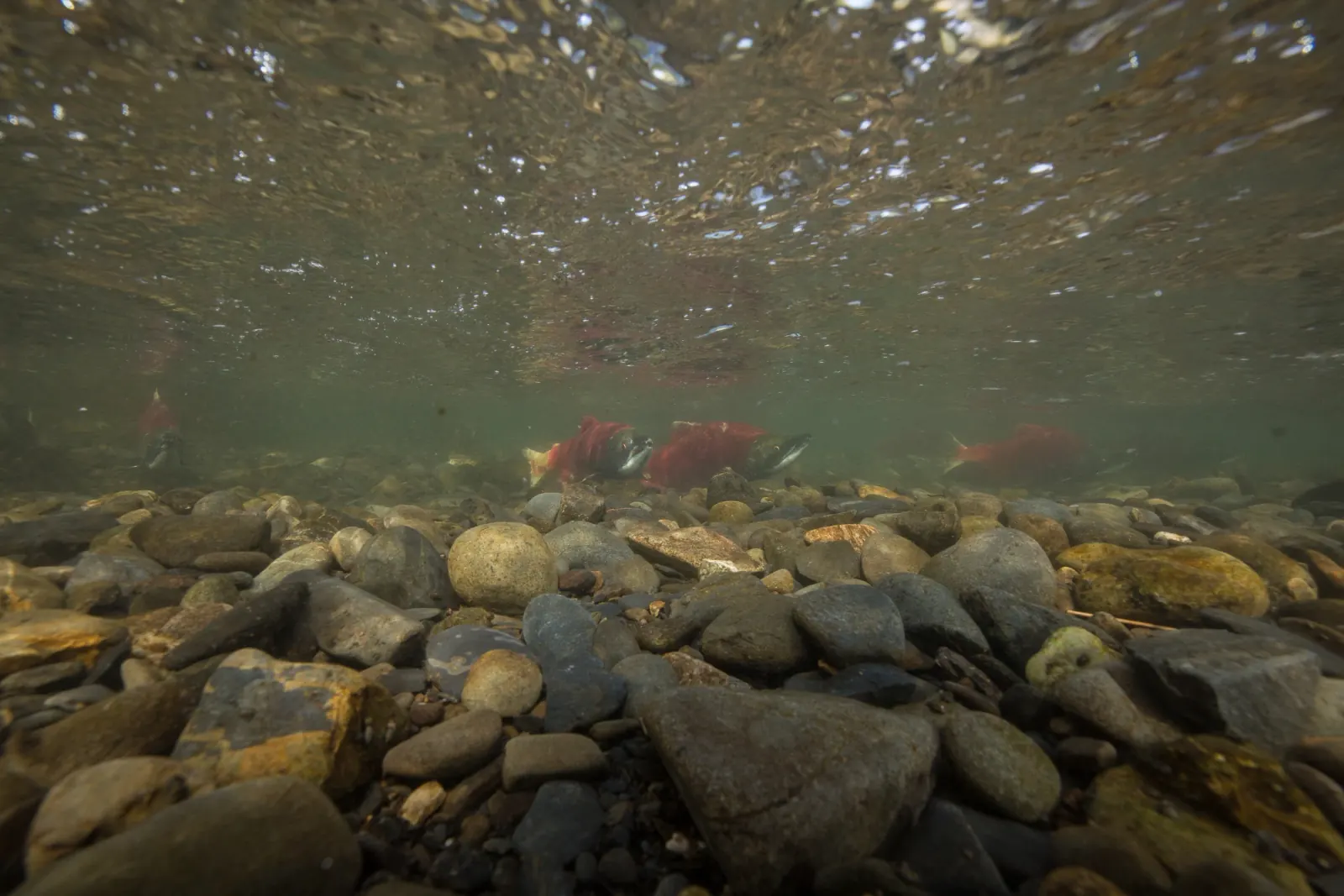
Photograph · reviewed 2026-08-27
USFWS species-labeled underwater photograph of migrating sockeye salmon. Adult body and salmon morphology are visible in natural river habitat; the image is identity/context evidence, not a location or run-strength recommendation.
Ryan Hagerty / USFWS · U.S. Fish and Wildlife Service · Public Domain — U.S. federal government work Source
Before you target this fish
Regulated context — check the rules for the exact water
Where this applies Alaska and Pacific Coast sockeye fisheries; some lower-48 ESUs are federally protected.
The reviewed context, unedited
Regulated-context record. Verify current fishery status and population identity. Snake River and Ozette Lake ESA contexts must be explicitly selected rather than inferred from a water name.
Rules for this fish change at a state line and sometimes inside one. Check the ones that apply to the exact water you are standing on before you act on anything here — this record is biology, not permission.
Take this somewhere
This page is the record. The reading is what happens when you add water, a season and a temperature to it — that is where the families below get ranked against each other instead of just listed.
Those three links carry the fish and nothing else. No conditions were declared on this page, so none travel, and the link says so rather than sending an empty reading.
The half nobody publishes
What this record does not know
Everything else on this page comes from a named agency or peer-reviewed source. This is the other side of that: the questions a reviewer went looking for an answer to and came back without, and the fields the record leaves empty because filling them would mean guessing.
It is here rather than at the bottom because a page that only shows what it knows is easy to read as a page that knows everything. For Sockeye salmon there are 9 of them.
Named by a reviewer
7Somebody looked for this and wrote down that they did not find it.
- Behaviour
Nobody has sourced:
- species-specific angling-pressure response beyond general cover/light notes
- stock-specific travel-depth literature as a structured field
- Identification
Nobody has sourced:
- stock-specific mean size tables
- Forage
Nobody has sourced:
- ocean prey-taxa tables by stock
- finer month-by-month diet inside a season, which is waterbody-specific
- Season
Nobody has sourced:
- stock-specific run timing tables
- month-by-month location changes inside a season, which are waterbody-specific
Absent from the record
2No reviewer wrote a gap here. The field is simply empty, which is its own answer.
- Water temperature
No agency or peer-reviewed temperature band for Sockeye salmon was found that a review would accept. The reading runs without one rather than borrowing a number from a related fish.
- Population context
No regional population profile is registered. The species-level reading stands on its own; it does not silently become a local one.
Where the record puts it
Water and range
Flowing water
5 reviewed holding classes- Run
- Current break
- Pool head
- Pool tail
- Tributary mouth
Stillwater
4 reviewed holding classes- Inlet
- Outlet
- Suspended / open water
- Drop-off
DepthFreshwater adults may move through the column with migration stage, flow, light, and lake/river transition; juvenile lake residence is not an adult targeting proxy.
Moving waterMigrating adults use river travel lanes, velocity relief, and lake/river transitions rather than establishing trout-like feeding lies.
LightLight can alter travel depth and visibility, but it does not convert freshwater migration into proof of feeding.
Thermal band
Temperature
No reviewed temperature band
Nobody publishes a preferred or active temperature range for Sockeye salmon that a review would accept. Borrowing one from a related fish would look like knowledge and behave like a guess, so the reading runs without it and says which parts of the answer that weakens.
How it uses water
Behaviour
Freshwater returning adults are modeled as migration/interception context, not proof of feeding.
NOAA: juveniles in fresh water eat zooplankton, amphipods, and insects; ocean fish continue on zooplankton plus larval/small fishes and occasionally squid. Returning freshwater adults are not treated as actively feeding simply because a presentation family exists.
Light can alter travel depth and visibility but does not convert freshwater migration into a feeding event.
Seasonal activityOcean residence, return timing, and freshwater travel are life-history stages. ESA-listed ESUs are a status overlay, not a location.
Temperature-driven behaviourColdwater fish. Warm, low-oxygen travel water is a constraint, especially in some interior systems.
Depth movementFreshwater adults may move through the column with migration stage, flow, and lake/river transition. Juvenile lake residence is not an adult targeting proxy.
Facing the currentMigrating adults use river travel lanes and velocity relief rather than establishing trout-like feeding lies.
CoverVelocity refuge and channel form, not wood as a feeding station.
Open waterOcean phase is pelagic. Nursery-lake juveniles are pelagic planktivores.
Predator avoidanceDepth, turbidity, and grouping during travel. Not a cover-oriented ambush fish.
Spawning (conservation context)NOAA: typically spawn in summer or fall; females dig redds and both sexes die after spawning. Staging concentrations, redds, and listed ESUs are invalidators, never target layers.
Where the general rule stops
- Freshwater returning adults are modeled as migration/interception context, not a claim that they are actively feeding.
- Snake River and Ozette Lake sockeye are federally protected ESUs; population status must be explicitly declared rather than inferred from a water name.
- Kokanee remains a separate landlocked record and the alias 'sockeye' must never resolve to kokanee after this record exists.
What it can eat
Forage
- Zooplankton
- Aquatic insects
- Small forage fish
Ocean-phase sockeye feed on zooplankton, squid, and small fishes. Freshwater adults returning to spawn typically cease feeding. Juvenile lake residence is not an adult targeting proxy and is not a current-hatch claim.
- Feeding style
- Specialized
- Feeding zone
- Pelagic
Through the year
- Summer
- Returning adults in freshwater are not treated as feeding trout. Ocean feeding is behind them.
- Late summer
- Migration and ripening, not a forage-matching problem.
- Fall
- Spawning fish do not establish feeding lies. Diet guidance for freshwater adults stays conservation-first.
By life stage
- Young of year
- Lake-rearing juveniles feed on zooplankton and aquatic invertebrates.
- Juvenile
- Smolts leaving lakes still reflect a plankton-based freshwater diet before ocean entry.
- Adult
- Ocean diet is pelagic zooplankton, squid, and small fishes. Freshwater adults generally do not feed.
Ontogenetic shiftFreshwater plankton feeding in juveniles; marine pelagic feeding in adults; feeding largely stops on the spawning migration.
SubstitutionsDo not substitute inland kokanee Daphnia feeding for ocean-phase sockeye, or vice versa.
Diet capacity is not proof that a hatch or prey event is occurring. Observed current forage still comes from a user observation or Hatch Match.
Through the year
Season
Summer
- Where they sit
- River travel lanes, velocity relief, and lake/river transitions.
- Movement
- Adults return through freshwater toward lake/tributary spawning systems.
- Feeding
- Freshwater adults typically do not feed.
What that changesSwing, cross-current retrieve, downstream retrieve, and pulse-jig remain the reviewed flowing families for lawful, non-listed contexts — they do not imply feeding lies.
What would count against it
- converting migration into a trout feeding calendar
- using juvenile lake residence as an adult proxy
Spawning reaches, staging concentrations, and ESA-listed populations are invalidators, never target layers.
Late summer
- Where they sit
- Continuing freshwater travel and holding in non-target migration water.
Listed ESUs stay fail-closed regardless of season.
Fall
- Where they sit
- Spawning systems. Not a presentation problem.
What would count against it
- naming spawning reaches or bottlenecks
Spawning fish are excluded from target guidance.
Spawning · Summer, Late summer, Fall
Adults return through freshwater toward lake/tributary spawning systems in summer and fall. Spawning reaches, staging concentrations, and ESA-listed populations are invalidators, never target layers.
Recorded as conservation context. No spawning site, staging concentration or migration bottleneck is named anywhere in this catalog, because naming one is how a population gets fished out.
Telling it apart
Identification
What to look at
- NOAA: 1.5–2.5 ft and 4–15 lb as sea-going adults — the size contrast with kokanee is the practical field split.
- Metallic green-blue back, iridescent silver flanks, white belly at sea; large spots absent from back and fins, including the tail.
- Fine black speckling may occur on the back; this is not the large oval spotting of Chinook or rainbow.
- Spawning fish turn red-bodied with green heads; males develop a hump and hooked jaws.
- This record is explicitly not kokanee. The alias 'sockeye' must not resolve to the landlocked record.
- Average adult length
- NOAA: 1.5–2.5 ft.
- Common angling size
- 18–28 in for returning adults in many fisheries.
- Typical weight
- NOAA: 4–15 lb.
- Maximum documented
- Occasional larger fish occur, but NOAA's 4–15 lb band is the reviewed working range for this dossier.
- Longevity
- NOAA: typically mature around age 4–5 after 1–3 years in fresh water and 2–3 years at sea; all die after spawning.
What it gets confused with
- Kokanee
- Landlocked/non-anadromous O. nerka. NOAA: kokanee rarely exceed 1.2 ft, while anadromous sockeye are 1.5–2.5 ft and 4–15 lb. Treat them as separate catalog records.
- Coho salmon
- Coho have spots on the upper half of the tail and white gums; sockeye tails are unspotted and the spawning dress is red/green rather than coho maroon/black.
- Chinook salmon
- Chinook are larger, with large black spots on back and both lobes of the tail and black gums.
What follows from all of that
Presentation families
Flowing water
Swing
Let current carry a bait or fly across a lane so it broadens and lifts at the hang.
- downstream quartering
- controlled belly
- hang-down pause
- slow lift
What it asks of the tackle
- Depth control
- Moderate
- Sensitivity
- Moderate
- Casting distance
- Moderate
- Weight range
- Unweighted to 1/4 oz
- Cover resistance
- Low
- Line visibility
- Moderate
- Retie frequency
- Low
Cross-current retrieve
Represent mobile prey crossing or holding near a current boundary.
- horizontal travel
- intermittent pause
- depth retention
- controlled acceleration
What it asks of the tackle
- Depth control
- Moderate
- Sensitivity
- Moderate
- Casting distance
- Moderate
- Weight range
- 1/8–3/8 oz
- Cover resistance
- Moderate
- Line visibility
- Low
- Retie frequency
- Moderate
Downstream retrieve
Move a bait with the current, then add just enough speed to give it a swimming job.
- cast upstream
- recover slack
- match or slightly beat current
- pause in pockets
What it asks of the tackle
- Depth control
- Moderate
- Sensitivity
- Moderate
- Casting distance
- Moderate
- Weight range
- 1/16–3/8 oz
- Cover resistance
- Low
- Line visibility
- Low
- Retie frequency
- Moderate
Pulse / jig
Lift and drop a compact bait so it occupies a pocket, seam, or head without leaving the water column.
- short lift
- controlled drop
- stay in the pocket
- repeat on the same piece
What it asks of the tackle
- Depth control
- High
- Sensitivity
- High
- Casting distance
- Short to moderate
- Weight range
- 1/8–3/8 oz
- Cover resistance
- Moderate
- Line visibility
- Low
- Retie frequency
- High
Stillwater
Horizontal retrieve
Move a swimming bait through a chosen depth band along structure or open water.
- count down
- steady or pulsing retrieve
- keep the band
- cover the edge
What it asks of the tackle
- Depth control
- Moderate
- Sensitivity
- Moderate
- Casting distance
- Moderate to long
- Weight range
- 1/8–1/2 oz
- Cover resistance
- Moderate
- Line visibility
- Low
- Retie frequency
- Low
Suspend / pause
Leave a neutrally buoyant bait hanging in place where fish are already holding.
- reach the band
- long pause
- tiny pulse only if needed
- do not leave the zone
What it asks of the tackle
- Depth control
- High
- Sensitivity
- High
- Casting distance
- Moderate
- Weight range
- 1/8–3/8 oz suspending
- Cover resistance
- Low
- Line visibility
- Low
- Retie frequency
- Low
Vertical jig
Work a compact bait up and down through a marked depth, basin, or timber pocket.
- stay over the target
- measured lift
- controlled drop
- watch slack
What it asks of the tackle
- Depth control
- High
- Sensitivity
- High
- Casting distance
- Vertical
- Weight range
- 1/8–3/4 oz
- Cover resistance
- Moderate
- Line visibility
- Low
- Retie frequency
- Moderate
What moves them for this fish
Reviewed rules that push particular families up when the conditions match. Each one names the conditions it needs and why it exists, so you can disagree with it.
Returning sockeye are being ranked for migration/interception mechanics only; this delta is not evidence that freshwater adults are feeding.
When
Flowing water · Run, Current break, Pool head, Pool tail
Moves up
Cross-current retrieve, Swing, Downstream retrieve, Pulse / jig
Reviewed 2026-08-27
Lake/river transitions and migration depth can change interception mechanics without creating a feeding or aggregation claim.
When
Stillwater · Inlet, Outlet, Suspended / open water, Drop-off
Moves up
Horizontal retrieve, Suspend / pause, Vertical jig
Reviewed 2026-08-27
Where every sentence came from
Sources
Agency
NOAA Fisheries Sockeye Salmon protected-ESU profile
Used for habitat, thermal band and presentation families; identification; forage; season. Read 2026-08-30, next check 2026-11-27.
Agency
NOAA Fisheries Sockeye Salmon species profile
Used for habitat, thermal band and presentation families; forage; season. Read 2026-08-30, next check 2026-11-27.
Agency
NOAA Fisheries Sockeye Salmon species profile
Used for identification; behaviour. Read 2026-08-30, next check 2026-11-28.
A source with no link predates the rule that one has to carry a URL. It is still a real citation and still checkable; it just takes a search rather than a click, and that is worth knowing before you rely on it.