Trout & salmon · Freshwater
Chum salmon
Oncorhynchus keta
Wide-ranging anadromous Pacific salmon; most juveniles move quickly from freshwater into estuarine and marine habitat.
Also called Keta salmon, chum, dog salmon, calico salmon, keta.
- Flowing water
- Regulated context
- 4 of 4 overlays reviewed
- Reviewed 2026-08-27
Photograph · reviewed 2026-08-27
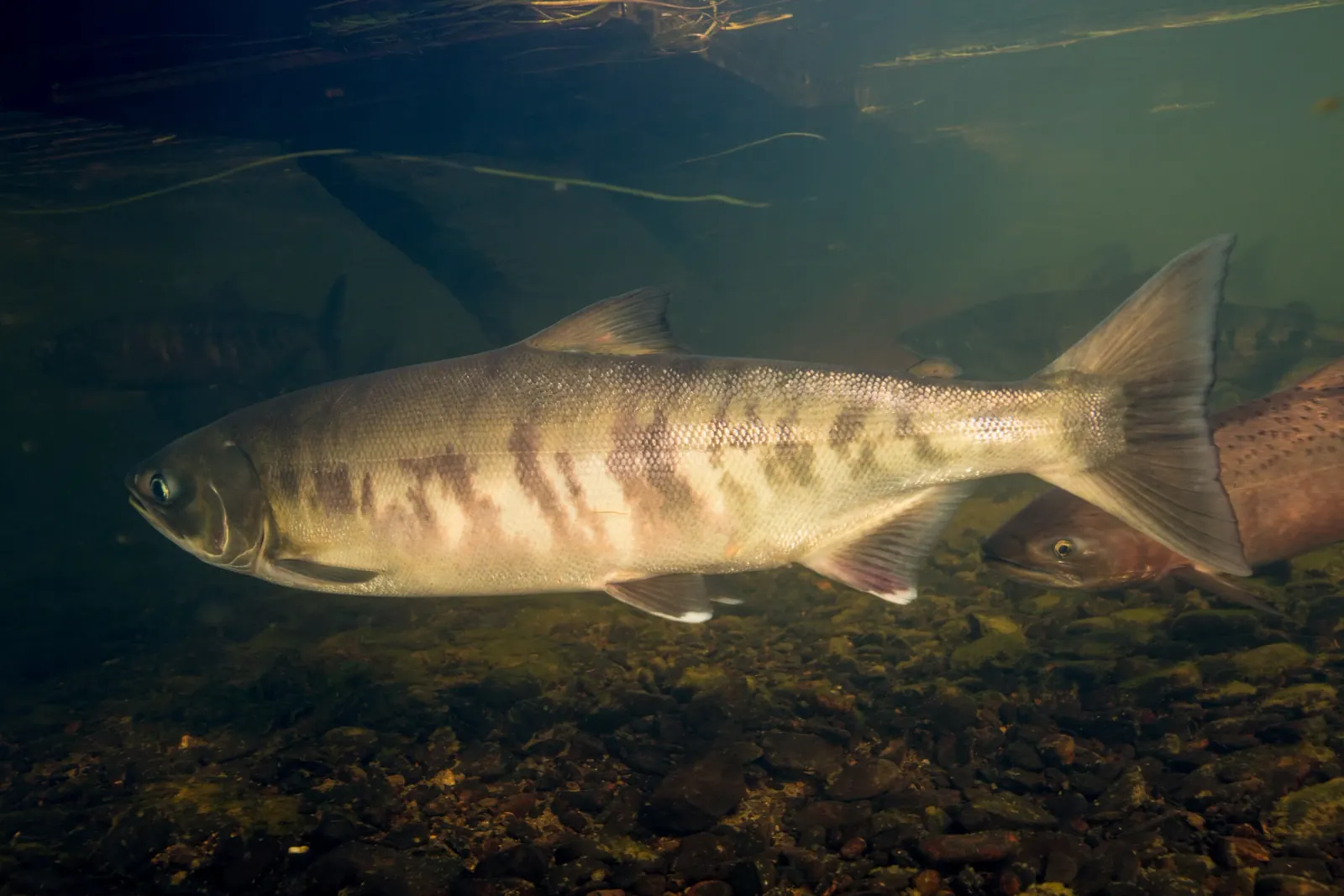
USFWS species-labeled underwater chum salmon photograph. The characteristic adult freshwater body pattern and lateral form are visible in natural habitat.
Ryan Hagerty / USFWS · U.S. Fish and Wildlife Service · Public Domain Source
Before you target this fish
Regulated context — check the rules for the exact water
Where this applies Alaska and Pacific Coast chum fisheries; Hood Canal summer-run and Columbia River ESUs are federally threatened.
The reviewed context, unedited
Regulated-context record. Verify population and current salmon regulations. Listed-ESU contexts must be explicitly declared.
Rules for this fish change at a state line and sometimes inside one. Check the ones that apply to the exact water you are standing on before you act on anything here — this record is biology, not permission.
Take this somewhere
This page is the record. The reading is what happens when you add water, a season and a temperature to it — that is where the families below get ranked against each other instead of just listed.
Those three links carry the fish and nothing else. No conditions were declared on this page, so none travel, and the link says so rather than sending an empty reading.
The half nobody publishes
What this record does not know
Everything else on this page comes from a named agency or peer-reviewed source. This is the other side of that: the questions a reviewer went looking for an answer to and came back without, and the fields the record leaves empty because filling them would mean guessing.
It is here rather than at the bottom because a page that only shows what it knows is easy to read as a page that knows everything. For Chum salmon there are 11 of them.
Named by a reviewer
9Somebody looked for this and wrote down that they did not find it.
- Behaviour
Nobody has sourced:
- species-specific angling-pressure response beyond general cover/light notes
- cold-front / barometric response with primary-source support
- water-level rise/fall response with primary-source support
- Identification
Nobody has sourced:
- stock-specific mean length tables
- gum-line character with a primary-source key beyond the no-spot / silver-tail split
- Forage
Nobody has sourced:
- finer month-by-month diet inside a season, which is waterbody-specific
- aquatic insect fraction in young fish (no catalog forage class here)
- Season
Nobody has sourced:
- month-by-month location changes inside a season, which are waterbody-specific
- listed vs unlisted population calendars as a structured overlay
Absent from the record
2No reviewer wrote a gap here. The field is simply empty, which is its own answer.
- Water temperature
No agency or peer-reviewed temperature band for Chum salmon was found that a review would accept. The reading runs without one rather than borrowing a number from a related fish.
- Population context
No regional population profile is registered. The species-level reading stands on its own; it does not silently become a local one.
Where the record puts it
Water and range
Flowing water
5 reviewed holding classes- Run
- Current break
- Pool head
- Pool tail
- Tributary mouth
DepthGenerally travels through mid and lower river columns with flow and channel depth rather than holding as a resident trout.
Moving waterReturning adults use migration lanes and velocity relief in coastal rivers; the record does not convert spawning migration into a feeding model.
LightLight and turbidity can alter visibility and travel depth; neither is a bite predictor.
Thermal band
Temperature
No reviewed temperature band
Nobody publishes a preferred or active temperature range for Chum salmon that a review would accept. Borrowing one from a related fish would look like knowledge and behave like a guess, so the reading runs without it and says which parts of the answer that weakens.
How it uses water
Behaviour
This catalog record is flowing water only. Adult freshwater presentation is migration/interception context, not proof of active feeding.
Alaska DFG: when adults return to fresh water on the spawning run, they cease feeding and their digestive tract degrades. Ocean feeding is behind them. Juvenile insect feeding is not a catalog forage class on this record.
Light and turbidity can alter visibility and travel depth; neither is a bite predictor (catalog).
Seasonal activityNOAA: spawn from late summer to March, with peak spawning concentrated in early winter. Hood Canal summer-run and Columbia River ESUs are federally threatened. Population-level status must be declared; it is not a location.
Temperature-driven behaviourPreferred band roughly 42–56°F. Warm, low flow is a travel constraint.
Depth movementGenerally travels through mid and lower river columns with flow and channel depth rather than holding as a resident trout.
Facing the currentReturning adults use migration lanes and velocity relief in coastal rivers; the record does not convert spawning migration into a feeding model (catalog).
Change in flowNOAA notes peak spawning concentrated in early winter when river flows are high. Flow is hydrology, not a named bottleneck.
CoverRuns, current breaks, pool heads, pool tails, and tributary mouths as travel classes. Redds are excluded.
Open waterOcean phase is pelagic. This freshwater record has no stillwater presentations.
Predator avoidanceDepth, turbidity, and grouping during travel.
Spawning (conservation context)NOAA: spawn from late summer to March. Listed ESUs and spawning concentrations are conservation context, not target opportunities. Alaska DFG: energy stored in body tissues fuels the run after feeding ceases.
Where the general rule stops
- Hood Canal summer-run and Columbia River chum ESUs are federally threatened; population-level status must be explicitly declared.
- Adult freshwater presentation is migration/interception context, not proof of active feeding.
What it can eat
Forage
- Small forage fish
- Crustaceans
- Zooplankton
Alaska DFG: adults on the spawning run cease feeding and their digestive tract degrades. At sea they feed on copepods, tunicates, mollusks, and a variety of fishes. NOAA: young feed on insects as they migrate downriver — aquatic insects are not a catalog forage class on this record. Freshwater adult diet is interception, not forage matching.
- Feeding style
- Opportunistic
- Feeding zone
- Pelagic
Through the year
- Late summer
- Returning freshwater adults have ceased feeding (Alaska DFG). Ocean feeding is behind them.
- Fall
- Migration and ripening, not a forage-matching problem. Listed ESUs remain conservation context.
- Late fall
- NOAA: spawning continues toward early winter in some populations. Spawners are not feeding trout.
- Winter
- Peak spawning can be concentrated in early winter (NOAA). Diet guidance stays conservation-first.
By life stage
- Young of year
- NOAA / Alaska DFG: insects on the seaward movement. That insect fraction is not a catalog forage class here; crustaceans and zooplankton are.
- Juvenile
- Nearshore crustaceans and small fishes after ocean entry (Alaska DFG).
- Adult
- Ocean: copepods, fishes, mollusks, squid, and tunicates (NOAA / Alaska DFG). Freshwater adults cease feeding.
Ontogenetic shiftBrief freshwater insect feeding off-catalog, marine crustacean/fish feeding, then digestive-tract shutdown on the spawning run.
SubstitutionsDo not substitute a trout hatch match or a pink small-scale diet as if they were the same fish. Do not add stillwater families — this record is flowing-only.
Diet capacity is not proof that a hatch or prey event is occurring. Observed current forage still comes from a user observation or Hatch Match.
Through the year
Season
Late summer
- Where they sit
- Coastal river travel lanes — runs, current breaks, pool heads, pool tails, and tributary mouths as classes.
- Feeding
- Alaska DFG: adults cease feeding and the digestive tract degrades.
What that changesSwing, Cross-current retrieve, Downstream retrieve, and Pulse / jig remain the reviewed flowing families — interception/reaction, not feeding lies.
What would count against it
- treating returning chum as feeding trout
- adding stillwater families — this record has none
Hood Canal summer-run and Columbia River ESUs are federally threatened (NOAA). Status is an invalidator, never a target layer.
Fall
- Where they sit
- Continuing freshwater travel. Not a resident-trout calendar.
- Feeding
- Still not feeding. Ripening, not forage matching.
What that changesSwing, Cross-current retrieve, Downstream retrieve, and Pulse / jig as interception mechanics only where the fishery is lawful and unlisted.
What would count against it
- converting migration into a hatch match
Late fall
- Where they sit
- Spawning systems in populations that continue into early winter.
What that changesReviewed flowing families remain interception only.
What would count against it
- naming spawning reaches or bottlenecks
NOAA: spawn from late summer to March. Spawning concentrations are excluded from target guidance.
Winter
- Where they sit
- NOAA: peak spawning can be concentrated in early winter when river flows are high. Hydrology, not a named bottleneck.
What that changesSwing and Pulse / jig remain interception mechanics only where harvest is lawful.
What would count against it
- forcing a stillwater calendar
- using listed ESU names as a place to fish
Listed ESUs stay fail-closed regardless of season. Spawners are not a feeding problem.
Spawning · Late summer, Fall, Late fall, Winter
Spawning timing varies broadly by population from late summer into winter. Listed ESUs and spawning concentrations are conservation context, not target opportunities.
Recorded as conservation context. No spawning site, staging concentration or migration bottleneck is named anywhere in this catalog, because naming one is how a population gets fished out.
Telling it apart
Identification
What to look at
- Alaska DFG: unlike Chinook, coho, pink, and steelhead, chum salmon have no dark spots on their back or tail. Tiny speckles may be present and are not those large spots.
- Alaska DFG: the tail has silver streaks along (but not between) the fin rays — a split from sockeye, which lack those silver streaks.
- NOAA: spawning males develop enormous canine-like fangs and a striking calico pattern, with a bold jagged reddish line on the front of the flank and a jagged black line aft. Both sexes can show a tiger-stripe pattern of bold red and black.
- Alaska DFG: average 24–28 in and 10–13 lb. NOAA: can grow up to 3.6 ft and 30–35 lb; average weight 8–15 lb. They are not pinks.
- Hood Canal summer-run and Columbia River ESUs are federally threatened (NOAA). That is conservation status, not a field-ID key and not a target.
- Average adult length
- Alaska DFG: 24–28 in. NOAA working range extends toward 3.6 ft at the documented maximum.
- Common angling size
- 24–30 in in lawful coastal fisheries.
- Typical weight
- Alaska DFG: 10–13 lb. NOAA: average 8–15 lb.
- Maximum documented
- NOAA: 30–35 lb class at 3.6 ft. Those maxima are not typical and are not a pink-salmon number.
- Longevity
- Anadromous; NOAA notes spawning from late summer into March depending on population. All die after spawning. Age is stock-specific.
What it gets confused with
- Pink salmon
- Pink have large oval spots on both tail lobes, very small scales, and no silver on the tail. Chum have no dark spots and silver streaks along the tail rays, and they are much larger.
- Sockeye salmon
- Both can lack large black spots. Alaska DFG: chum have silver streaks along the tail-fin rays; sockeye do not. Sockeye spawning dress is red body / green head, not calico bars.
- Chinook salmon
- Chinook have black gums and black spots on both tail lobes. Chum have no dark spots on back or tail.
- Coho salmon
- Coho have small spots on the upper tail lobe and a white band at the tooth base. Chum are unspotted with silver on the tail rays.
What follows from all of that
Presentation families
Flowing water
Swing
Let current carry a bait or fly across a lane so it broadens and lifts at the hang.
- downstream quartering
- controlled belly
- hang-down pause
- slow lift
What it asks of the tackle
- Depth control
- Moderate
- Sensitivity
- Moderate
- Casting distance
- Moderate
- Weight range
- Unweighted to 1/4 oz
- Cover resistance
- Low
- Line visibility
- Moderate
- Retie frequency
- Low
Cross-current retrieve
Represent mobile prey crossing or holding near a current boundary.
- horizontal travel
- intermittent pause
- depth retention
- controlled acceleration
What it asks of the tackle
- Depth control
- Moderate
- Sensitivity
- Moderate
- Casting distance
- Moderate
- Weight range
- 1/8–3/8 oz
- Cover resistance
- Moderate
- Line visibility
- Low
- Retie frequency
- Moderate
Downstream retrieve
Move a bait with the current, then add just enough speed to give it a swimming job.
- cast upstream
- recover slack
- match or slightly beat current
- pause in pockets
What it asks of the tackle
- Depth control
- Moderate
- Sensitivity
- Moderate
- Casting distance
- Moderate
- Weight range
- 1/16–3/8 oz
- Cover resistance
- Low
- Line visibility
- Low
- Retie frequency
- Moderate
Pulse / jig
Lift and drop a compact bait so it occupies a pocket, seam, or head without leaving the water column.
- short lift
- controlled drop
- stay in the pocket
- repeat on the same piece
What it asks of the tackle
- Depth control
- High
- Sensitivity
- High
- Casting distance
- Short to moderate
- Weight range
- 1/8–3/8 oz
- Cover resistance
- Moderate
- Line visibility
- Low
- Retie frequency
- High
What moves them for this fish
Reviewed rules that push particular families up when the conditions match. Each one names the conditions it needs and why it exists, so you can disagree with it.
Chum freshwater weighting is migration/current mechanics, not proof of active feeding; listed ESU policy remains a separate gate.
When
Flowing water · Run, Pool head, Pool tail, Current break
Moves up
Swing, Cross-current retrieve, Downstream retrieve, Pulse / jig
Reviewed 2026-08-27
Where every sentence came from
Sources
Agency
NOAA Fisheries Chum Salmon protected-ESU profile
Used for habitat, thermal band and presentation families; behaviour; season. Read 2026-08-30, next check 2026-11-27.
Agency
NOAA Fisheries Chum Salmon species profile
Used for behaviour; season. Read 2026-08-30, next check 2026-11-27.
Agency
NOAA Fisheries Chum Salmon species profile
Used for habitat, thermal band and presentation families. Read 2026-08-27, next check 2026-11-27.
Agency
Used for identification. Read 2026-08-30, next check 2026-12-07.
Agency
NOAA Fisheries Chum Salmon protected-ESU profile (Hood Canal summer-run and Columbia River threatened ESUs)
Used for identification. Read 2026-08-30, next check 2026-12-07.
Agency
Used for identification. Read 2026-08-30, next check 2026-12-07.
Agency
Used for behaviour. Read 2026-08-30, next check 2026-11-27.
Agency
Used for forage. Read 2026-08-30, next check 2026-12-08.
Agency
Used for forage. Read 2026-08-30, next check 2026-12-08.
Agency
Alaska Department of Fish and Game Chum Salmon species profile
Used for season. Read 2026-08-30, next check 2026-11-27.
A source with no link predates the rule that one has to carry a URL. It is still a real citation and still checkable; it just takes a search rather than a click, and that is worth knowing before you rely on it.